Emptyset’s live performance was an experience that blew my mind — and my nose.
Let me rewind. If “Electronic Body Music” weren’t already its own thing long before Emptyset came along, the term would be a fitting description of the music that Paul Purgas and James Ginzburg make together. The curves, blood, and nerves are all there in Emptyset tracks – visceral blasts of noise and tones which double as studies in pressure and nuance, placing the distortions, feedback loops, and ephemeral touches of their processing on an amplified center stage.
Now back to where I was – watching Emptyset perform live on Public Records’ lauded soundsystem during Bang On A Can’s Long Play festival. The vibrations going back and forth, turning the floor of the venue itself into a kind of instrument, and then suddenly, my sinuses cleared. An eclectic and experimental evening – opening the show was Kim Gordon and Bill Nace’s Body/Head, with a charming palette cleanser of Foodman to end the lineup after Emptyset.
Emptyset’s performance, along with their latest album, Dissever, was based on a commissioned performance at London’s Tate Modern during the exhibition Electric Dreams: Art & Technology 1950-1990. For an album born of site-specific sound strategies, it’s appropriate that a Dissever-inspired performance is carefully thought out. Following a meticulous soundcheck, I sat down with Paul and James on a sunny Brooklyn afternoon to discuss the evolution of electronic instruments, how Bristol sound system culture shaped their ears, and why the streaming era has accidentally restored dynamics to recordings.
Listen to Emptyset’s new album, Dissever
You mentioned that you don’t often tour these days, preferring to line up the right shows and opportunities.
James Ginzburg: We’ve done this long enough to know that if we play all the time, we lose the sense of why we’re doing it. The project should feel like a worthwhile contribution to a wider cultural conversation, not a production line. When a show intersects with what we’re thinking about – like the Tate Modern opportunity – it makes sense. Otherwise, we’d rather stay home and experiment.
That Tate Modern debut placed Dissever inside a show about art and technology’s intertwined histories. How did that context shape the album?
Paul Purgas: Curating the South Asian electronic music compilation and documentary reminded me how messy and cross‑pollinated those histories really are. Looking back at the late ’60s/early ’70s – Pink Floyd at Pompeii, Hawkwind’s synth voyages – you see multiple futures for electronic music and rock music and minimalism that almost happened. We wanted to pick up some of those “roads not taken” for Dissever.
The NID Tapes: Electronic Music from India 1969-1972, curated by Paul Purgas
James: On our previous record, Blossoms, we used an early GAN system, an AI system, to basically produce a record from unsuccessful outputs. The systems were very, very primitive and what we were interested in was trying to create a sense of futurism from a system learning to “think”. We realized there was no place forward for that exploration, because in in that process, by the end of the two months’ worth of processing time, the outputs that were coming out of the system were very, very close to the inputs. Inevitably in the last year or so, you have systems that can be trained on Spotify or YouTube and produce more of what already exists.
For us, looking at that near past and into the slightly less near past, it gave a lot of space to think about other threads of exploration that we could pick up and move forward with.
Paul: In a sense, it’s almost rejecting that futurism of a neural network, and thinking back to the complexity of the sonic history of just the 20th century. These things that kind of existed as micro genres on their own.
Early Emptyset records featured an ascetic sonic palette – sine waves, noise, feedback. What’s the palette this time?
James: We were interrogating what constitutes the construction of music – how we could look at the history of generative art and generative music and apply those techniques in a way that we hadn’t really explored, within the analog and electro-acoustic framework.
The source sounds were mainly sine waves and noise. A lot of Dissever starts with a static chord built from 10-15 sine waves, and no arrangement. The structure comes from gesturally interacting with that very static thing, and the sense of dynamism in the pieces comes from very small changes and gestural movements across the gear. The gear is important, because it’s an expression of the histories of music that we’re looking at – but the essential thing from a compositional perspective is the interaction between stasis and gesture.

Paul: We recorded at Matt Sampson’s Bristol studio, geared for rock bands, with multiple amps and live rooms. Quite a few Bristol bands produced material there over the years – Massive Attack recorded “Karmacoma” in that studio.
The infrastructure being geared towards rock bands lent itself really well to a generative way of working, using multiple amps, effect sounds, sound rooms, plate reverbs, swinging microphones – physically moving things around. I think that the backbone of producing the record is translated into how we think about the live shows now, trying to mimic that way of working. That methodology goes back to our Medium sessions in a derelict Gothic mansion, or to bouncing HF radio off the ionosphere for Signal.
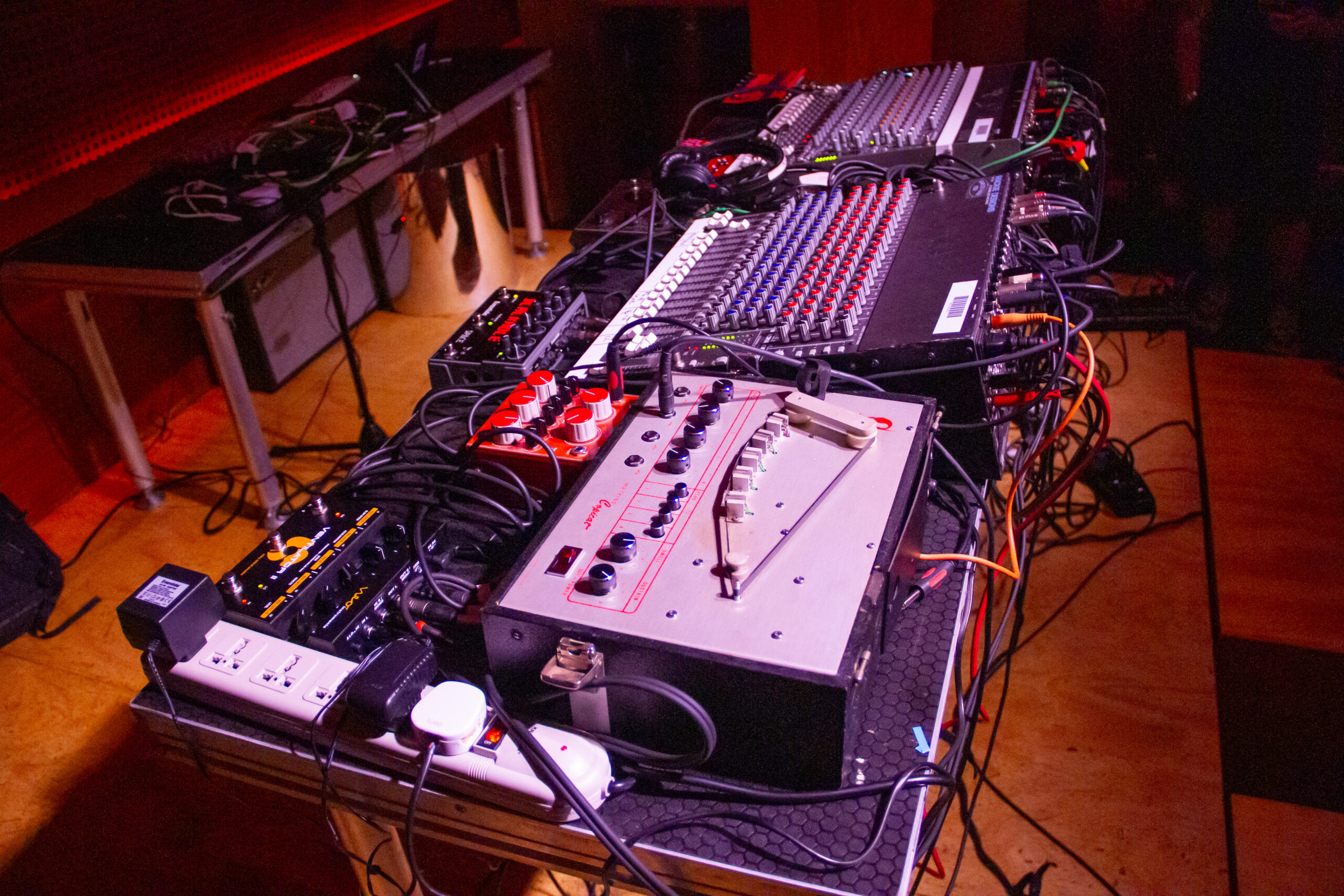
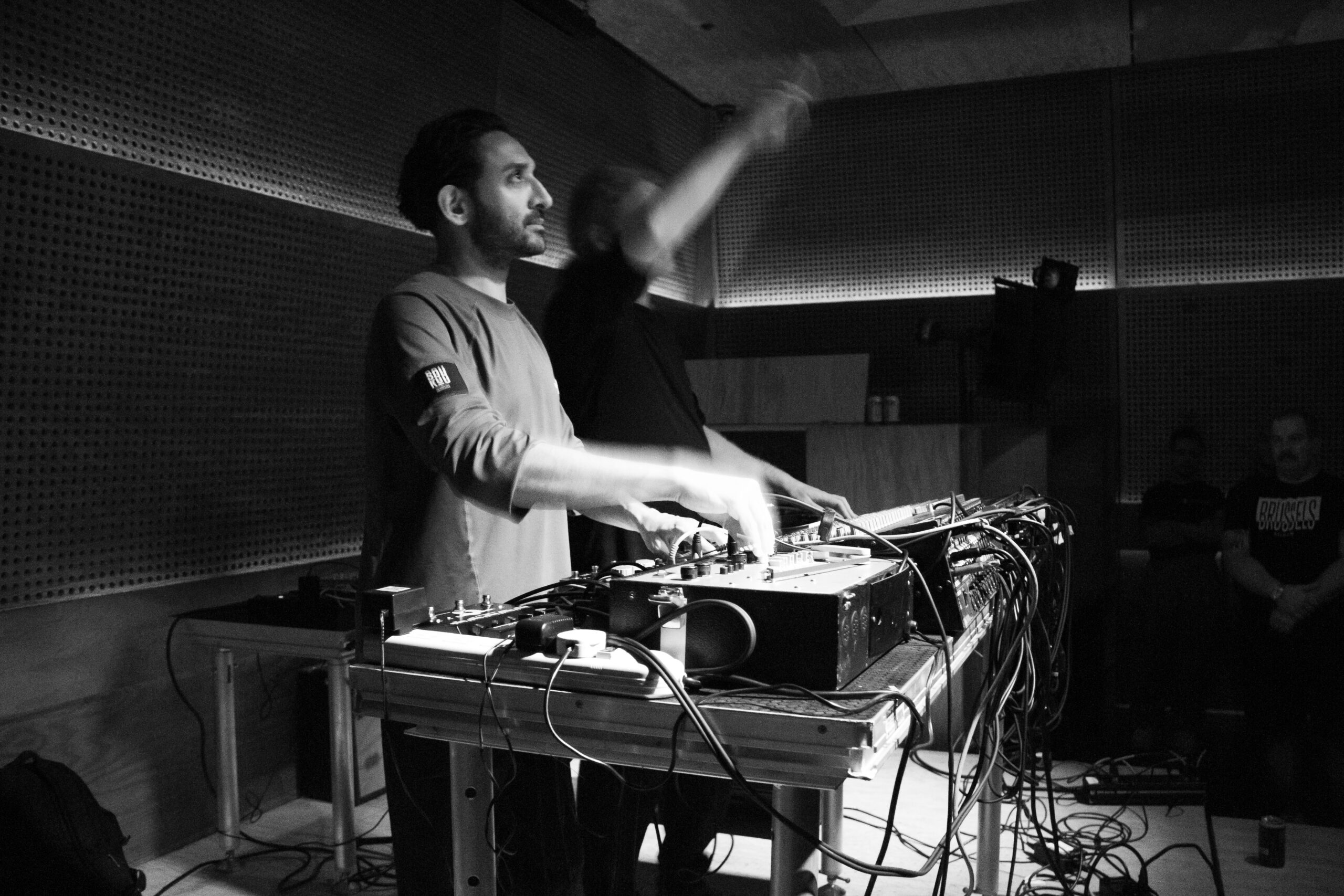
Your live rig tonight includes two mixers, tape delay, and plenty of stomp boxes. To what extent are you aiming to capture the uncertainty of the setup, to kind of make it play itself?
James: It’s about interaction across the outboard and the mixer. You know what a flanger sounds like when you turn the fader up, but when it interacts with a master‑bus compressor and a saturating preamp, thresholds appear where the circuit suddenly blooms into something else. What happens live is a complex interplay, finding the limits of a process that is on the one hand uncontrolled but balanced to where it’s neither statis nor unlistenable.
There’s an incredible physical element to your playing, especially in the sub frequencies in a room like this one. How do you consider that when you’re, say, listening to masters of music that be listened to on cheap earbuds from Spotify?
James: Weirdly, while Spotify has destroyed the music industry, its normalization to -14 dB LUFS means that you don’t need to limit a mix very hard. Compared to our previous material, Dissever is not very loud, because it doesn’t have to be in order to be perceived at the same loudness as other music. This is by far our most dynamic record.
People think that what gives something impact is sub bass, but in reality, it’s a bit higher up for the most part. You’re always trading off how much of the overall power of a soundsystem the lowest octave chews up against a sense of perceived loudness. I moved to Bristol when I was 17, so I had all my formative musical experiences there. Every year there’s the St. Paul’s Carnival, with lots of local sound systems playing music from jungle to dance hall. That was really my first experience of hearing sound systems that were really, really focused on the bottom octave – below even what most records are capable of reproducing.
In the beginning of dubstep in Bristol, Pinch and I had started the label Tectonic (ed. note – James founded the publisher Multiverse Music, responsible for groundbreaking releases from Skream, 2562, Vex’d, Joker, and many others. Tectonic was one of the labels under this umbrella), and I had started Subtext. We would get records as demos, and then when we listened to them on one of those sound systems in Bristol we’d realize that what we thought was the record wasn’t actually the record, because something was happening in a much lower register. Sometimes the full sound only reveals itself 500 meters off-axis, when the long waves have space to form!
Paul: I was looking at some club nights in Bristol recently, and there were no DJs on the lineup – it was four sound systems across the night. The systems were the performers for that moment. You don’t really see that in London, not in the same way as in Bristol. That kind of reverence, respect, and attention to detail that people have within such a relatively small city, it creates a powerful culture around sound.
With the technological advances in physical modeling and computing power that can easily handle it, it’s become more and more possible to replicate some of these acoustic and analog phenomena digitally. Does that factor into your practice?
Paul: Physical modeling is an interesting one. Yes, certain things can be very well emulated now, but at the same time, something as simple as swinging a microphone in a room with several amplifiers still has a kind of…let’s say, pure alchemy that, up until now, is untouched through simulation.
In our way of working, the digital processing is sat more at the very end stages, rather than at the core of composition. Emptyset emerged out of quite a material practice – not necessarily a defined philosophy, but exploring the transformative nature of sound. On Dissever, whether it’s tape choruses, moving microphones, early flangers – the idiosyncrasies of those pieces of equipment were what made the record sing.
James: Maybe the most transformative musical experience I had was as an 18 year old listening to a Herbie Hancock record. In a moment, it stopped being a collection of instruments played by individual performers. It became just sounds, not mediated by any concept of how it was being generated. That move from a semantic to a spectral reading of sound informs my approach to thinking about music.
“In a moment, it stopped being a collection of instruments played by individual performers. It became just sounds, not mediated by any concept of how it was being generated.”
And you’ve put out electronic acts like Roly Porter and Zuli on Subtext, alongside more acoustic or modern classical musicians like Yair Elazar Glotman.
James: Yeah, doing the first Yair record, Etudes, it was interesting. He came to me with something like 20 mics on his contrabass [laughs], and we just treated as if it was any of the other music that we were working worth. Sound that was extending from 20 Hz to 20 KHz and making it as physical and embodied an experience as possible.
You’re about 20 years into the life of Emptyset now, and you’ve both played significant roles in cataloguing and curating music past and present. When you look around, what do you see as the effect of your output on younger artists?
Paul: Part of the answer to this lies in Bristol. We developed Emptyset in the context of a community in Bristol of sharing knowledge, sharing skills, and music and sound being the bond – a kind of mutual support network that emerges through sound. Coming from that culture – as opposed to a larger city like London or Berlin, where there might be more of an industrialized idea of music – we started with no intentions, not thinking that people would engage on a national or even international scale.
Reinforcing and supporting other artists, whether through starting record labels or through mentorship or a knowledge-sharing infrastructure – that’s part of the spirit of being an artist from Bristol, I think.
James: I agree. Obviously I’ve gotten a lot of demos of the years from younger artists who were inspired by the earlier output on Subtext. Helping them get their careers started, then seeing how not only to they succeed but they take the baton and run with it, inspiring other artists – it’s a living thing.
With all our experiences now mediated through social media, there’s a sort of flattening of culture. It’s a bit frustrating looking back that when we started, you still had this very healthy, thriving independent music scene where there were many distributors, shops, and magazines that would cover all kinds of materials, promoters who would book all kinds of music, festivals, etc. One of the challenges that I find when I’m talking to younger people now is not to poison them with my cynicism of how things changed – not to discourage them. You have to trust them to be in a better position to understand the nuances of culture and navigate the world as it is now.
Paul: In New York, about five years ago, I visited the home and studio of Yasunao Tone, and electronic noise artist who was part of the Fluxus movement. He was in his mid-80s, and still making incredibly uncompromising electronic music, and performing at CTM in Berlin around that time as well. I think of that when speaking to younger people: setting aside the music industry compelling young artists to the idea of a singular genius to propel their work, what do you want sound and music to mean to you when you’re 80 years old? Do you want this to be a lifelong practice? What do you want art to be in your life?
Dissever is available now on Thrill Jockey