Music and sound are not action — at least, not normally. But sound can recenter you, rewire your brain, and let you catch your breath before that action. So I find myself returning to this eight-hour broadcast by London’s Sister Midnight FM, which includes Palestinian artists who have long been featured on CDM, including Muqata’a, bint mbareh, and Dakn.
This program aired at the end of July. It’s an answer to what you might do with music in dark times. That seems appropriate on today, which is a global day of action / global strike. Those events ask you to avoid doing something, but also raise the question of how to fill that absence.
The full eight-hour playlist is now online, with a number of dear friends included.
I also love that Kareem Samara showed up with his oud in the studio. But there are beautiful moments, some of them with words, some without. Yazan proves that you can make club music in these contexts, too — not only in crass, commercial surroundings. Dakn and Muqata’a made transcendent sets, as always; Dina (Bint Mbareh) made me cry a couple of times, again.
I was going to write more but the organizers say everything:
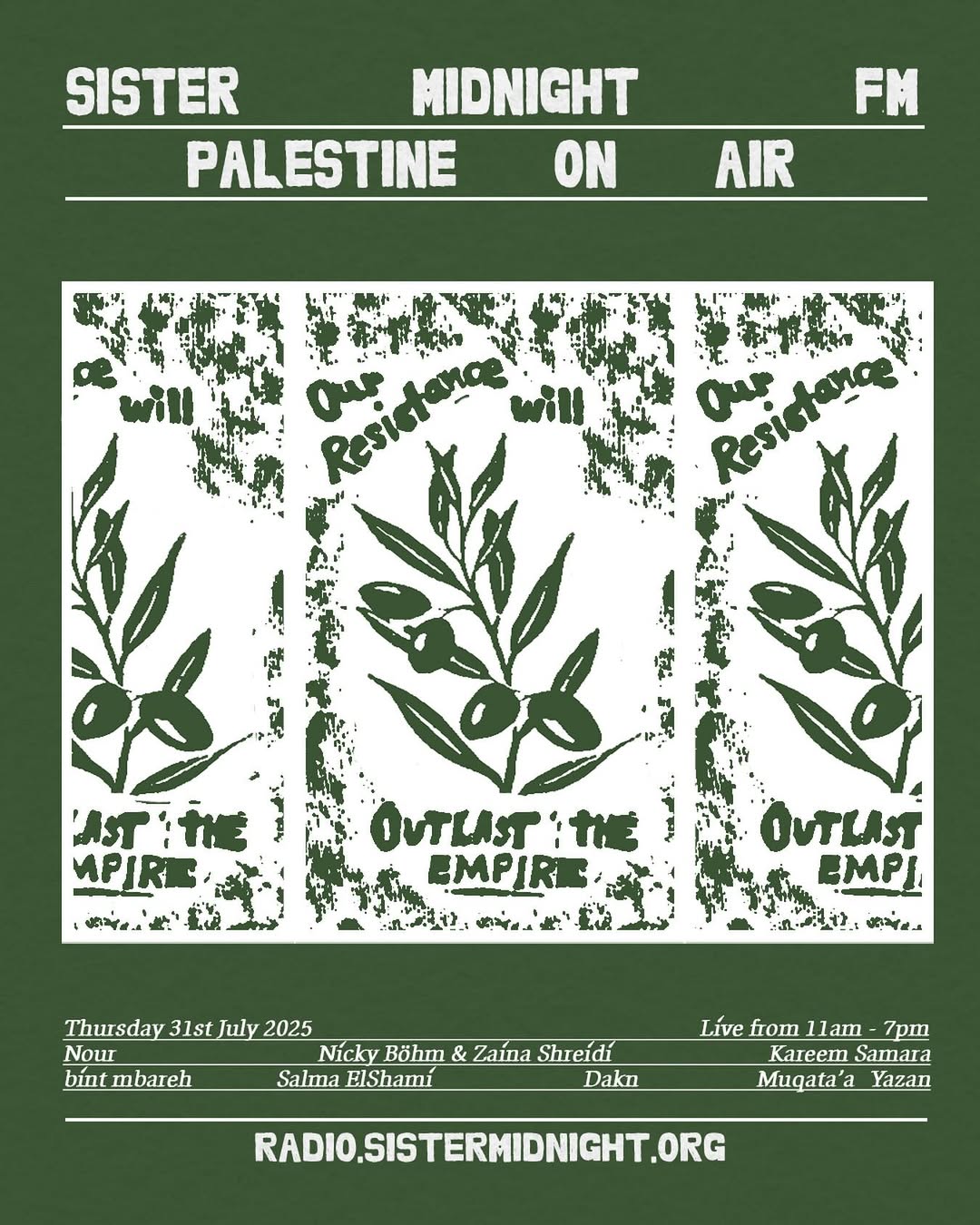
Sister Midnight FM is dedicating the airwaves to Palestine. Eight hours of music, conversation, and cultural resistance connecting liberation struggles across the diaspora.
As genocide, occupation, and apartheid continue, we’re reminded that every platform must be used to speak out against colonial violence. Radio crosses borders and, as a medium rooted in community, it becomes a vital tool for resistance, connection, and amplifying the call for Palestinian liberation.
This takeover brings together artists, organisers, and musicians – from reflective poetry and music to a live oud performance, conversations on cross-movement solidarity, and tracks that challenge corporate streaming platforms.
Featuring contributions from @nourpalestina – @kareemsamaramusic – @nickyboehm – @zzaina – @bintmbareh – @s_shamiii – @dakn791 – @muqataa – @ya_z_an.dj
Curated by @gabsdann
This station is doing other lovely things, too, and regular specials like this — see their Instagram, linktr.ee. (We really need more fedi/self-hosted/independent stuff but that’s another post or ten.)
And they have a beautiful website with a member drive on now.
Action
We’re at the stage where a lot of us wake up in the middle of the night thinking about how to stop this, how to stop the genocide. We’ve seen the power of inaction; it’s time to answer that with action.
I’d like to see this guide out on the open Web, too, but for Instagram users (and then shareable on that platform), Let’s Talk Palestine has put together a compelling set of ideas about actions that could change the situation on the ground:
There are clear touchpoints in music and music technology, too, including cloud infrastructure that we all use, plus the involvement of US and EU governments, relevant to this site operating from Germany/EU and reaching a largely EU- and USA-based audience. You can also see their website for more information.
Putting pressure on the media to balance their coverage can have immediate impacts because it, in turn, impacts policymakers. Accountable Media 48 and NewsCord (Linktr.ee / Instagram / Site) each have actions to take that impact Palestinians and Palestinian journalists directly, and NewsCord also acts as an aggregator for news so that you act as your own editor/newsdesk. In Germany, which has turned into a case study in biased media , there’s also de:press (Insta | linktr.ee).
And people still need eSIMs.
As I’m based in Germany, let me also point to the letter Michael Barenboim (violinist, of Barenboim/Said Akademie) and Hanna Keinzler (refugee and conflict mental health expert) have written to the government here:
If you’re a journalist (or looking for what to say to journalists), I recommend a recent Columbia Journalism Review article. Despite the “Columbia” on the banner, this is a Palestinian-driven effort and features concrete actions to protect journalists from the viewpoints of Palestinians working in Gaza and abroad:
Urgent Ideas for Defending Press Freedom in Gaza
I want to specifically highlight Ahmed Al-Najjar, who’s been an advocate of Palestinian arts and a journalist voice for arts in Gaza, even now (including covering some of the projects I’ve written about):
Ahmed Al-Najjar / he just filed this report as I wrote this.
In addition to Al Jazeera English, who have reporters on the ground, Dropsite News and Lebanon’s Megaphone News have been great resources.
I’ll finish with some more music. (I still can’t believe someone complained that I’m featuring acoustic music … the one studio in Gaza we featured was bombed, and electricity isn’t available. Also, I like the oud. We can learn a lot from the oud. I also sing and play instruments as part of this whole “music” thing. I don’t know why I’m arguing here with something so stupid. Back to the music.)
Ahmed is also still fundraising.
Now, “whatabout–?” Yes. All about all of it. Unite the struggles. We keep saying music is universal; maybe we should start acting like it.