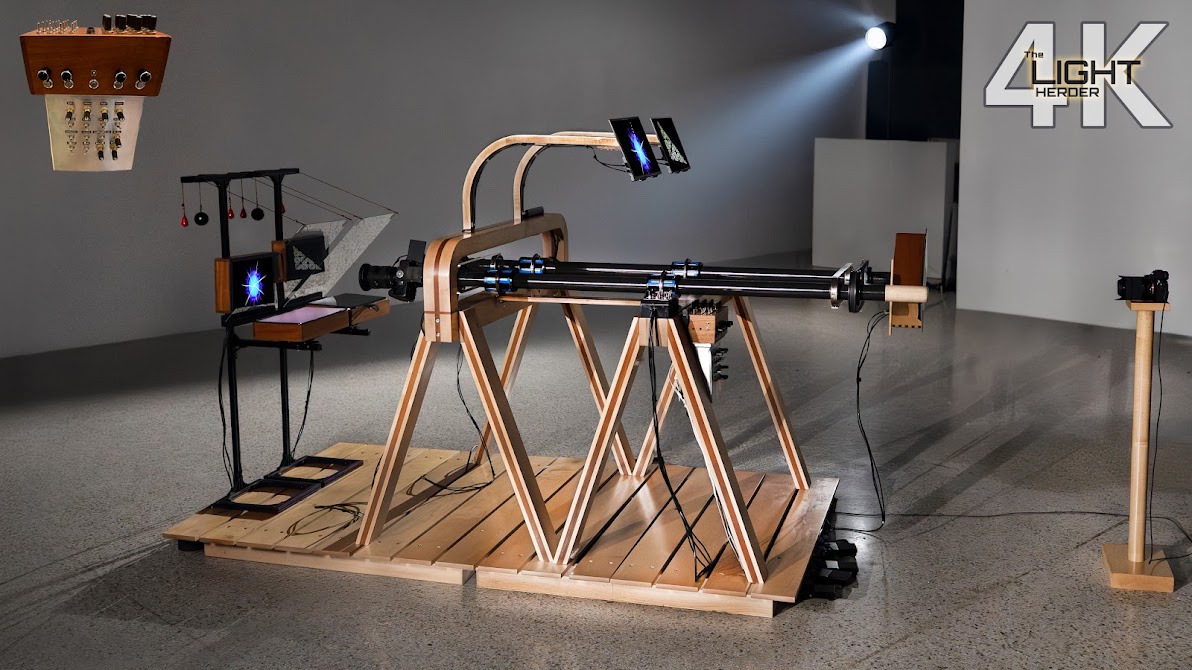
It’s digitally controlled optical goodness: a humble Teensy translates analog knob turns into control of 4K displays, all built into beautiful mahogany enclosures and giant cranks. The result: elegant, precise fractals blossom out of 4K displays by literally tweaking the knobs on the units. Behold, The Light Herder!
I did a double-take at that last part. Like, yes, I see enormous, almost nautical-steampunk cranks rotating the displays and SLR cameras. But this rig also tweaks hue, saturation, brightness, and contrast knobs on the monitors. It’s a kind of precision analog-optical feedback kaleidoscope. Watch, as it’s then much clearer, with full explanations. Then dazzle as trippy, almost algae-like videos tumble from the output in hypersaturated full color.
From the description:
I made custom 4K screens with analog knobs to create finely controlled 4K optical analog video feedback and fractals: it’s classic video feedback from the 1970s taken to a ridiculous, never-before-seen level. See images getting trapped in feedback loops! See one set of fractals create another set of fractals! See two fractals create each other! See my cat Bonkers! Find the largest screen you can, put on headphones, and stare at hypnotic images set to great music!
While there are computer chips in the various components, no computer is creating the images made with the Light Herder Video Feedback Fractal Device. The fractals are made in real-time with just cameras pointed at 4K screens, half-mirrored glass, and the operator at the helm – as a part of the feedback loop – moving the cameras smoothly back and forth and 360° around while adjusting the analog knobs. The operator “plays” the Device like a musical instrument, creating galaxies, cell structures, strands of DNA, plants, insects, tentacled primordial creatures, spirals within spirals, loops within loops, fractal sets within fractals sets.
Obviously, if I had a festival, I’d book this.
A project like this doesn’t just spawn overnight. There’s an equally obsessive companion website that details the whole process — and it’s worth digging through, as there are some beautiful examples of outputs and happy accidents at each stage of that exploration. It’s delightful all the way back to the very first iteration.
You can bliss out to this website alone for an extended period.
https://www.thelightherder.com
Thanks to Gösta Wellmer for sending this one my way. It’s like the old days when every blog picked up the same story — and well-deserved.