Do you love drones? I mean, like you’re craving nothing more than aggressive drones coming right into your ears from violin and self-made reed instruments for 27 minutes, 28 seconds straight? The legendary Werner Durand and John Krausbauer have you covered on label-for-the-heads Moving Furniture Records out of Amsterdam. And then we take a side trip to time crystals, images, and sounds to discover from La Monte Young and Jung Hee Choi.
First, Black Seraphim by Werner Durand & John Krausbauer. As Moving Furniture label boss Sietse van Erve describes:
Anyone familiar with both their output knows this is some golden collaboration. Deep, intense drones blast out of the speakers, created with self-invented wind instruments and violin.
For those new to these names: think Tony Conrad, Catherine Christer Hennix (with whom Durand also worked), La Monte Young, etc. Old school drone goodness!
It’s a full bath of sound. To me, honestly, electronic invention always makes me want to go back to acoustic sound, and acoustic instruments always make me want to go back to electronic sound. It’s just insatiable listening, all of it — even the instrument-building part, the ultimate active listening. And this is just what insatiable lovers of harmonics and drones will need:
Still more drones, in the world of La Monte Young
This got me free-associating back to La Monte Young. The Marian Zazeela Dream House project continues, enduring a changed New York City, and touring the world. Artist Jung Hee Choi has been a driving force in maintaining that brilliant legacy, and sure enough, she has a new work out to start 2026:
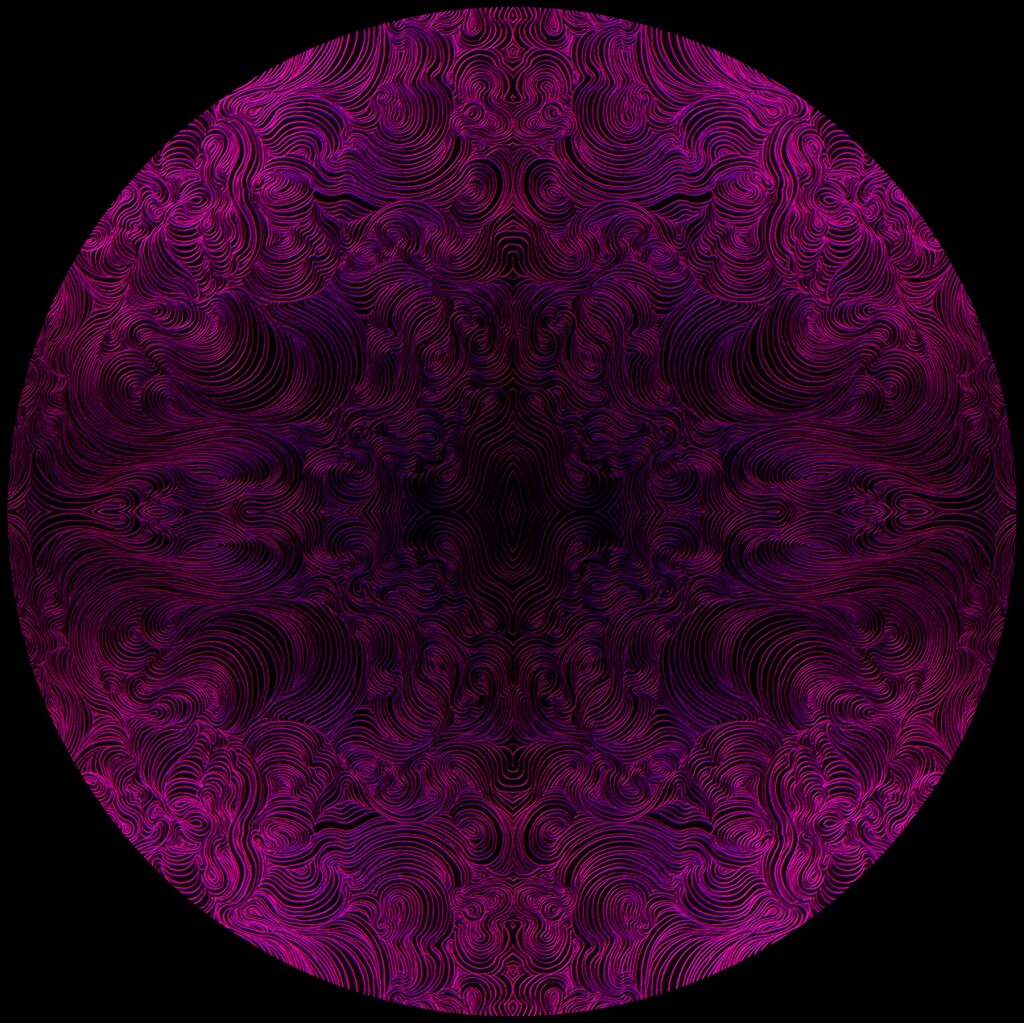
Time Crystals Rippling Over the Magenta Ocean is a light‑projection work composed for La Monte Young’s New Version of Chronos Kristalla for String Octet with Marian Zazeela’s Dream Light at the Bourse de Commerce in Paris.
I love the way this was produced, which explains why it’s making your eyes tickle:
The macrostructural image of the projection—unchanging throughout the piece—is my pencil drawing Composition 2016 No. 1, photographed under a specific angle of light so that the thin graphite lines reflect maximally. The image was then digitally separated into red and blue channels, offset by just a few pixels to produce magenta as a resultant tone. Magenta does not correspond to any single wavelength in the visible spectrum, which exists only as a perceptual construct created by the visual system’s synthesis of red and blue in the relative absence of green. In this sense, magenta behaves analogously to an acoustic “combination tone,” emerging from emerging from the interaction of two distinct frequencies.
This image is just stunning. I could stare into it all day. Full description of this 2026 creation:
Here it is in context:
Let’s return to some of those seminal earlier works, too, while we’re at it.
Back to my own NYC days, here’s Jung Hee Choi in 2009 with RICE, a site-specific multi-channel video sound installation with “Composition in the style of La Monte Young’s 1960 sustained friction sounds.” This is in the Marian Zazeela Dream House as part of The Third Mind exhibition at the Guggenheim Museum on March 28, 2009.:
There’s this beautiful piece from 1960, as rendered in 2021, but do any of those years matter? These drones feel like tuning into cosmic hum, like we should measure in light-years as much as inches or centimeters of tape. It seems just as appropriate for the significance of the moon this week to multiple faith traditions and our historical notion of Earth time. It’s also as gentle as the above drone is not, though I adore both.
Dust Archive writes:
Yesterday, for #droneday 2021, we performed 1 hour version of La Monte Young’s Composition 1960 No.7, one of our favourite classic drone pieces. 2 long tape loops (6m one way and back each) playing this: Fostex M80 is playing 8 tracks, one note each (half played with doublebass, half with sopran sax, half B, half F#). Uher SG561 is playng the chord with Spitfire Audio’s LAB (Strings Flautando), processed with Ciat Lonbarde’s Cocoquantus.
Also on Bandcamp:
And a very different rendition of the same work, in Kyoto: