Alif Hilal’s Hymnal is an ecstatic, prophetic vision, a hybrid of synthesis and organicism in an improvised compositional structure with processed voice and strings, conveyed with striking intimacy. Alif talks to us about inventing culture and reconnecting with musical roots while unlearning, all at once.
Fountain was a breakout work, constructed entirely from Alif’s voice (the artist formerly known as Lyra Pramuk). Hymnal reimagines the instruments as SATB voices compositionally, but transforms sound and voice together into a communal, congregational whole.
Hymnal suggests folk and US American roots, but to me, the transcendent, mystic cycles here connect as much spiritually to whirling dervishes and cosmic ego surrender. Four-part church harmonies, melting into modal cycles, fuse effortlessly with alien gestures and otherworldly utterances. It’s rich and dense, with layers Alif says she tamed using chops acquired from mixing as a DJ. Alif is aware of her roots in New York minimalism, club music, and folk and congregational church music of the USA, but the more I listen to Hymnal, the less I feel any restrictions of those forms.
It comes across as deeply personal and coherent, a completely natural narrative, but there is a web of materials informing the composition. Across the whole album, there’s the brilliantly machine-like virtuosity of Sonar Quartett strings, re-amped and processed into the productions. Software engineer Jordan Juras, a published machine learning researcher, works Unsupervised Machine Translation (UMT) into three tracks.
Maybe most revealing of the process is the cross-species, fragmentary approach to scoring — so that even the scored, composed parts are allowed to evolve as a lifeform. Nadia Marcus contributed poems which Alif mapped out via key words. Alif and biological/computational artist Jenna Sutela then set the slime mold Physarum polycephalum to work path-finding over the language, forming visual/textual notation for Alif’s marathon 8-day improvisation, deep in a trance state. It’s the opposite, really, of the normal ego-driven intention of music — and even the labor undertones of the word “production.” It freed Alif to grow through those pathways, like the journey of that myxomycete.
Accordingly, Hymnal is disciplined, but acelullar; it’s composed, but in situational sponteneity. It’s fully electronic, but voice and strings are poured with all their materiality into that lost-wax digital process. And the elements fuse together in the way a congregation singing does, a communal entity. It’s also driving in a way that has the visceral abandon of a dancefloor, something that can get lost in “academic” composition.
And it will continue to live and evolve and lead to more work, I’m sure; Alif talked about wanting to reimagine this live — see upcoming live dates at bottom. There’s a creative process here that overflows the usual album/release/label boxes.
I talked to Alif in her Berlin studio a few weeks ago, just as the album was nearing release.
Directed and Edited by Lucy Beech
Guest Direction (high speed camera shoot): Krzysztof Bagiński
Duration, narrative, and journeys in time
Peter: These tracks are mixed for continuous listening, right; they’re individual tracks, but meant to be listened that way?
Alif: It sounds very seamless. So it has this quality of a DJ mix — and it’s all kind of intact.
Right, with a moment in between, like a breath.
It’s a breath. There was a sense, also in my last record, even when I’m working on individual tracks, I’m editing it as one piece. Like the album is the work. That’s probably the part of my brain that grew up listening to instrumental, symphonic music, song cycles. It might be nine songs, but they’re all intended to follow an order, and they tell a complete story, and there’s this sense of dramaturgy.
I would love to work on a project that was not as regimented — that’s more fluid. But the way that I’ve been producing to this point, it’s a lot of post-production. It ends up being a lot like sculpture. It’s very concrete. And I’m thinking, is there a coherent story?
And every time I have tried to break it apart, it just doesn’t. I think it needs to be in that flow because there’s a meaning, there’s an expressive potential or function of the sequence. When it’s broken, the experience or the function of the whole thing becomes more diluted.
It needs to be cut like that. It’s this chunk of time, 50 minutes. It needs that time; it needs the length. Or else you’re not immersed.
I like singles. I like having relationships with single songs. But I just love longer works. I love to be challenged; I’m very sensory seeking. I like a musical journey that asks more of me. And usually that means longer. That’s a huge reason I got into rave culture and techno and experiential electronic music sets, DJ sets, live sets, that it’s long and takes you somewhere.
The length of it also forces you to leave behind a certain sense of logical cognition that we might be embedded in on a daily basis. You’re forced to go on a journey. I appreciate that a lot about music, and the psychoacoustics of minimal, repetitive electronic music and trance in a functional sense, not as a genre but as an experience.
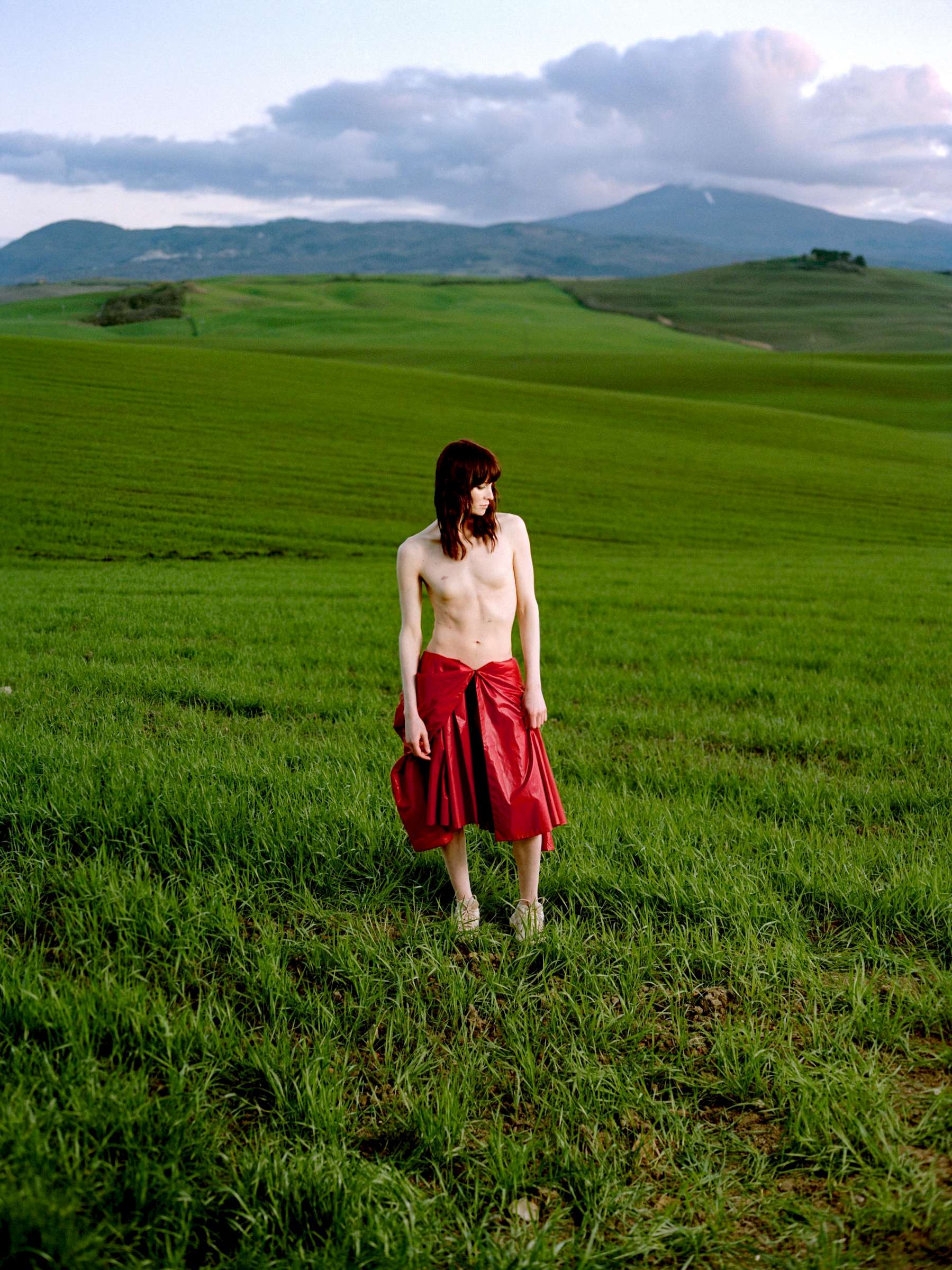
Photo (above, top/featured): Leonardo Scotti.
Discovering a Practice
I was thinking about Meredith Monk and the notion of folk music from an alien world; this can sound like that. You talk about being critical of Western culture, but at the same time, for some of this album, you’re referencing that Western cultural practice, too?
Well, I am Western. I want to be really honest about where I come from. I’m also trying to approach a speculative or other process or musicality within this culture and lineage.
So it was, like — what is my culture? It is very personal for me, I think, because white culture is so predicated on all these extractive models and systems, and colonial, capitalistic architectures. There is not a model for trans womanhood or transness in that system.
So I’m without a culture. I’m having to invent a culture as a white trans person. There’s nothing designed for me.
Even if you look at the deeper manosphere, woman-osphere kind of stuff: what is the definition of a woman? For neo-reactionaries, it’s very, very rooted in those early colonial definitions of women as caretakers and childbearers and property and all of these things. And it’s connected to the exploitation and capture of female bodies. And I don’t have a uterus, so what am I good for, for them, anyway? I’m not producing a family. There’s no place in that system for someone like me.
But so you go through this process — you’re not severing your connection to your influences. Your work with the string quartet and the way you work with your voice and the way you’re assembling all the parts and composing — it’s all there.
I think it’s because I’m so steeped in New York minimalism and also techno — the liberatory, radical techno that came from Detroit and then to Berlin. The New York classic House tradition that also came to Europe and was transmuted into so many other things…
There’s a really simple connection point in the Venn diagram between New York minimalism, Reich and Glass and Monk, and a lot of that rave music. It’s spiritual, it’s healing. Reich, I think, is inspired a lot by gospel. So there’s a vocality and a kind of humanistic compulsion — togetherness. And there’s a deep-dive trance state that is also very geometric and mathematical. For me, it’s not disparate at all. Those are my two cultures.
These dance music cultures, created by marginalized Black and brown queer people, were the spaces that took me in when I needed to find community.
And, my musical background, my training, aesthetic visions for many years in classical music was this other thing which I really love. One of my mentors at Eastman School of Music, where I studied, is this conductor Brad Lubman, and he’s premiered a lot of works with Reich. And I saw him and his Ensemble Signal and Alarm Will Sound in New York play so much Reich — Music for 18 Musicians, Tehillim, Double Sextet. These are some of the formative experiences of hearing American concert music. That’s the heritage of my education, my community that I studied with.
Yeah; we came from parallel backgrounds in that way; me working with Ed Niemann (Reich) and Martin Goldray (Glass) and then being so influenced at Sarah Lawrence by Meredith. I was thinking while I listened to you about Meredith’s work and how you work with the voice, as choreography.
I always knew Meredith’s music, but it was after I really became a raver and then started to make music again that I registered Meredith’s music in a different way. Because there was so much movement in it.
Such choreography, such cast, choir — I relate so much to that now. From a formal, structural, philosophical vantage point, I love that about her music. In dance, you might have a gesture that is very intuitive. She does that with her voice.
It’s the Gertrude Stein automaticness of an intuitive gesture emerging, like Anne Carson wrote in the gender of sound about utterances or leakages. As a feminine principle of energy leaving the body in all these different ways that didn’t have to be structured into logical thought — not like the urban patriarchy in ancient Greece expected it to be. It’s like this idea in Carson that women leak.
Women leak blood, but also leak emotions, leak sounds. And there was a long history in Western civilization of that being disallowed or moved to the outskirts of the city. I got to see the film that just premiered at the Berlinale about Meredith. I think you see a microcosm of that history of women being exiled for making strange sounds. And for the first 20 and 25 years of her career, just like being like, you are fucking like, wrong.
Or Yoko Ono! I feel Yoko Ono was underrated for the same reason. As a woman.
Men are allowed to make those voices, but somehow it’s wrong. Don’t make crazy vocal sounds.
A lot of my favorite experimental vocalists are women because they go much further, I find, into places that are sometimes quite scary, even. I think of Anne Gillis, Diamandes Galás, Ami Yoshida.
There are so many vocalists in experimental music. Men, of course, too. There was this kind of brokenness, ugliness — like really sitting in ugliness — that I find a feminine principle in female vocality.
Meredith does it, too. I know some people who have very visceral reactions to the sounds that she makes. They’re like, this is overly theatrical and ugly, and like, why is she doing this?
That’s really empowering as a vocalist, though, right? So many of the problems you have as a vocalist are because of trying too hard to control the instrument. Or fear — fear of making an ugly sound.
It needs to be free. Because I studied classical music and I memorized so many songs — it was such a labor. I wrote some more traditional songs after I finished music conservatory, like experimental pop with lyrics.
This just feels more real — I just wanted to give myself a lot of room to improvise.
One of the things I’m proud of with this record — it’s a very composed tapestry. There are a lot of utterances and fragments in the listening experience, but I structured it in a way that I have so much room to improvise in the live concert. Like, a lot. And I improvise a lot. And it’s so fun. It’s a playground, and that’s what I wanted for myself more than anything. Like, even on Fountain, it was more like experimental pop. I had more moments where it was more like theater, and I had to like hit a mark or something.
Now you can be like the slime mold. You can go in any direction — wherever the oats are at the moment.
Exactly. And that’s so liberating. I want to be free. I want to be free, and I hope that that freedom is also compelling other people to realize you can do other things on a stage. Like, it doesn’t need to be sequins, rhinestones, bodysuit, backup dancers, all the lyrics exactly verse / chorus / bridge / pre-chorus, chorus, whatever. It can be a bit weirder.
I’m not really interested in, like, declaiming text to people. It’s too intellectual for me. I feel like music is a language.
Directed by: Alif Hilal
Producer: Shub Roy
Director of photography: Camille Blake & Margarita Maximova
Textuality and interpretation
Some of the text is clear. And some is not. I’m curious if you had any kind of intention for how we would listen to it.
I’m going to wear my Susan Sontag Against Interpretation badge till my death. I like to make work that is abstract and surreal enough that you can experience it from many different perspectives. I’m more interested in making things that feel like there’s enough space in it for people to really build their own relationship with it. where it’s not, “Oh, this is definitely about that.”
I find that very boring. I’m interested in making mystical music, and mysticism is not easy. It’s not linear. It’s not modern, it’s not concrete, it’s not Chat GPT. I think it mirrors the complexity and the mysteries of our lives. And I think to listen to music that inspires this kind of inquisitive state is more meaningful to me than music that clearly connotes text.
I don’t think I’ll ever be as good a writer as Joni Mitchell. In her lyrics, there’s this complexity and multiplicity that I find astoundingly beautiful because even when she says something in a heavy-handed way, there’s often multiple ways of looking at what she’s saying. That’s the best of poetry for me. I’m not sure that I’m a poet in that way.
I mean, you found your own way to do that — that’s how it sounds to me.
I think there’s something very visual about my music that you could, like, map the shape somehow. There’s something very visual about it. It’s very collage. And so I think the language for me is more tactile, sculptural, visual, and more primal — as something that has mass, that has weight, like painting.
Letting it speak in a more abstracted way to our hearts and letting it as a material hit us, hit the ears, hit the body. And that it’s a kind of language that is multisensory, rather than only linguistic.
I was wanting to bring more language in, but in a way that wouldn’t overwhelm the kind of musical surface. And so there are times for me where the language, knowing what I am singing, comes to the fore.
And there are times, like there’s a track near the end, where it clearly sounds like my voice is saying words, saying something very direct, but it’s totally unintelligible and chopped.
It’s almost this feeling of, you have a partner, somebody speaking in their sleep, and it’s completely clear, but it’s not words that you can understand.
I love magical realism and surrealism and dream states. Politically, I think, music that goes to dream states is very useful because we’re able to have some distance from the world, rather than the more sober, rational way. I think that’s the magic of David Lynch, as well. It’s all of these archetypes of American life that are transmuted into this dreamlike, high art space that makes you question the very fundamental underlying concept of the reality that you are so sure is happening every day.
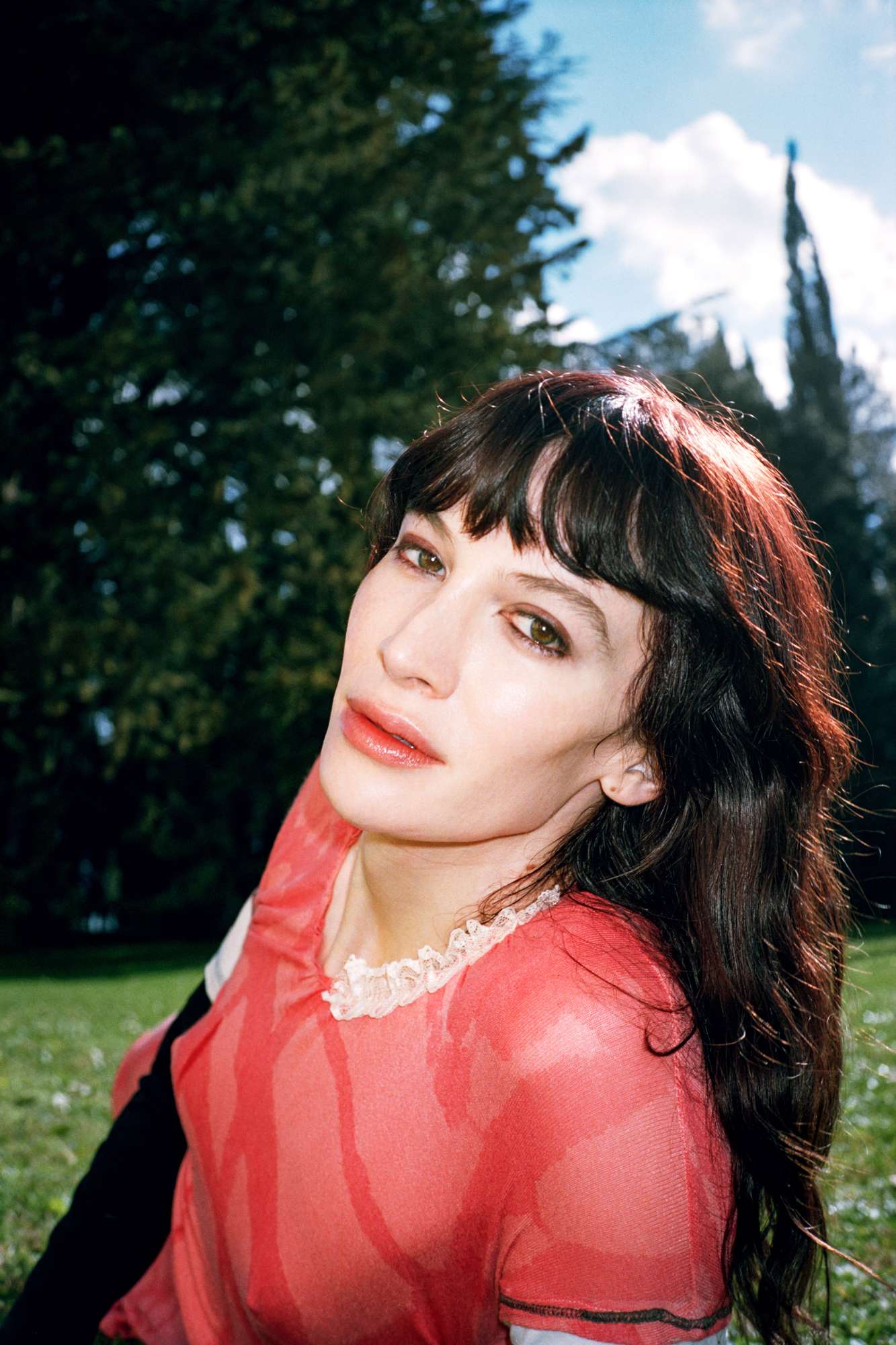
What about the decision to structure this as a hymnal? What led you to that choice?
So obviously it refers to, like, congregational, religious group singing, especially in the Christian faith. It’s like a compositional quality, first of all, because all the parts I wrote for the strings were Soprano, Alto, Tenor, Bass. Four voices.
So yeah, the hymnal aspect is literally referring to the strings as voices.
And then it refers also to the devotional quality of the many voices, both the strings and the human voices, and all the fucked up, vocally produced voices that come and go throughout the record. It’s like the swarm of different voices, just like my last record, but stylized differently.
There is a congregation in the record, even though it might be all my voices and just this one string quartet. It’s like this luminous electro-acoustic music space of many voices. jamming together.
Composition and production process
What did the scores look like?
We arranged parts that I had written in MIDI on a laptop keyboard.
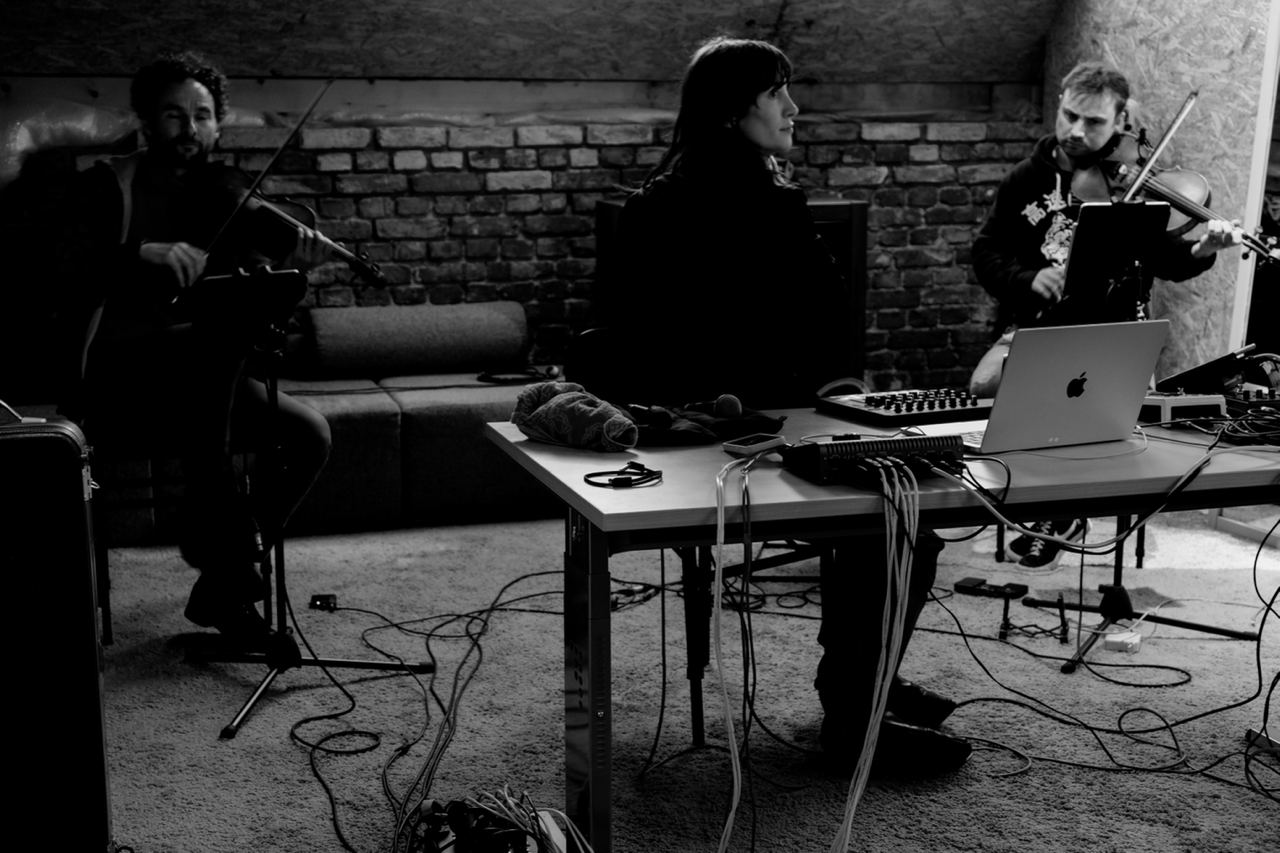
It was 20 demos or something with parts that I worked on with an arranger, Francesca, in Switzerland [xxx]. And so we had arranged parts for a string quartet with a doubled contrabass. We recorded for two days; 75% of it was just recording that stuff.
I wanted it to sound so electronic, in a way. This continuous loop, it took a lot of work to get there, because it’s not something that string players normally do. To play so stupidly, like a sawtooth synth and with this kind of energy that you’re already thinking about the loop, that the amplitude ends at the same level as when the phrase begins, that I would seamlessly loop it in Ableton, like a four-bar phrase. And that’s very unusual, I think. Obviously, everything was recorded with a click. Everything was recorded at 135 bpm.
We started to get it once I was conducting a bit. I had to go into the room and be like, you know, this is actually stupider, louder, stupider, louder. Because I wanted it to sound like synths.
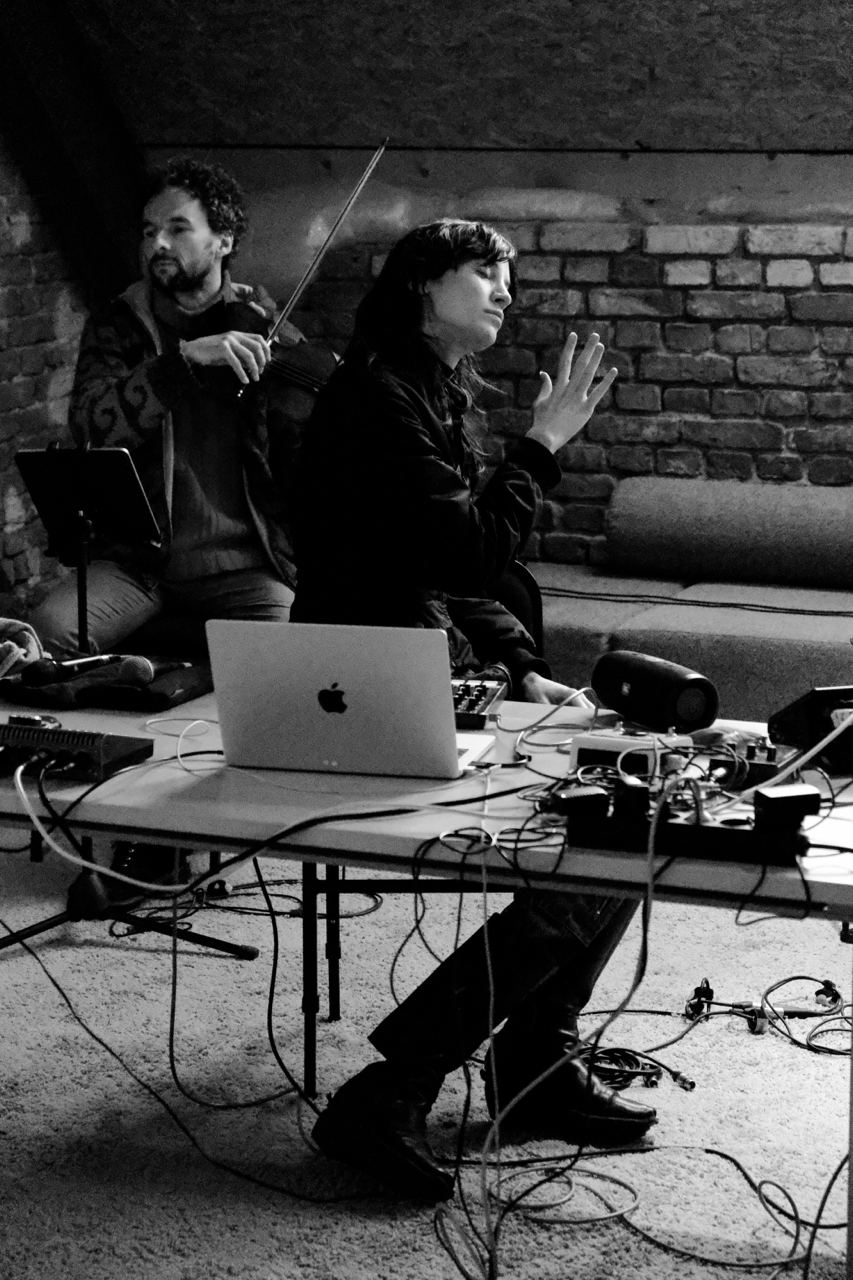
They improvised a lot too, where I would like give a style indicator, like you might give to AI or something like this. And then we would be like, “Okay, would they start to play this beautiful thing?” And then I’m like, “can you two cut out? Now, okay, switch to minor, get more quiet!” — I’m calling on the intercom like this. And so that was a big part of the session, too.
They are such phenomenal players and musicians and have so much life experience and musical experience. So it’s a combination of composed material and them bringing their musical experience, perspective, and style. Ian, the violist, is Scottish.
There’s like some Scottish-style lament or a kind of jig. That’s just him being himself on the record. It’s the folk quality, too. I was asking them to play what they want.
I’m so happy with the final result. I love this album.
The players must be happy, too.
Yeah, and it’s an electronic music experience, electro-acoustic, whatever – electronic and acoustic and stringy and human at the same time.
They feel like one ensemble, not a clear sense of here’s the electronic element and here’s the acoustic, right?
Yeah, exactly. The other conceptual element is these glitched-out vocals that feature across the record, which sound much less human.
They also connect the actual voices to the strings; they’re these nether voices. They kind of sound like AI voices, like if AI were to do to your voice what you didn’t want it to do — like the dirty underside of using models to produce voices.
But they’re organically produced AI voices, without AI, just you. I understand you were also working with CDJs?
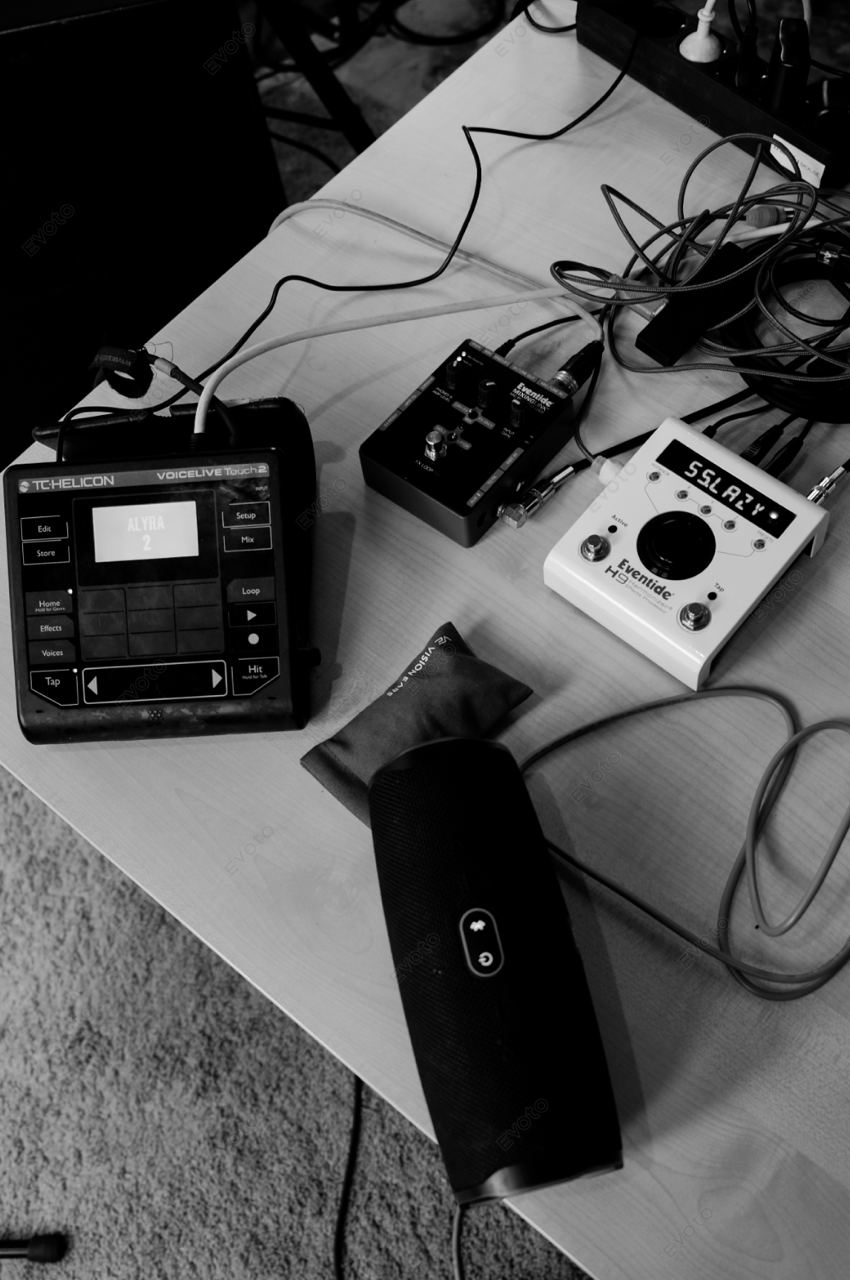
I was working with the CDJs to compose the demos and understand what the flow would feel like between like voices and strings and tracks. But I didn’t actually record CDJs into Ableton.
I had these sketches I listened to. Even the sensibility of having DJed a lot when I was putting this record together, I was thinking about live mixing, even when I was in Ableton. I’ve gotten really good at simulating DJ mixes in Ableton Live with just repitch mode, slightly warping the speed of things like.
They influence each other – the way that I use Ableton and the way that I use CDJs. It’s having a sensibility for filtering, bringing in a loop, fading something in, using high-pass filters — these basic mixing techniques that can be very impactful.
So you’re using the full range of your instrument — to go to extremes, yeah?
Totally — the voice being an instrument in this electro-acoustic playground, and not just the voice being an indicator of humanness.
What was that vocal process like?
I improvised all the vocals on the record. I didn’t write any top lines, melodies. It was just improvised.
I did an eight-day vocal improv session. And I went into a trance state, so I would record a lot of these vocal ostinati, these repetitive vocal rhythmic patterns. I was just recording for hours for eight days.
It felt like the strings were these loops, and a lot of the vocals are these rhythmic ostinati or two-, four-bar loops. They’re not edited, the rhythm; it was just recorded like that. I wasn’t editing a lot. I wanted it to be these rhythmic patterns that I do — just one live take and just put it on the record.
And I wanted it to feel like folk music in that way of you just like capturing a performance, but then sequencing the loops together. So it felt more techno-y.
There are some great grooves that you get into. Yeah, it’s like old school techno, really — where you get a live groove going that works right away on gear and just record that.
Yeah. And that’s also very folky. You know, locking in during a live performance and hoping that someone recorded it. That quality of wanting to capture something gold and then sequence it in.
It was a long process, but very minimal. It’s really just two recording sessions.
You must have gotten your instrument in shape for that — the body and voice, to support a marathon session like that.
I mean, that’s the benefit of studying classical voice at conservatory, and doing this really intense physical training, that I can work it back there when I need to.
It’s not something unnatural. It’s not something that’s going to hurt you.
I use folk as a term of political transmission. It’s also about giving myself the humanity that I would like to give other people through my music.
That means not forcing myself to be a machine. Or to be this industrialized, instrumentalized conduit.
I’m doing this because I’m having fun. And not because someone needs me to be.
Alif live dates
September 4: Manchester, The White Hotel – tickets
September 5: London, CTM x ICA tickets – tickets
September 20: Rome, RomaEuropa @ Pelanda T2 – tickets
October 2: Ghent, Wintercircus – tickets
Lastly, enjoy Alif’s mix for Resident Advisor (with interview/tracklist) if you need more sounds once you’ve finished playing Hymnal on repeat:
I also wrote about Fauve from K-Devices, which gets some use in the production side of this record: