This is truly haunting — the sound of a vintage machine’s lightbulbs hooked up to audio inputs, proving it can be more Boards of Canada than the actual Boards of Canada. Even the sound of loading up the punch cards and flipping the switches is oddly soothing. And more rabbit holes await.
The action is from the Computer History Museum in Mountain View, California, recorded in July:
The computer: a Digital Equipment Corporation PDP-1, ca. 1959. If the panel looks luxurious, it ought to be — the purchase price of this machine was around $1.3 million in inflation-adjusted cost.
The software: Harmony Compiler 2, originally written back in 1962 by Peter Samson. That project is being revived by Joe Lynch:
The people — Peter Samson: PDP-1 Operation, Author 1962 Harmony Compiler Transcription and Code Support. Samson, incredibly, got his start through MIT’s model railroad club but went on to become a legend of both computer science and computer music (including a system widely used at Stanford’s CCRMA).And now he’s doing restoration and docent duties at the museum.
Joe Lynch: Music Transcription, Music Paper Tape Creation, Video Production; with Diane Zingale and Joe Fredrick on production support.
They’ve put up more notes, code, playing instructions (by Samson, for the PDP-1!), and even a simulator (so you can prepare for your performance), all on GitHub. The creation software is tested on macOS, so you might need to test it on other environments like Linux.
https://github.com/joeblynch/pdp-1-boc
Oh, and I do mean “they’re using the lightbulbs to play the music” — that’s not, like, some kind of technical simplification. Since the PDP-1 wasn’t intended to be used for sound, Samson hacked into the status lights and used them as oscillators.
Audio is produced on the PDP-1 with a clever hack done by Peter Samson as a student at MIT in the early 1960s. The PDP-1 has six “program flags”, which are 6 flip-flops wired to six light bulbs on the control panel. A CPU instruction provides the ability to turn these light bulbs on or off via software.
While these bulbs were originally intended to provide program status information to the computer operator, Peter repurposed four of these light bulbs into four square wave generators (or four 1-bit DACs, put another way), by turning the bulbs on and off at audio frequencies.
Four wires are attached to the signal lines for these light bulbs. Resistors are used to downmix these four signals into stereo audio channels and provide impedance matching into a standard stereo amplifier, and combined with capacitors to create low pass filters to cut out the buzz of the computer noise and soften the square waves.
The four light bulbs act as individual music voices. Each voice is transcribed separately using a custom DSL defined for the 1962 Harmony Compiler, and then merged into a single file which is then compiled by the original Harmony Compiler running on a PDP-1 emulator. The resulting paper tape file is then punched to physical paper tape using a tape punch, and then loaded into the real PDP-1 for music playback.
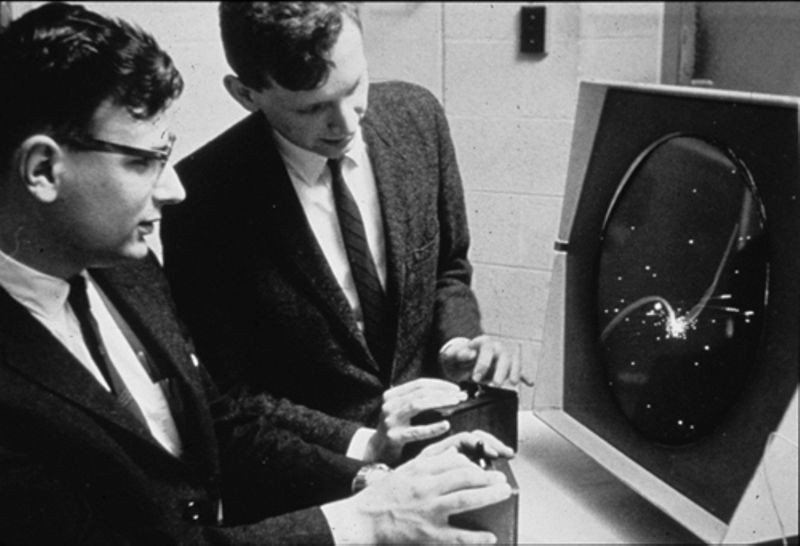
And by the way, Peter Samson also contributed to the development of the legendary video game Spacewar! Here he is playing that game on the PDP-1’s iconic circle-in-a-hexagon display, in a 1962 image also from the Computer History Museum:
Here’s the original track, which, you know, some of us have on CD. It’s such a beautiful composition, of course, which is what makes this work — but then that opens up exciting possibilities for people composing for the PDP-1. Let’s do it.
The visual here which pops up briefly is also spectacular — a lost relic from the early 60s, author unknown. There’s a melancholy to all of this — machines from another age, perhaps our own lost civilization.
I think I’ll have the voice of those PDP-1 lightbulbs singing to me in my head for the rest of the week.
Here’s more on the PDP-1, the phosphor display showing “Snowflake,” and yeah, they get some time in to play video games, which is not something you normally get to do on a 6-decade-plus, $1.3 million console. (I can’t really wrap my head around the idea that the same displays used to prepare for real thermonuclear war as a human race-ending possibility were also just making art and games on the side…)
Photo at top CC-BY-SA Alexey Komarov.

Updated: just to emphasize, what’s noteworthy here is that this is not a new hack. On the contrary, Samson’s work in the early 1960s was groundbreaking for the time, partly because the hack allowed effectively 4-voice polyphony. (Other experiments of the era were satisfied with getting some kind of beeping sounds and the like out of a single speaker.)
The museum has installed a new control box, but Samson himself has returned to work with them to restore the contents of the original tapes from the experiments from around 1962. Those objects are also in the collection, with these details:
Creation of a ‘harmony compiler’ by Samson allowed for sophisticated music to be played and soon the total quantity of music encoded for the PDP-1 reached several hours. Student Bill Ackerman encoded a version of all four movements of Mozart’s Eine Kleine Nachtmusik which may have been the longest single musical work ever played on a PDP-1.
See: https://www.computerhistory.org/pdp-1/music/