No need to brave the Arizona heat: Glitch’n is a course in electronics that even absolute beginners can enjoy, assembling oscillators, generative beats, filters, and noise on breadboard circuits. But it also helps young people to learn crucial skills that can lead to teaching others and getting jobs. And, for that matter, it could do the same for you. Let’s have a look.
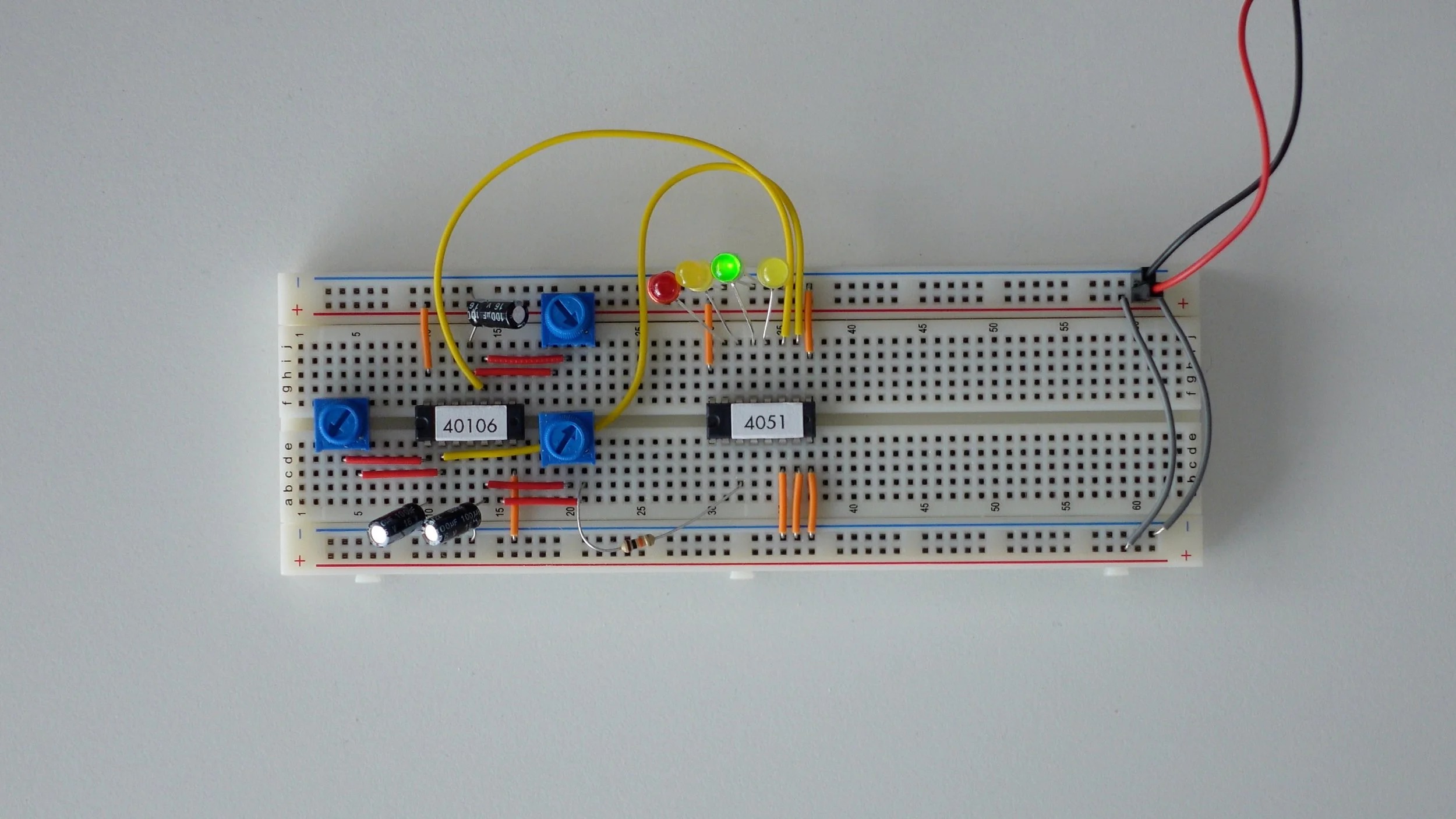
You can put together a $3 generative drummer. Or a handful of cheap ICs that form a modular drum machine for $5. (Like me, these chips date to the 1970s!)
See the full course online, free. Just grab a few dollars in components and wire them up on a breadboard; you don’t even need to solder anything. (Eventually, you’ll want to, because soldering is fun!)
Glitch’n Course
They’re working on a school-friendly, ready-to-go lo-fi glitch machine club, too. Look forward to watching this.
I learned about this from Seth Thorn, PhD, Assistant Professor of Interactive Media at Arizona State University. (He also makes terrific music – check below!) He works together with the Glitch’n team — including electrical engineering prof Jennifer Blain, PhD, and quantitative research professor Dr. Mirka Korko, and a Dr. in Economics (Rita Pivovarova, PhD), and an associate professor in music learning and teaching (Evian Tobias, PhD), plus teaching fellows and access and design consultants. (Check the full credits.)
Now, just wiring these and making weird sounds is more than enough for me. But there’s more to this than just some fun circuits. This project is also supporting people with fellowships and creating opportunities, both to teach others and to apply these skills in industry:
Glitch’n offers a free, arts‑inflected circuits course for Arizona youth and their families. Graduates may join CTRL, a paid cohort of community educators who co‑facilitate pop‑up workshops, build teaching experience, and gain industry connections—all designed to open pathways into engineering, computing, electronics, and semiconductor careers.
That’s a model that could apply far beyond Arizona, and I hope this triggers some ideas about how to make these models sustainable. The project is supported by the National Science Foundation—at a time when this kind of support is under attack, both in the USA and elsewhere. Encouraging curiosity and supporting people matter now more than ever.
They’re also working on a new AI pilot program that is exactly the kind of machine learning I love. We’re not talking big, noisy, water-sucking giant corporate data centers. We’re talking about where AI and embedded electronics began, in the nitty-gritty of neural networks. It’s actually feeding human intelligence and student mentorship, not putting AI into a black box and then charging you a subscription fee while you get dumber (and poorer). It gets back to why AI was exciting in the first place, as an amplifier for the human mind.
Anyway, watch this space, as I’ll be watching that project.
Anyway, speaking of feeding your mind, enjoy some of Seth’s breathtakingly beautiful music. It’s proof that you can be an engineer and a teacher and a violinist and an electronic music. Uh, actually, Seth, you are making the rest of us look a bit like underachievers. But don’t worry, because if that is causing some anxiety, this sublime album will chill you out again:
And actually, the one way to keep our minds young is to keep teaching young folks and teaching one another. Like I said, never grow old.