Ahmedou Ahmed Lowla is on the move. Breaking out across Europe for the first time in 2019, I caught up with the Mauritanian WZN superstar last month. Hearing his music will change how you think about keyboards — and new stuff is on the way.
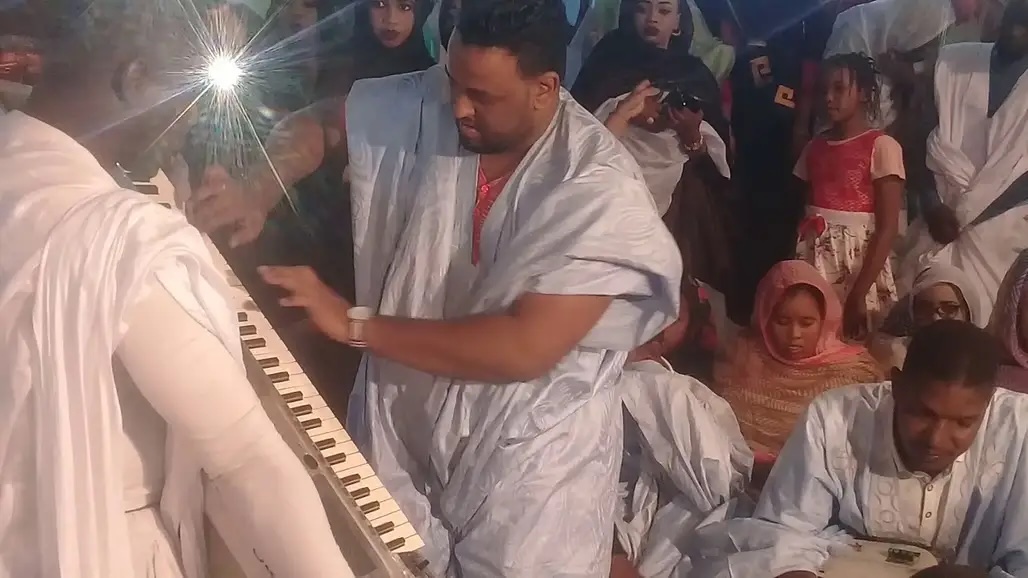
The northwest African country of Mauritania has Arabic as its national language, so Arabic musical practices should also not be a surprise. That history spans many centuries; this diverse, multiethnic country is deeply influenced by its Arab-Berber culture and Moorish heritage. Flash forward to our time, and that includes Arabic-specific keyboards. Ahmedou currently plays a Yamaha PSR-A5000, which the manufacturer calls “world music style” but aims at the Arab market; just remember that Cairo is about 5000 km away from Nouakchott.
But when I say play, he’ll turn it on its side, play with his elbows and forearms, and tear up this instrument at high velocities, only to nimbly pivot to delicate gestures. Here’s how that can look in action:
It’s part of a hugely popular music style, and Ahmedou is one of its great virtuosos. From the 2019 release:
Ahmedou Ahmed Lowla plays instrumental electronic keyboard in a style known in Mauritania as WZN, or in Arabic simply “music.” Born into a musical family tradition (his father is a renowned tidnit player from Traza), today Ahmedou Ahmed Lowla is one of Mauritania’s most premiere keyboard performers. Soundtracking lavish weddings in the countries capital, Ahmedou has earned a reputation for his evocative theatrics, accentuating notes with by playing with his elbows, or tapping the keyboard with his head.
I’m going to take umbrage with the use of “microtonal” elsewhere in the description, and the idea that it’s “difficult to place” — better to say that Ahmedou is a peak practitioner of this style!
There’s also this excellent joint outing with Jeich Ould Badu. Both of these releases are out on Sahel Sounds:
Instrumental synth and lute from the Sahara desert. Playful electronic drums combine with gothic tinged organ freakouts and quivering electric “banjo” to create an anachronistic trance music. Mauritanian WZN (literally “instrumental music”) has emerged as pop music, blaring out of taxi cabs and cassette shops throughout the country. These are two of the genres biggest stars: griot Jeich Ould Badu, playing a hacked traditional lute with built in phasers and pre-amps, and synth wizard Ahmedou Ahmed Lewla, on an Arabic scaled pitch bending keyboard. Hypnotic and infectious, transporting Mauritanian classical music into technological futures, like a drug free baroque rave under the open air of the Sahara. Originally released on cassette, this is the first international release ever of the celebrated regional genre.
From 2021, here’s a salon in Nouakchott, which in the midst of the pandemic they broadcast all the way to Katowice’s Tauron Nowa Muzyka Festival.
We got to catch a live recording session at Morphine Raum, the space run by Byblos-born, Berlin-based Morphine Records mastermind Rabih Beani. From the description for that event:
After the overwhelming success of his debut European tour in April 2019, where the larger-than-life personality and dedicated gun nut created havoc everywhere he played, shredding the keyboard with his elbows and head, he will be finally back after 5 years of waiting – ready to take the big festival stages or to rock the shack in your backyard! Expect a wild show to watch out for, or like the good people of Sahelsounds put it: “Ahmedou Ahmed Lowla transports Mauritanian classical music into technological futures, like a drug-free baroque rave under the open air of the Sahara.”
So this does mean that while my recording links here are a bit dated, more is inbound. I can’t wait.
MZN is instrumental; for some vocal music from Mauritania, I found myself listening to this. Notice there, they pick up a GEM WK workstation keyboard; it’s also an Arabic-focused arranger keyboard that once competed alongside the likes of Roland, Yamaha, and Korg. (GEM was a range of the now-defunct Italian maker Generalmusic.)
And yes, dear music manufacturers, this should be your clue that the market for this is best understood as global, via diasporic music and interwoven musical practices, plus the curiosity of musicians around the world. We’ve seen a gradual shift in that sense from keyboard makers, at least, but maybe what’s missing then is greater access to this functionality. And we should all give the music a good listen — in person, if we’re lucky. Here’s looking forward to more tours from Ahmedou, for sure.
Thanks to Amber Amber for the recommendation.