Tom Oberheim may be in retirement, but the instruments and his legacy are just getting started. Artists are rediscovering vintage classics, and instruments like the new TEO-5 are taking off. So to celebrate his 89th birthday, here’s a recent conversation with the man behind that famous synth name.
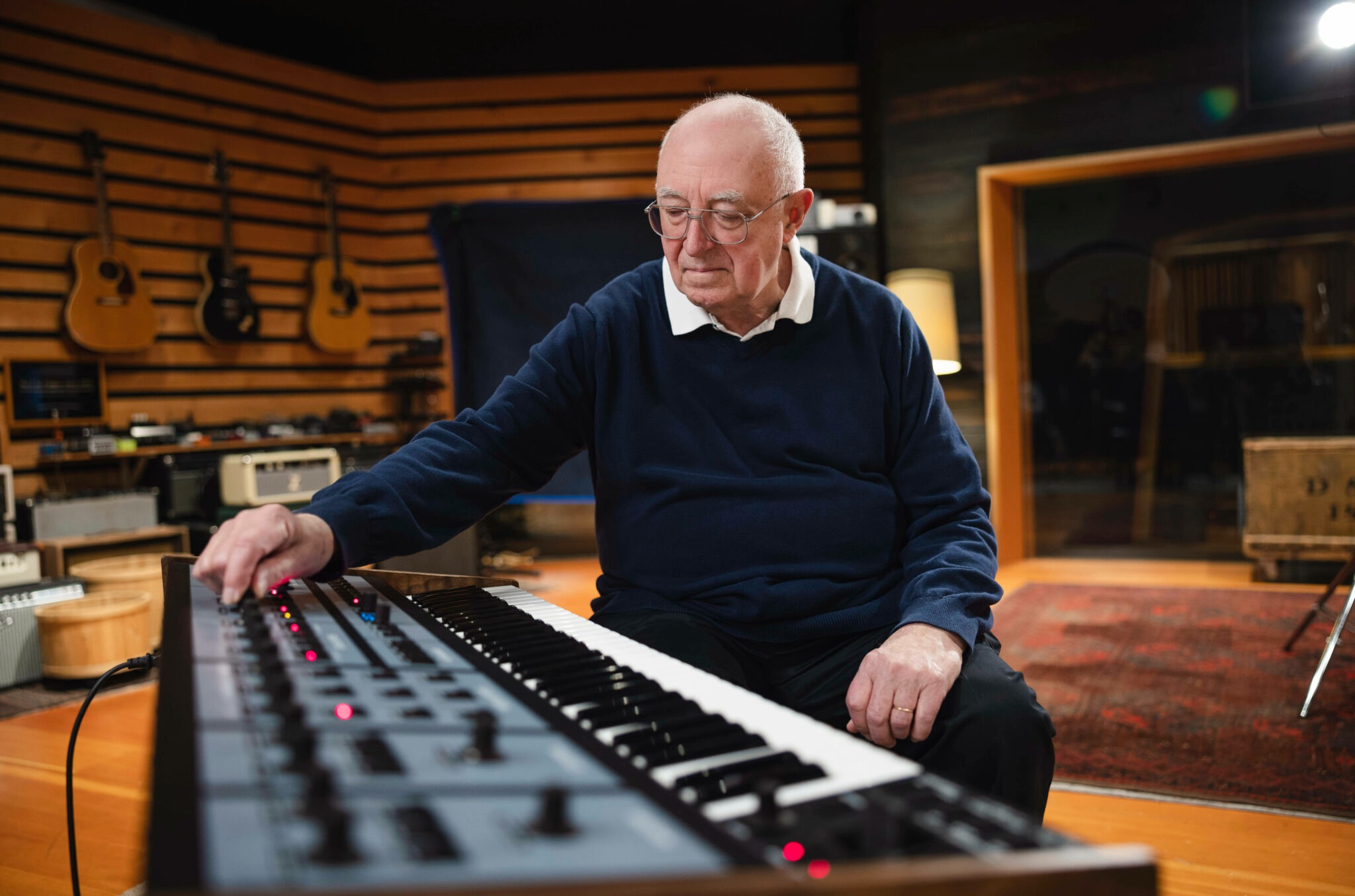
Tom Oberheim is “slowing down,” he says, as he’s passed the torch to the folks at Oberheim (now part of Focusrite alongside Sequential), plus software editions of Oberheim classics at GForce Software. That’s meant time to build a garage studio for himself where he can play, flirting with big band arranging, and now doing a lot of listening, including getting to some later Miles Davis records. (Chick Corea had an Oberheim ring mod starting in the 70s; by the 80s, Miles had an OB-Xa. And like many a synth lover, he didn’t read the manual, but it wound up on the record, as you can follow in anecdotes collected for Allen Michie’s review of volume 7 of The Bootleg Series.)
“My first thought is not, is it an Oberheim. My first thought is, oh, I love synthesizers,” says Tom. “You know, it doesn’t really matter that every time I hear a great synthesizer sound, that it could be mine.”
Of course, a lot of those great sounds do come from instruments that bear Tom’s name. And he has a singular perspective on how instruments have evolved, from Oberheim and the other industry figures he’s known, and how his original designs have found new life with new generations. I had the pleasure of speaking with Tom via Zoom a few weeks ago. We wound up chatting about a lot of things, including his recent fascination with listening and immersive sound.
Oh, and Tom’s current project is a return to what he did before synthesizers, engineering computers–with a relay computer he’s building in his garage.
It’s perfect timing to hear Tom’s reflections, though. You can pick up a hardware TEO-5. Or in software, the GForce TVS Pro just came out, a software rendition of an ultra-rare instrument, re-released just after the SEM re-release. But far beyond that, just hearing how Tom thinks about instruments and his career is always engaging.
I’ll leave Tom’s words here on his own.
Meanwhile, pour yourself a glass. (Pictured: former Oberheim engineers Marcus Ryle (co-founder of Line 6/co-creator of the ADAT) and Tony Karavidas, with Sequential’s Dave Smith–pour one out for Dave.)
Interview
Words: Tom Oberheim
May 2025
How it started
Tom: The interesting thing was to live through that age. I got in the business pedals starting in 1970. I knew about synthesizers because I was good friends with Paul Beaver, the guy in LA who really brought synthesizers to the West Coast.[Paul Beaver was half of Beaver & Krause, R.A. Moog Co.’s West Coast sales reps, known for putting out The Nonesuch Guide to Electronic Music.]
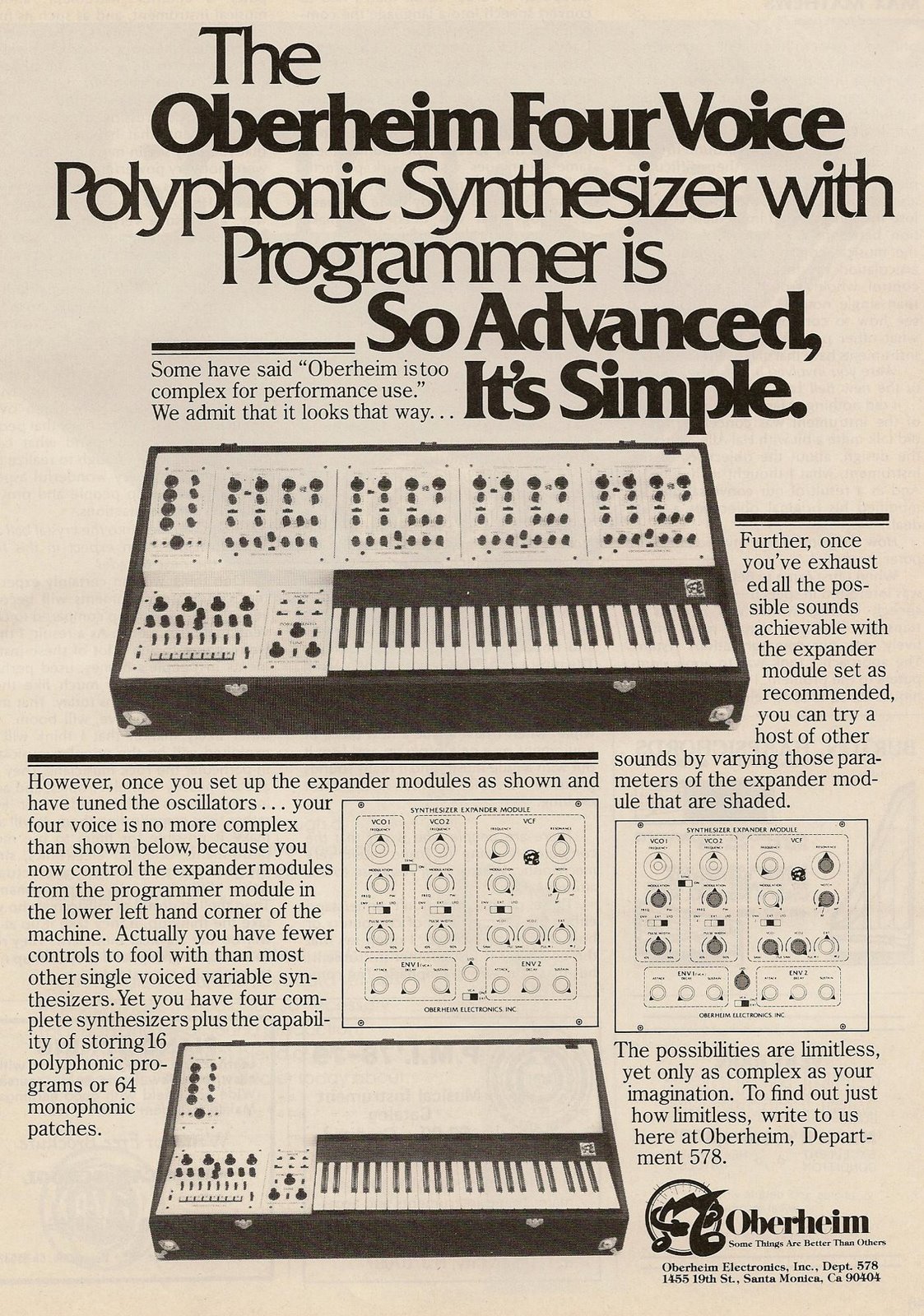
I was never planning to get into the synth business because my pedal business was doing well. I came out with this little expander module called the SEM. I was really not thinking that would be a big thing for me. But then, the company buying the pedals cut me loose in January of ’75, and I had to look around and decide what to do, and I had the SEM. I decided to do the Four Voice – I designed that in five months and showed it at the NAMM show and went from there.
In a Synthy Way
My experiences started out with more of the jazz people. They were starting to do electronics, thanks in some respect to Miles Davis, several years before it became a steady thing in rock music.
Dave’s [Sequential] Prophet-5 really lit a fire, lit a rocket. I had to answer that because my 4-Voice and 8-Voice had been a nice income stream from 75 to 78. But by the end of ’78, it had pretty much gone to zero. And in response to that, we did the OB-X… then the OB-Xa, OB-8, Matrix…
But I enjoyed it. The year after I lost my company, Dave’s first company went away. Roger Linn’s company went away. And for a while, the market was pretty much dominated by workstations and digital machines. And analog was pretty dead in the 90s. But the amazing thing was that thanks to the dance crowd, it came back with a vengeance.
Dave’s [Sequential] Prophet-5 really lit a fire, lit a rocket. I had to answer that.
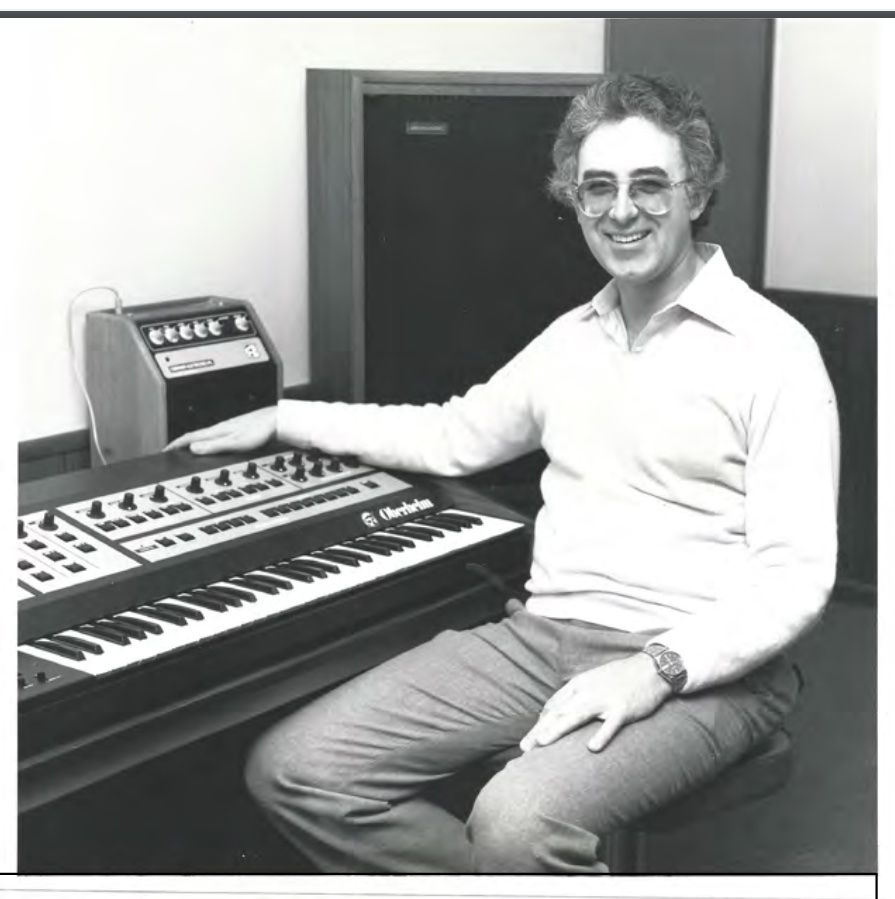
Tom (probably at the Oberheim office on 9th street in Santa Monica) in 1979. Historical photos courtesy Oberheim / Notes: Marcus Ryle.
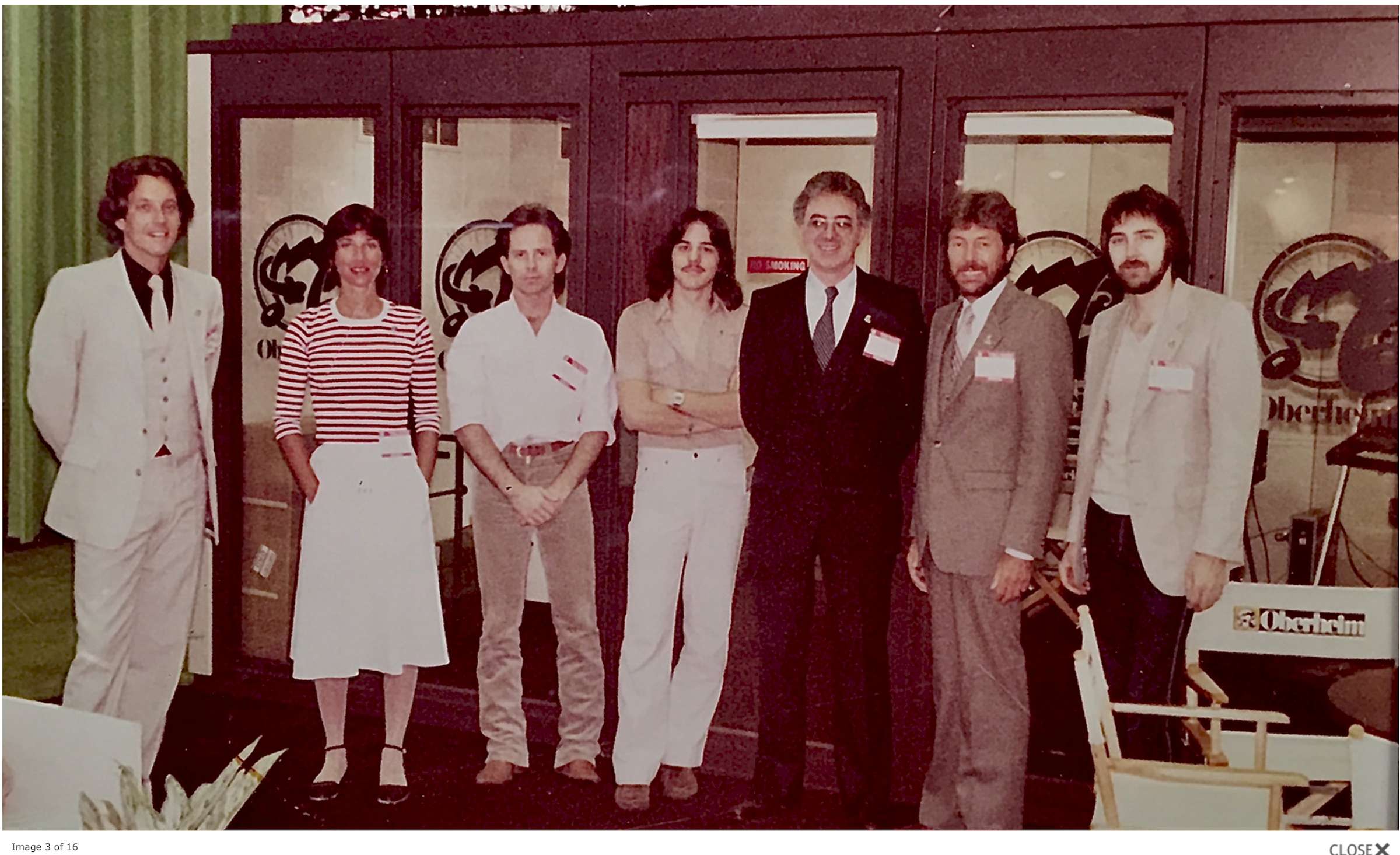
McCormick Place in Chicago at the Summer NAMM show, June 17-30, 1981. Left to right are Gordon Rudd, Lisa Lagattolla, Geoff Farr, Marcus Ryle, Tom Oberheim, Russ Jones, Woody Moran.
From SEM to Two Voice, Tom’s engineering contributions
That’s my baby. The Two Voice is my baby, because it’s more my design from outside in than any other Oberheim. The original SEM, Dave Rossum did the oscillators, and Dennis Colin, who worked for ARP and designed the 2600 did the SEM’s filter, and then an engineer that worked for me did the envelopes, which are pretty much like the Minimoog envelope generators. My pride in the SEM is, I’m very pleased with the front panel layout. And of course, I learned synthesizers on a 2600, so that’s my influence.
The 2-Voice is my baby, because it’s more my design from outside in than any other Oberheim.
When the engineer who worked for me and I put together the first SEM prototype in 1974, with the oscillator and filters from these geniuses, I didn’t really design any electronics except the power supply. But I did have an opportunity, and felt the need to work for about a week with a soldering iron and a bunch of resistors, tweaking the signal levels throughout the SEM. I didn’t really like the way the prototype sounded when we first started. So by ear and with my trusty soldering iron just trying signals–there wasn’t really anything scientific about it. I was just trying it until I got it the way I liked it. So that’s my main contribution to the SEM.
TVS Pro and GForce’s software
When I did the TVS Pro, I finally got around to actually designing something that had to do with MIDI. [laughs] I was on my own. I needed to have a MIDI-to-CV converter, so I designed that myself. If a software engineer looked at my code in that, he’d scream bloody murder. It’s horrible code, because I’m not a software guy. But I really was proud of the Two-Voice Pro. And now I’m happy to see that our buddies at GForce have made a simulation. And I’ve had a chance to play with that. That was the first plug-in of an Oberheim thing I’ve had a chance to try, because I really didn’t have a studio until a year ago.
At first, I play a lot of the patches, and it doesn’t sound so much like a Two Voice, because it’s got reverb and delay and all this stuff–which sounds great! But I did find a way for my own purposes where I could turn off a lot of stuff, and it sounds like a Two Voice. It does. It’s amazing, but it does. It sounds great. So I hope GForce does well with that.
My first thought is not, is it an Oberheim. My first thought is, oh, I love synthesizers.
Roger and Tom and coffee
I got into building electronic music devices starting in 1969, 1970, because I’d had 11 very intense years in the computer business, where eventually I was actually designing complete computers. This was before everything was on a chip; you had to have a chip for each flip-flop and each logic gate and whatever. And after 11 years of doing that, I was totally burnt out. So getting into electronic music was like a hobby for me.
In Roger Linn’s case, he invented the machine [the drum machine] and pretty much people followed his line. So he was coming from a different place.
Roger’s another one of our group of geniuses. I don’t put myself in that group, but I seem to be in the group anyway.
Coincidentally, I got a job at UC Berkeley, and Roger moved to Berkeley from another area. I said, ‘Let’s have coffee.’ And we started having coffee. And then it was like, let’s invite so and so. And the thing went on for like ten years. People come through town, they’d be invited. We got a regular group with Roger and me and John Chowning [originator of FM synthesis]. And the joyful thing for me was, I would pick up Max Mathews, who invented computer music at Bell Labs, from the BART station and take him to the coffee place. But we had a good time.
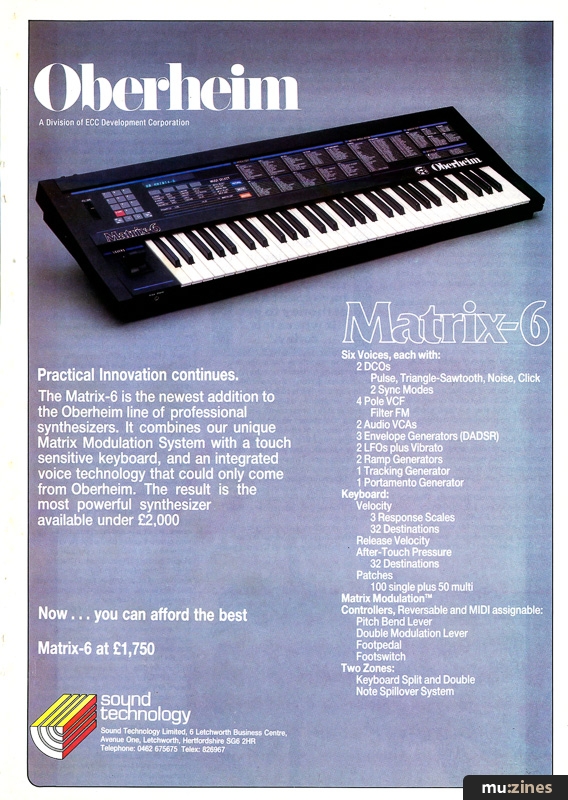
Page: 51, Electronics & Music Maker, Jan 1986 – from mu:zines
Back to computers
I’ve had a great career. I sometimes feel I should get back to my lab in my garage and do something now. But then we’ve got younger people to do that now, so I’m pretty content. My only project I have going now is a machine that has zero commercial worth, and that is building a small computer out of relays.
And it’s amazing. It sounds like a crazy idea. They’re of no use other than a curiosity because instead of a million instructions per second, it’s three instructions per second.
On the latest Oberheim TEO-5
They did a fantastic job. I have one of the prototypes, and it sounds terrific. The price is very good – of course, we don’t know what the price is going to be in the future [for US sales, with the tariffs].
Where synthesizers could go
Taiho and I had coffee the other day, and we’re always talking about where it’s going. I don’t have a clue of what’s next in keyboards. There are some hints; it’s a project that’s been going on for 30 years, and that’s to make these keyboards performance machines. It’s a musical thing where you have to learn musical performance things to make them valuable. And that hasn’t happened with too many of those ideas.
I would wish for a more logical way of combining the technologies. In other words, it would not be something that would be new. We had analog, and then we had FM, and over the years, different companies have tried mixing the two
Just to get closer to whatever it is that affects our bodies that makes us love music and makes us excited–whatever we can do to expand that. My mobility is such that going out to concerts and such is a problem; I’m losing my balance. The last time I went to the San Francisco Symphony, they did the full ballet score from The Firebird. That has an amazing climax–120, 130 players playing as loud as they can. And everything works.
The only thing I think about is just improving the art where it’s closer and closer to that excitement you get hearing that orchestra, and there’s no electronics there at all. Expanding the experience.
Everything old is new again
The fact that all the old Oberheims and Sequentials have come back–you have to be careful, because you go too fast, and it doesn’t work.
By that I mean, in the early 80s, there were a lot of expectations about the DX7. I was at the NAMM show talking to an engineer from another synthesizer company–not Sequential, but another one. This was ’82, ’83. And he said, Tom, you know this Yamaha thing is going to be so great, why don’t you just save yourself a lot of money and shut your company down now, because it’s going to kill you off, right?
In fact, from ’82 to ’85, Oberheim sales increased 50% every year. It was very simple: the DX7 kind of legitimized synthesizers. It made it so it was a more acceptable instrument. But of course, then FM went on the back seat, and analog came back.
It’s part of our industry that doesn’t happen in the cell phone industry. Analog’s back and it’s great.
You have to be careful, because you go too fast, and it doesn’t work.
People, not tech
I wouldn’t say I know every Japanese engineer who has worked at Korg or Roland, but I’ve met a lot of the people over 50 years that have done synthesizers, and it’s always been a fun thing. I love the whole–I won’t call it an industry, but the conglomeration of companies that make them, and the people I’ve met. It’s like, you know, painters today, a lot of great artists still use oil paint or watercolor. It’s interesting to hear people playing synthesizers and doing great things with them. But I don’t see it as a result of technology.
Over the years, it’s always been fun to go to the NAMM show or Messe [or Superbooth]. The really great ingredient of being in this business is the people you meet.
More thoughts from Tom
Tom has gone deep into this history before. With the now-defunct Red Bull Music Academy, he did a deep dive into his sound and contributions:
And he joined Dave Smith and Marcus Ryle at Superbooth for a Superpanel in 2022:
New hardware and software with Tom’s name
Oberheim TVS Pro @ GForce Software
And a very happy birthday to you, Tom. Thank you.