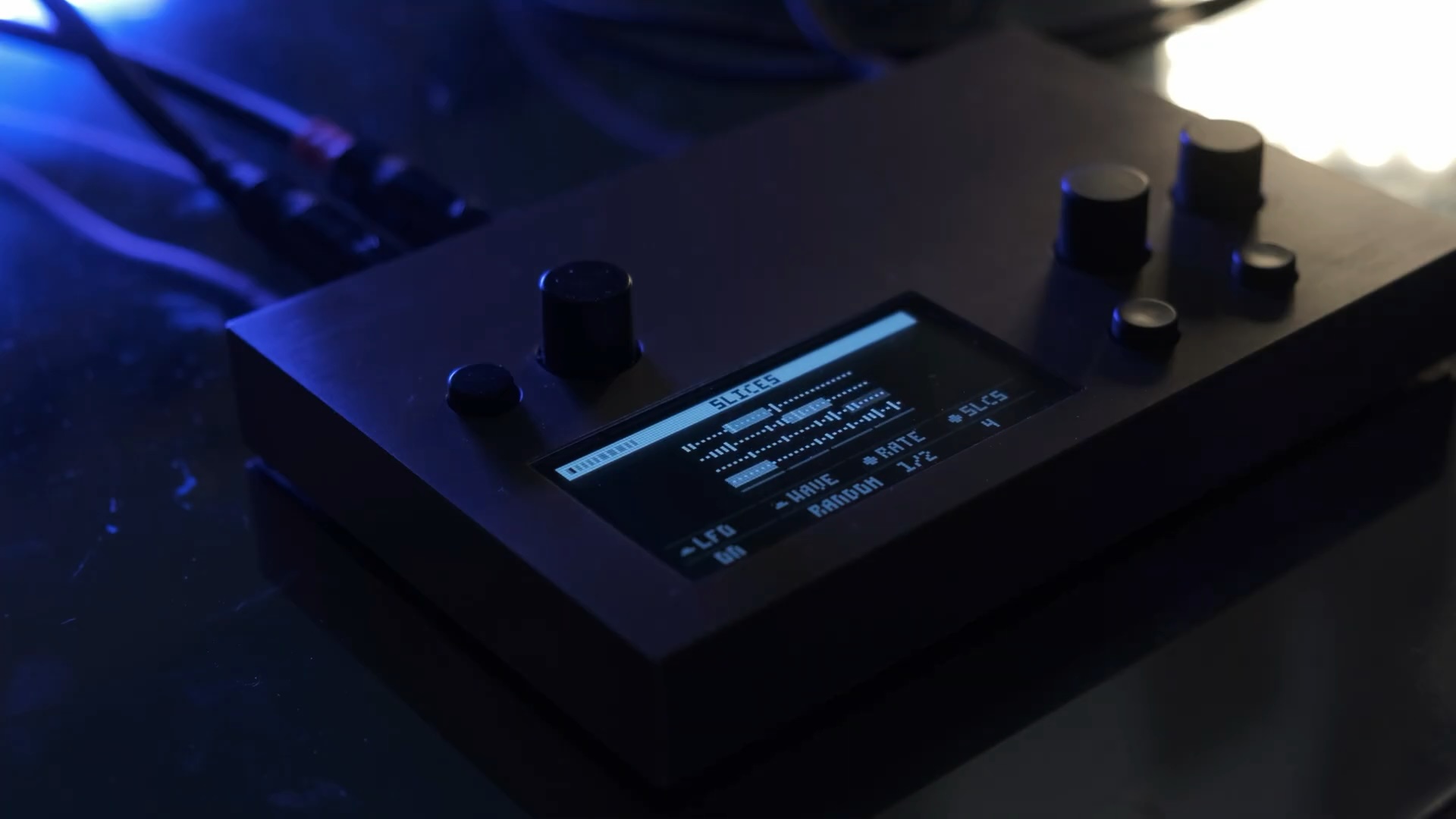
In its bones, Eterna for monome norns returns to some of the original success of monome: doing imaginative, intuitive, musical things with slices. A single audio file transforms via 6-voice sampler/sequencer and 12-page interface into everything from delicate ambient textures to detailed grooves.
Without taking away from the hard work people do across the industry, I think it’s fair to say some of the best ideas right now come from independent shops and individual artist-engineers. All of the major grooveboxes and sampling machines from the big makers are based on repurposing old ideas. They’re great — don’t get me wrong — but they’re designed in a mold of interaction from something that came before.
Etsuko here has done extraordinary work in designing something that’s far more focused — compositional, even. It’s a tool you can pick up and use, but its minimalism is thanks to creating a point of view. And watching it in action gives me the same twinge of excitement that I felt when I first saw mlr, the Max-based sampling app that made the monome take off as a community movement. (You could also argue that indirectly, the mlr/monome combo was what drove Novation Launchpad and Akai APC, Ableton Push, and Native Instruments’ Maschine, plus everything that followed those.)
Flash forward a couple of decades, and now this community effort can work on the canvas of a single, integrated piece of hardware/software. (The monome was essentially just a controller for software.)

Eterna is delightfully designed, a full hands-on 6-voice sequencing instrument. The sampling engine cuts the sound into slices, arraying those slices across the six voices. An envelope/lowpass gate on each lets you then sculpt the slice/voice, with per-voice playback rate (and reverse). (Oh yeah, top tip to anyone complaining “why haven’t I got on CDM?” Does your product feature an LPG? That’s the key. There is no other feature about which I have such a positive bias.)
You get extra features in filters and echo, which let you do all sorts of pretty gestures, and useful stuff like a compressor, but it’s not overwhelmed with features. It’s really best to just ignore what I’m saying and watch the musical examples. And maybe that’s the point. Etsuko aka Ruben writes us that his background is in music composition and technology, as well as work in both production and software engineering. The payoff to all that experience is being able to employ software and UI/UX as part of a musical experience. It’s as fundamental to what we do as someone learning to tune a harpsichord or hammer percussion. (Delawhere also contributes to those beautiful samples you hear in the video.)
The monome folks were equally impressed; they shared this project a couple of weeks ago with the praise, “we never cease to be amazed at the phenomenal instruments imagined and created and shared.” And come to think of it, soon we should do a check-in with what’s happening with other folks in the monome and norns community. Another hint: you can email me directly by combining “Peter” with the domain of this site.
To find the project, there’s a discussion on monome’s excellent lines community/forum:
https://llllllll.co/t/eterna/73584/3
And the download, GPLv3-licensed code, and full documentation are over on GitHub:
https://github.com/etsuko-fm/eterna
By the way, monome norns is open source hardware, meaning if you can’t afford the full hardware project — or are just curious to hack your own version and design your own personal enclosure, etc. — you can absolutely make that happen:
https://monome.org/docs/norns/shield
norns runs are still a thing, though, at around $900. Here’s a refresher from the launch, which feels just as relevant if not more so these seven years later: