The best of show at Superbooth 2026 is an easy pick. Bastl Kalimba, with its combination of acoustic and physical interaction with fluid digital synthesis and sensing, is a triumph of instrument design.
Czech-based Václav Peloušek, also known by his artist name Toyota Vangelis (with the mystic automaker merch to match), is really onto something here with his team at Bastl. It’s not so much that instrument design is back as some of the industry has strayed from those core ideas. There’s no reason electronic musical instruments need to lack physical interaction, or to erase or totally flatten tradition. The truth is, just as we’re finding new ways to riff on the keyboard and keyboard instruments, there are basically endless possibilities for what we can invent here.
And people are getting the message. As I write this, the Kickstarter campaign is trucking toward three-quarters of a million euros — it had blown past the original goal by ten times before Superbooth even wrapped.
Just as big-data AI is removing physical interaction, automating music, and imposing sameness, electronic instruments can do the opposite. They can come back to physical interactions and expressive, creative weirdness that’s all your own.
African thumb pianos go by different names in different cultures and variants, but in some version, this instrument is thousands of years old. The metal-tine approach, even, dates back around 1300 years. Going into the full depth of the instrument’s colonial history is probably a must at some point, but suffice to say few instruments on the planet have the history of this class of inventions. And because human hands are shaped and sized the way they are, and we’ve evolved opposable thumbs, it’s going to be tough to ever top the mbira’s handheld, left-and-right thumb design. (Bastl wisely kept the two-directional, interlaced pitch structure, including when you play the Bastl Kalimba in other tunings.)
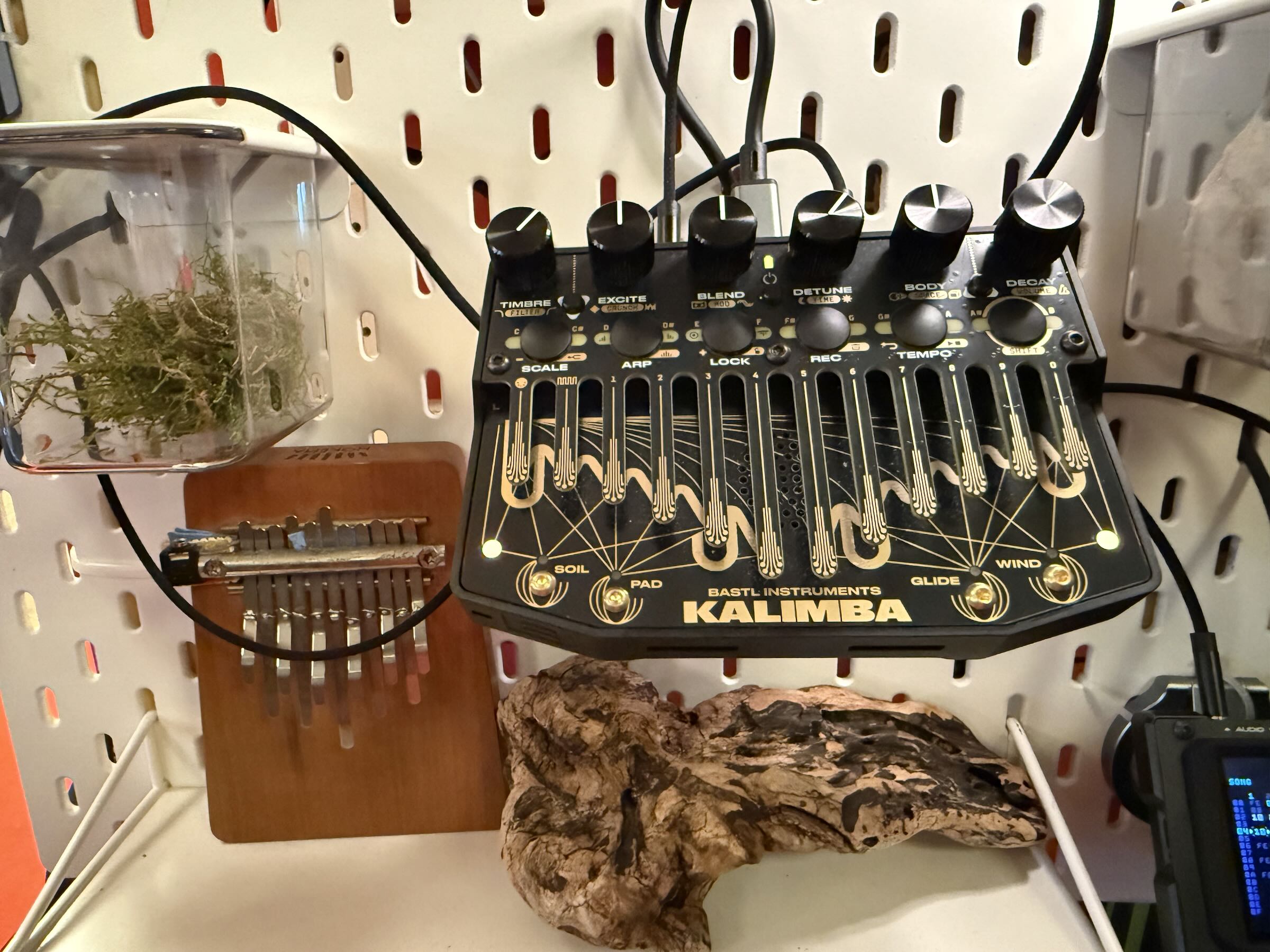
The clever twist in the Bastl Kalimba is that the titular metal tines are acoustic interfaces but that the sound engine itself uses digital synthesis. So Bastl Kalimba has several components:
Interface. Internal mics plus touch-sensitive areas. Just as with home-brewed contact mic devices, you can also strum and strike the case and tines. That lets you pluck it (kalimba style), touch it (like, uh, electronic touch instruments), or knock it (like percussion).
Sensors. There’s also an onboard accelerometer, plus four touch points on the front (owing some history to Buchla and the like), and two assignable touch points on the back — just every part of this you can play on, if you choose. (The assignment bit is important, because as I said the engine is digital, not acoustic.) And so you can rotate and make gestures with the device to interact with the onboard engines.
Encoders plus shift function. All of this was really intuitive, though — six dedicated parameters you can turn, plus another six via shift function.
Digital engines. There’s both an onboard physical modeling engine and an FM engine. That exciter + physical modeling engine means that this is closer to creations like the work of CHAIR Audio team than the KORG phase 8 “acoustic” synthesizer. Actually, I think the only thing I miss on this thing is that I wish there were an experimental mode that let you pass through the live input (maybe via a separate audio out), but … I totally get why that’s not there.
What’s interesting about that — and you’re aware of this the moment you start playing it — is that the Bastl Kalimba is almost the inverse of the Korg phase 8. Yes, both have metal tines — but that’s about it. They share this interest in physical interaction and acoustic design, but they sound completely different. On the phase 8, you play with resonance and the pickups and the acoustic sound. On the Bastl device, you have more precise touch-sensitive controls but an entirely different sound built by the engines. (There are even tricks to avoid feedback in the acoustic sensing activation.) The phase 8 requires manual tuning, too, though that to me is also interesting. I imagine they’d be a nice contrasting pair to include in a set. I just want to clear up any unfair comparisons.
Smart functionality and connectivity. Here’s really where it comes together. There’s an arpeggiator. There’s an onboard looper you can layer on, with some time stretching and 90 seconds. There’s octave up/down pitch adjustment. There’s a tempo/metronome. There are onboard effects (reverb, delay, bit-crush, overdrive, filtering, and modulation are all mentioned). This thing has all the Bastl-y goodness for performance you might expect, and it’s a practice companion, to boot. It’s meant to play. It’s meant to jam. It’s meant to take out live. Plus:
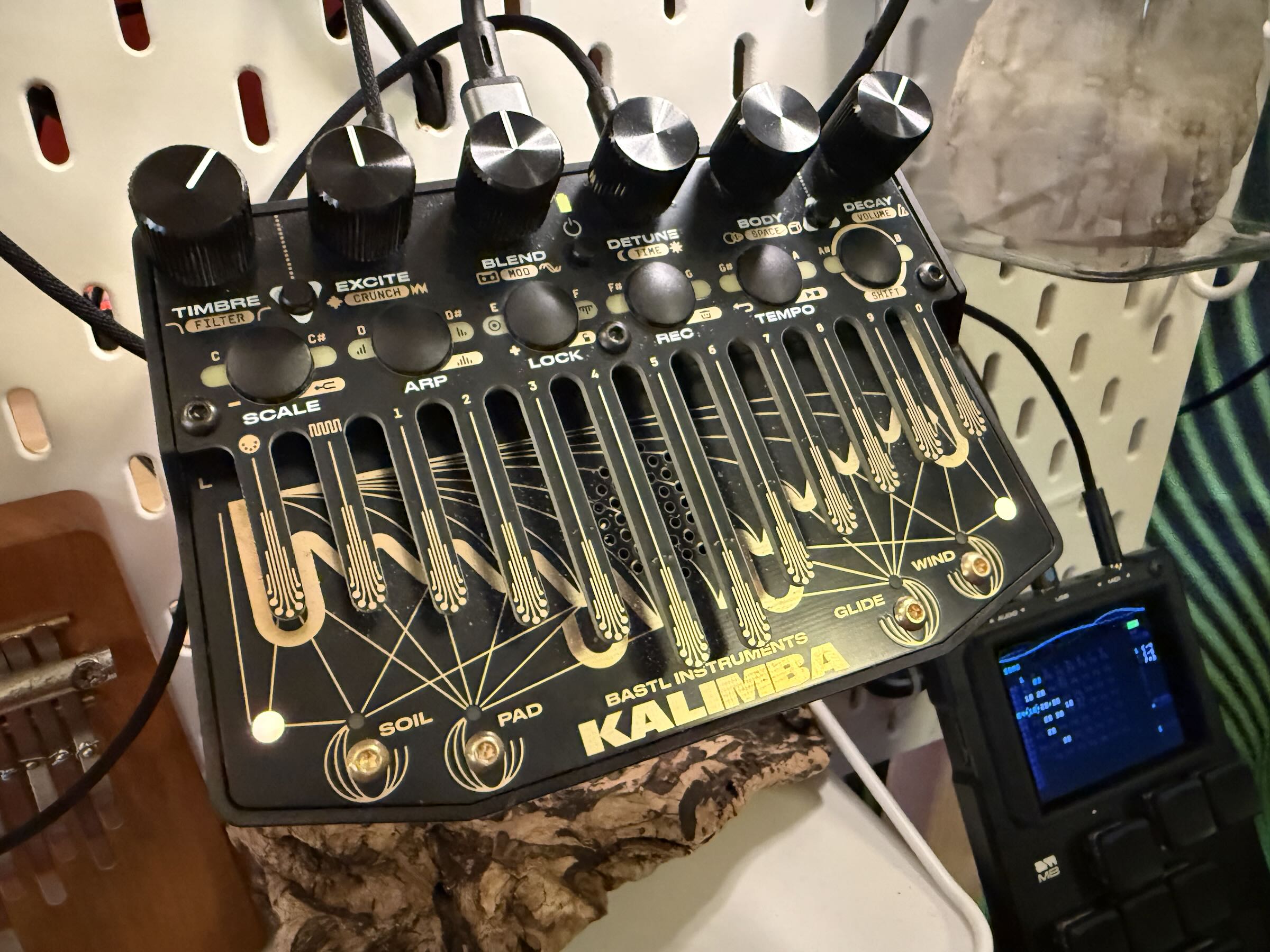
- built-in speaker
- rechargeable battery (you have to carry this on airplanes, but don’t put your Bastl Kalimba in a cold hold anyway!)
- USB-C power (and data — their stretch goal was a Web editor, so that should be coming)
- MIDI in and out (on minijack TRS type A and USB-C)
- analog clock input (plus the midi out can double as analog clock out)
And it weighs just 310 grams. They’ve also got a hardshell carry case for it and a bunch of different accessories, depending on which version you get.
There’s also custom scale and tuning support, which happily is not restricted to 12-tone equal temperament Western common practice grayscale. No, I met up with Hany from the Beirut Synthesizer Center, also a Prague neighbor of Bastl’s, who packed this thing with a bunch of original Arabic maqam tunings. (That personal touch matters, too, because there’s no Official Book of Maqams; it’d be like trying to standardize cooking. My grandma made it differently than your grandma. My grandma also probably made it better than yours, but we can settle that another time.)
Oh, and a lot of other great friends like Oliver Torr and Never Sol were involved.
Early bird is still up; ha, I hope they can make all of these. Starts at a deeply discounted 389 EUR, with nice bundles and swag available.
And they made a big documentary, too; I’ll leave you with that: