If there’s a throughline in Gigi Masin’s releases, it’s an aquarian presence – water often appears on album covers, and there’s a liquid quality to his playing. You can hear the elements (his debut is called Wind, after all) in his music, but water – still glistens, crashing waves, gentle rain, pounding storms – lends itself particularly well to describing the sonic character.
David Abravanel
Water also presented Masin with his greatest challenge in 2007, when an exceptional Venetian acqua alta destroyed his equipment and archives. This pushed Masin toward the computer, and toward a philosophy he articulates beautifully below: use the digital utilities, but keep thinking analog. Masin moved forward solo and with beautiful and diverse collaborations – as Gaussian Curve with Jonny Nash and Young Marco, a stunning release with Deepchord’s Rod Modell, and most recently with Greg Foat and Moses Boyd on 2023’s Dolphin.
Movement, Masin’s latest album and first solo release since 2020’s Calypso, is out on Sacred Bones (home to similar hard-to-pin cult figures like John Carpenter and Alan Vega). The title is a mission statement: rhythm, long an undercurrent in Masin’s music, steps forward to drive these pieces, from the gathering pulse of the title track to the wobbling machine-funk of “Deception Dance.” It’s still unmistakably Masin — melancholy, romantic, meditative — but it moves. And, as he reveals below, even the album’s most convincing “acoustic” moments are something else entirely.
Masin answered my questions in writing, with a warmth and generosity reflecting his lifelong artistic passions. We discussed the discourse around what “ambient” even means, the complicated feeling of hearing yourself sampled in other people’s hits, the TEAC reel-to-reel that never leaves his side, South African jazz, and the white rabbit that may or may not come out of the magic hat next. Listen to Movement while you read.
Movement is a more rhythmic album than I’ve heard from you before. Was this a conscious choice to focus heavily on rhythm?
I have always loved rhythm, and I have often used it especially in concerts, but the idea of greater movement or dynamism was partly present in some songs in the past. Now I believe that there is a need to take a step forward and prevent ‘ambient’ music, which we really love, from becoming a road destined to be interrupted due to lack of imagination and beauty. I’m sure that there will always be people who like ‘ambient’ music as it is now. I live it much more as a life path, and it seems to me that instead of progressing towards the future, [ambient music] is still looking at itself in the mirror.
“There is a need to take a step forward and prevent ‘ambient’ music, which we really love, from becoming a road destined to be interrupted due to lack of imagination and beauty.”
For some of the tracks on Movement — such as “Movement” and “Deception Dance” — the rhythm doesn’t just underpin the piece; it dominates in moving the piece forward. Especially on “Movement” — it sounds like you did some compression tricks to really glue that piece together in a way that really makes it pop.
Even in music, there are experiments not only in sound but also in composing. It is certainly not easy to try to combine a style that is above all meditative and romantic with something more dynamic and pulsating, without being epic, I mean… This is not the opportunity to suddenly change my language, but instead a conscious attempt to update my attempt to be present to life and try to express my music by looking ahead and having fun.
There’s a significant amount of discourse over what makes something “ambient”. I think of Marc Weidenbaum of Disquiet looking at the difference between “beatless” and absent of rhythm/meter. Many of your classic tracks (thinking of “Tears of a Clown”) don’t have traditional percussion, but they’re certainly anchored in rhythm. How do you conceive of “ambient” music, and how does it relate to the music you make?
I am probably not the most suitable person to examine the question that you kindly ask me… Actually, my first album (Wind) is now considered an example of ‘ambient’ music, while when I made it I thought it could be a very Venetian version of something vaguely ‘jazz’ despite the presence of sequences made with a synth. Evidently the beat exists in me, and perhaps it has more to do with minimalism than with jazz (may purists forgive me!). Let’s say that I no longer mask the rhythm, but I try to give it space and reason for being within my music in a more evident way than in the past. I have always had some doubts about talking about ‘ambient music’ as if it were a precise type of music, especially because my introduction to contemporary music (Ligeti, Maderna, Nono…) thanks to the theater has given me fantastic encounters with unique compositions such as the soundtrack of 2001: A Space Odyssey, which in my opinion is beyond a ledger of music in general and for me the true ‘ambient music’ ante litteram.
Gigi Masin – “Tears of a Clown”
Where did the title “The Age of Sampling” come from? I do think of your music in the context of the postmodern aspects of sampling — how Björk sampled not your original “Clouds”, but To Rococo Rot’s “Die Dinge Des Lebens”, which heavily sampled “Clouds”. Eventually it ended up sampled on many beat tapes, and even in a Post Malone track. So, what’s your take on this age of sampling?
At first you are dumbfounded, but then the pride of having created something that has gone beyond the narrow scope of your world grows. It’s how they treat you when they use your music, which is horrible: with detachment, annoyance, as if it were absolutely natural that you, an unknown Italian, silently accepted the intellectual and musical superiority of those who use your music but have no intention of doing you justice. It takes you a while to accept the situation, because you really admire those who have used music sampling in a brilliant or surprising way, as a real artistic act, but on the other side you understand at the same time that it is always a good idea to have trusted lawyers by your side.
Gigi Masin – “Clouds”. Look no further…for that sample source.
And I have to ask — do you have a particular favorite sampler right now (software or hardware)?
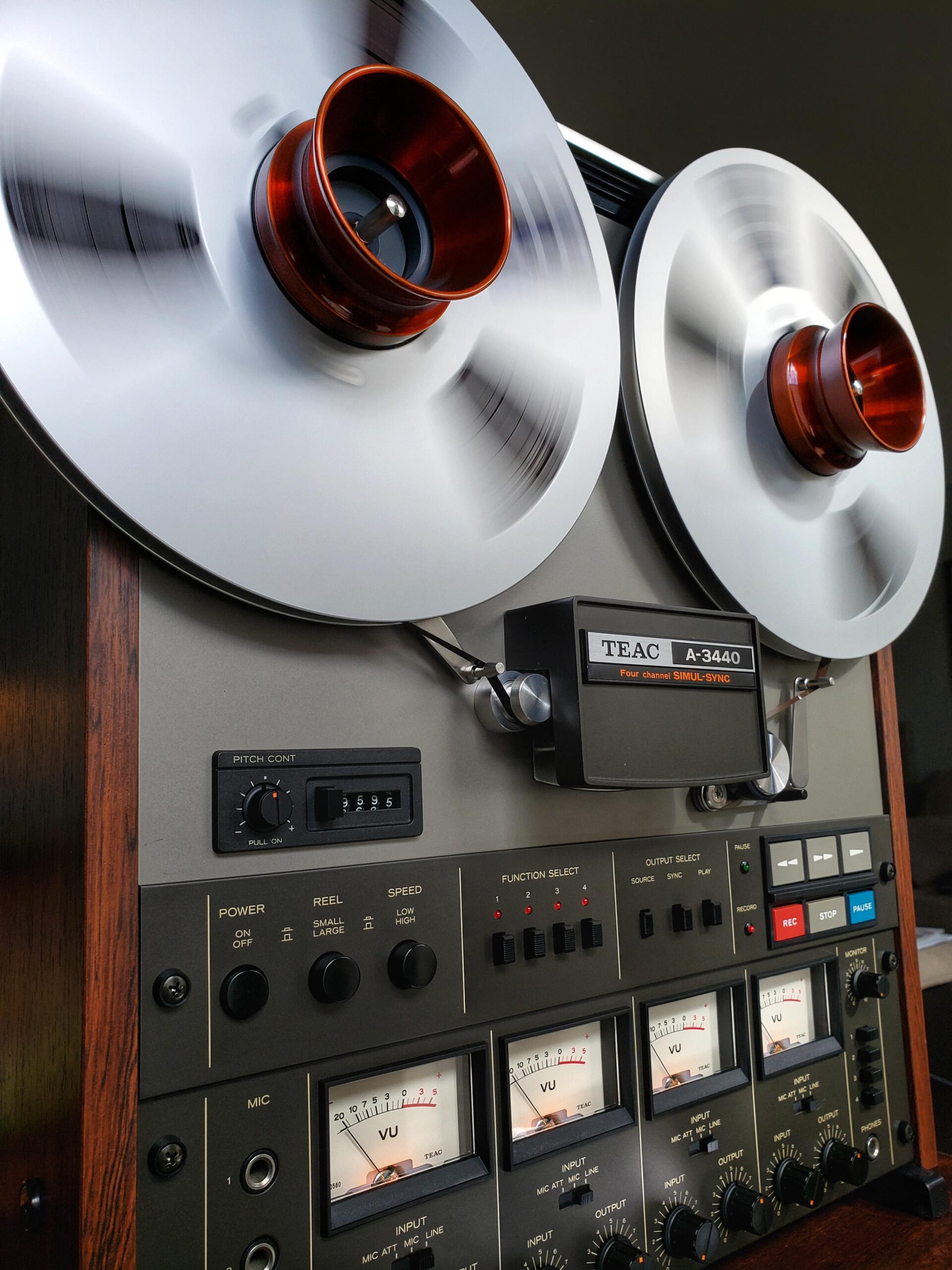
My lovely TEAC 3440 reel-to-reel recorder, a longtime old brother to me… At the time of National Radio, with a lot of patience, I learned on those Studer recorders how to create loops with reel tapes and adhesive tape. The fact that my music has been so intensely sampled both professionally and for fun has perhaps prevented me from having as much fun as I could with loops. I’m always looking for a new idea, a sound that represents me but at the same time fascinates me. I use loops from my music for concerts, but in the studio or in the recording sessions, it’s fun that I don’t like anymore.
You’ve made music with synthesizers for decades, so you’ve seen analog be in favor, then digital, then analog again, the advent of virtual analog, DAWs and plugins, etc. Are there any stalwarts that never leave your studio? Specific instruments or effects that you will always use, no matter what?
An exceptional high tide, in 2007, actually destroyed my sound equipment as well as all my memories. It was that moment when you decide to stop or start again, and then: start again how? A bit for my work at that time, I began to learn more about the use of the computer and the related technology, which I find fascinating but I avoid it taking me prisoner… There is some software that helps you make music without forcing you to do what they tell you to do… Let’s say that I was lucky enough to use, and still use, software that allows me to continue to think analog with the benefit of the digital utilities. Also, I believe that human thought is analog, that little electric current in our neurons and a lot, a lot of imagination.
It was that moment when you decide to stop or start again, and then: start again how?
For the focus on rhythm on Movement, did you work with any new instruments to facilitate this mindset?
At the moment I’m still using the technology that helped me make my previous records. I always tell myself that I should try to fall in love with some new keyboards but then I stay true to my world, where I probably feel safe.
How does your background learning classical violin influence your compositional style? Do you find that you approach creating music differently to someone who might have come directly from samplers and drum machines?
To tell the truth, my study of the violin was hurried and spontaneous, since I could not study it as a school path. That made me hate music writing a lot, you know, that sort of teenage rejection? It cost me a lifetime of determination and patience, but music has remained in my world with dedication and passion, even though I have not studied it to make it a classically official profession. Actually, the word ‘self-taught’ suits me perfectly. I think I am one of the most stubborn and long-lived representatives, since for me learning and studying is a human and ideological foundation. You learn by playing with other musicians, reading, listening, experimenting, and fantasizing. It’s a never-ending story.
Gigi Masin – “Lost”
There are some great showcases for acoustic instruments on Movement — I’m thinking of the saxophone that bobs in and out of the vaporous sound of “Lost”. Who played that part? And did you compose together with your collaborator, or had you already envisioned a saxophone part for that piece?
Really? Thank you… I am very proud of my sounds, voices, brass… I have lost many nights to realize them. I started from some sounds in some software, but then I slowly made them personal, and I often use them as if they were a part of me, a portion of my language that I could not do without. As in the best tradition, if there are no other names, I did it all.
The past decade or so, there’s been a real surge of interest in private-issue ambient and new age music. It seems like part of it comes from the ubiquity of media in the information age — it’s thrilling to hear great pieces of music that still require some work to find. Have you found it fun to revisit your classic albums in reissues?
When I decided to reissue my first album (Wind) years ago, it was a decision born from the deep regret of seeing the original copies of the album put up for sale by private individuals for sums of hundreds of Euros. If you think that that record was born not to have a price, it seemed to me a decent action to put copies back on the market at an accessible price. But in truth you are right: there have been numerous episodes of excellent music made in a private form, often with sacrifices not always known, which is a demonstration of passion and hope not to be underestimated… It is having the responsibility of one’s art and at the same time making it available to others, both as a means of communication and as an artistic gesture in the true sense of the word. How many writers and even how many directors have had to make the most of their economic possibilities to make their works, a private act that by becoming public could be the possibility of a lifetime, the realization of dreams and hopes?
Gigi Masin – “Movement“
On that subject, are there any particular records — by yourself or contemporaries — that you think really deserve another listen from a new audience now?
Of course, I would like with all my heart to give light and fame to all those musicians from South Africa who have taught Europe what jazz is and what the African musical tradition really is. I’m talking about musicians like Chris McGregor, Abdullah Ibrahim, Dudu Pukwana, of whom I have tried to collect as much as possible over time. A listening that is always fascinating and sometimes surprising… I can’t forget those musicians who for me are the zenith and nadir of music — I mean talents like John Martyn or Joe Zawinul, Eliane Radigue or Stephan Micus, to name a few… I am indebted, but we should all be, indebted to that flood of fans who have searched the markets or old shops for those forgotten records that have allowed us to discover beautiful and unforgettable things. The world is full of surprising and still partly unknown things; you have to cross borders and not stop at appearances, dig and then dig to find the gold mine.
Do you have plans to tour for Movement? How might you set that up differently to your previous shows?
There are already several concerts scheduled in the coming months: Europe, Japan, USA, China. How I love to travel the world with my music! Technically, I won’t change the set of my concerts for now, but certainly the music will not stand still and will not just repeat itself time after time. Everything is really in motion, and it is the necessary ticket for the future.
How did you come into contact with Sacred Bones? Has that been a different experience in terms of culture/audience for you?
I love collaborating with artists and musicians, so if I have to talk about my management, Alessia Avallone and her ‘Language of Sound’, I think it is the best collaboration that has allowed me in these 10 years to take important steps like that, in a world that is not always easy and gentle. I sincerely admire and am honored by the availability of Sacred Bones to my music. I am sure that it will be a decisive step to improve in the coming years. It is essential to measure ourselves against new challenges; every day is a good day to leave the old stuff behind and look forward with confidence.
What’s next for you? Are you keen to explore rhythm and motion further in your music?
If we really knew what tomorrow will be… I’m absolutely curious to see what will come out of the magic hat, whether a new project or the famous white rabbit… Having projects is essential, visions to realize, music and songs to sing. This is what I would like to do in the future. Change is not a lifestyle; it is an opportunity that we will have to seize, with open arms.
“Every day is a good day to leave the old stuff behind and look forward with confidence.”
Gigi Masin’s Movement is out now on Sacred Bones Records — his first solo album since 2020’s Calypso, arriving as Wind turns 40.
Gigi Masin – Movement on Bandcamp
Gigi Masin’s forthcoming shows on SongKick