Suren Seneviratne (My Panda Shall Fly) has been painstakingly cataloging lost software, oldschool patches, and retro musical practices, reviving old machines and software and breathing new life into them. But now, we get some classic Max patches, remade for the current era of Max patches. Download them for free, and listen in as Suren interviews Leafcutter John and John interviews Suren.
Beyond techno-solutionism and futurism, there’s another view of the computer — one where the musical practice comes first, and you save rather than discard sound experiments. In other words, everything old is new again. You’ll find a catalog of Suren’s work with the community of music makers at the ongoing project Missing Music.
Patches reborn
And that brings us to Max. Cycling ’74 connected with Suren and revived a select handful of beloved Max patches of yesteryear to bring them up to speed with the current Max. That project took nearly a couple of years, and culminuates today with the release of patches by jasch, jhno, Leafcutter John, and Lewis Keller, plus current artists making new work with them.
The original patches and their modernized counterparts:
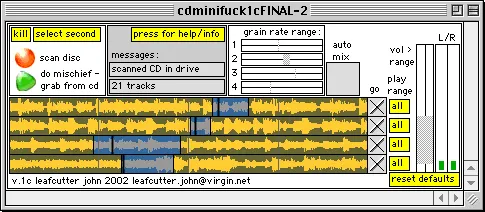
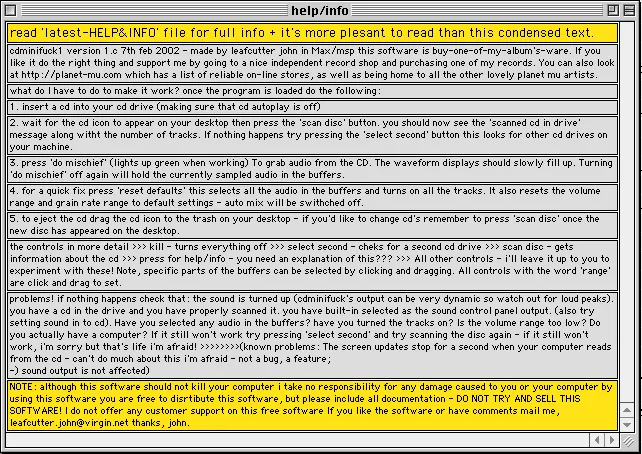
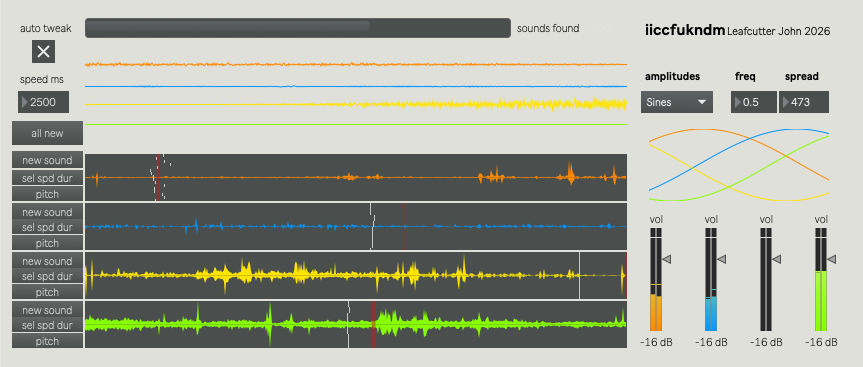
CDMF2026 by Leafcutter John:
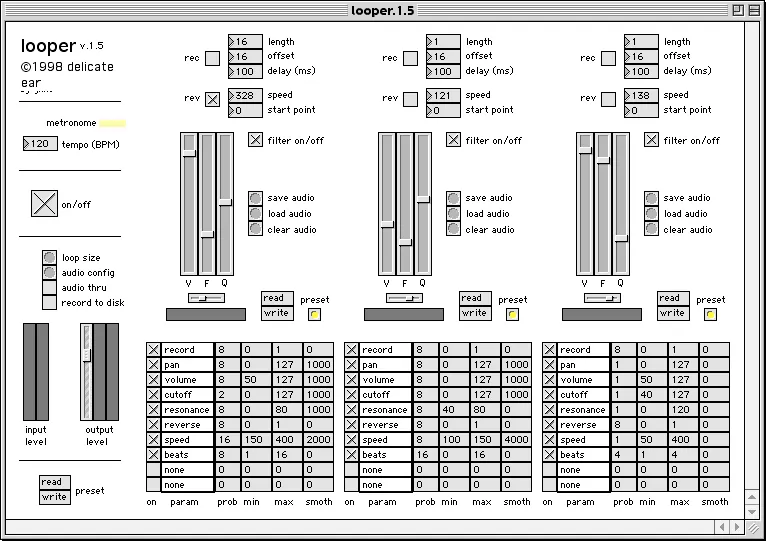
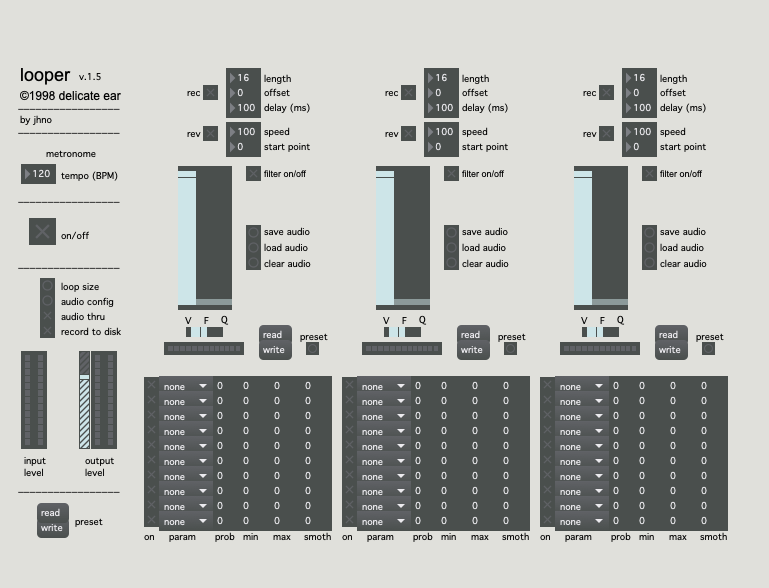
looper by jhno:
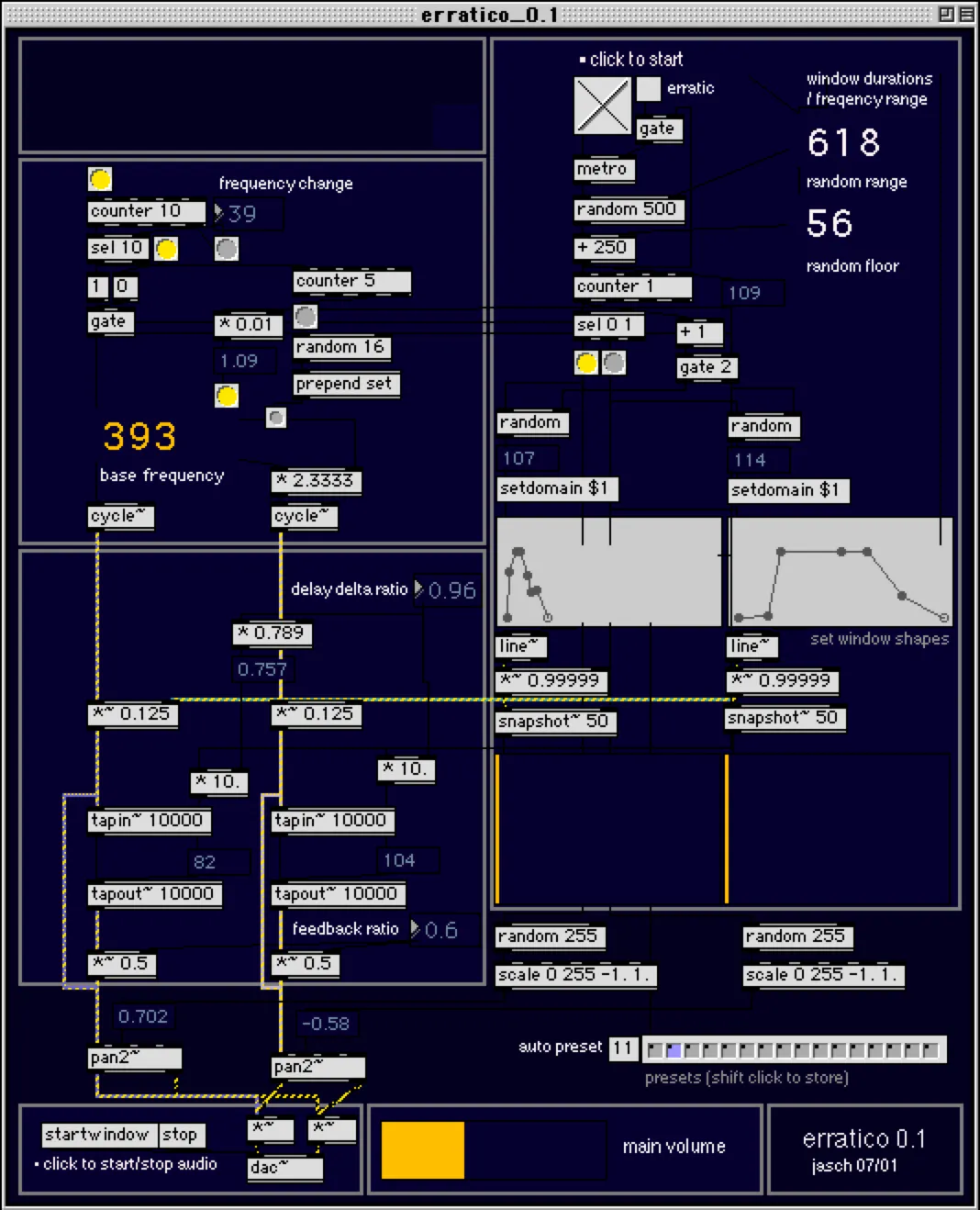
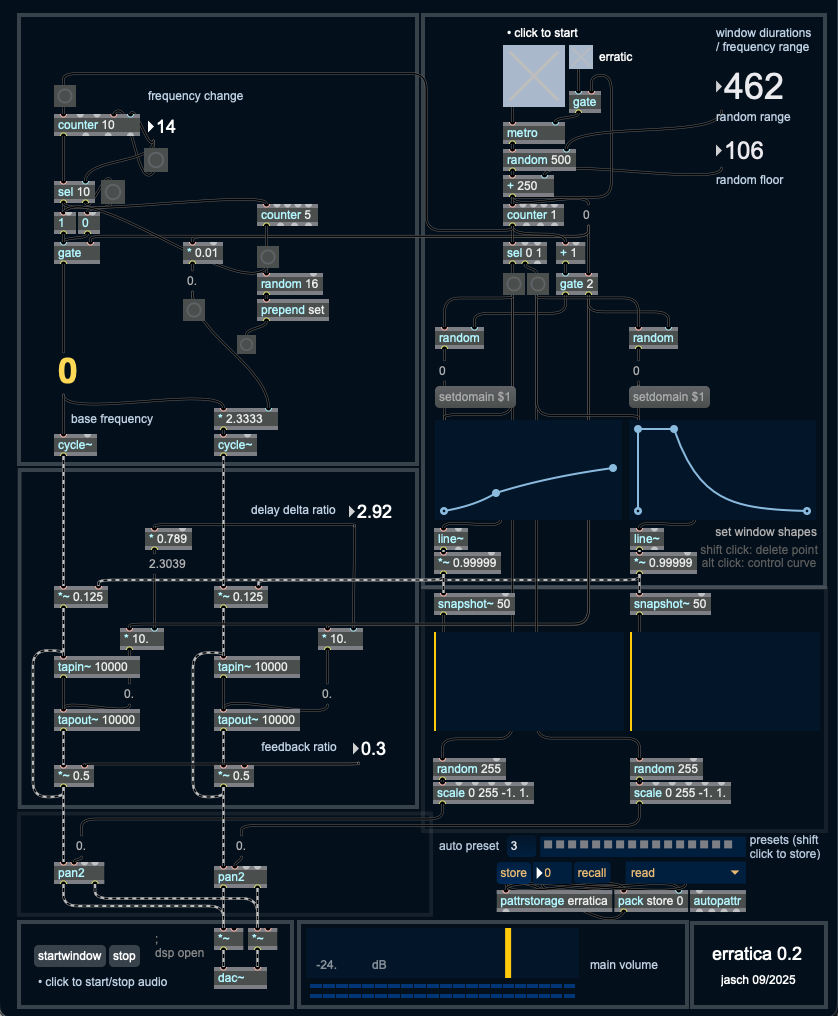
Erratica by jasch:
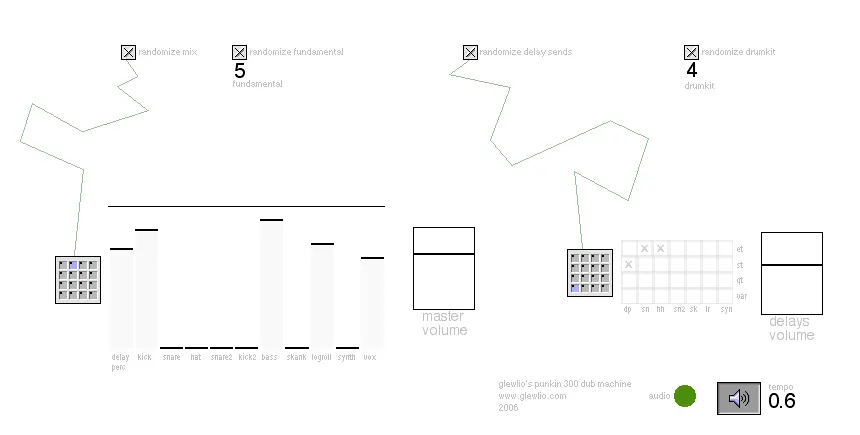
punkin300_2026 by Lewis Keller/glewlio (maybe the closest visually!):
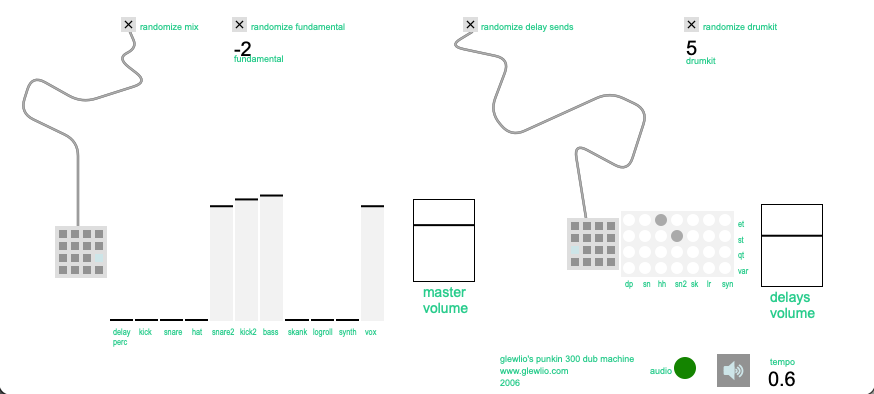
It flips the prevailing notion of software on its head. You can pick this up just like you could an older acoustic instrument. Our friend, the legendary Andrew Benson, writes up the Max restoration project, including free downloads of all the patches for Max and Max for Live users:
Here’s littlescale, turning a lab of computers into an orchestra of chiming Max patches. It’s transcendent:
I was really drawn to Jasch’ erratica_0.21 patch. The sounds that were generated from the presets alone seem both familiar and alien, with this strong sense of organic change through chaos. What better way to enjoy these sonic materials than to scale up their implementation, both in terms of number of instance and space?
I used a lab of 35 computers in my exploration of this patch. 34 copies of a (very) slightly edited erratica_0.21 have been launched on 34 machines. A 35th machine controls the others via the network to manipulate preset, level and erratic behaviour – all individually, in rows of machines or the entire room at once. This turns the patch – and the entire room – into a playable instrument, where the voices seem to co-operate at times and clash at others. Modern Max 9 infrastructure is leveraged to make this easily possible as patches are communicating with each other via the new, built-in OSC server, which can expose an object as an OSC parameter with a single click. Many thanks to Suren, Jasch and the Cycling ‘74 team for inviting me along to explore.
“We should slow down,” I hear a chorus of … I mean, at least several readers crying out! “Short clips of other clips of podcasts played in fast succession is a tool of capitalist hyper-optimization that reduces thoughts to AI-controlled tidbits and makes us increasingly dependent on a malignant tech oligarchy!” Yes, readers, it’s like you’re just shouting out my own thoughts!
“I want to read an extended interview with Leafcutter John and Suren!” Yes! Let’s do it!
Here it is, a CDM exclusive — eat your heart out, Rolling Stone!
Suren and John, in conversation
SUREN
I’d like to ask you about your history with Max and how you came to it, how long had you used it before making your first applications? How was that experience? Specifically how and why did Cdminifuck come about? I don’t believe I’ve come across any other software like it so it’s still pretty unique to this day!
JOHN
I downloaded the demo of Max back in the late 90’s or very early 00’s. I remember doing some tutorials, converting from Celsius to Fahrenheit. I didn’t really get what I could use it for, but on the very last day of the demo period I realized I could hack up other people’s patches and set up these little generative systems which would provide me source material to work with and improvise against. It took me a good 6 months to a year before I got fluent enough to make useful patches of my own. I had to use a cracked copy of Max for the first year or so of learning because I was living in London, just making music the whole time in my rented bedroom, hardly eating or sleeping, or doing anything else. At the time, you could be unemployed and get a bit of money from the government to live on and have some help to pay the rent. I didn’t earn any money for the first few years, and looking back I feel It’s a bit of a miracle I stayed sane.
I released my first electronic record (Concourse EEP on Planet Mu), and over the next few years I released 2 more albums. Slowly I started doing gigs, first in the UK and then Europe and eventually all over the place. I loved playing live at this time; it was super exciting to escape the bedroom studio and play for the people of Hamburg in the brilliant and tiny ex-public toilet Golden Pudel club. a place crammed into a seedy fold of the Docks. Prospective audience members only gained entry if wild-eyed promoter Ralf liked the look of them, and afterward you got paid in Deutsche Mark or weed depending on your preference. I, like the rest of the burgeoning early 2000’s electronica scene, began to look for ways of performing my music live. Initially there were no tools to do this, and I quickly realized that Max would be the perfect environment to build a live show in.
When I first had a computer, it couldn’t record audio, but when audio inputs became more widely available, I got mildly obsessed with it. The simple act of speeding up and slowing things down felt like pure magic. Maybe because of this, I’ve always really enjoyed processing recorded sound, and I find it a really inspiring way to start a composition. Cdminifuck was made as a kind of automatic idea generation machine. Technically, it is 4 granular synthesis engines which randomly pick sound chunks from a folder of sounds. Playback position, pitch, and speed are all randomized.
There was an incredible culture of remixing in the early 2000s; we all remixed each other’s tracks. I must have done at least 10 remixes a year for the first half of the 2000’s. After a while, I thought it would be funny to make a machine to make the remixes automatically. Later I thought, why stop at remixing just one track? You could distill a whole album down to one remix.
The innards of the CDMF granular engine owe a lot to “msp Granular Synthesis v2.5” by Nobuyasu Sakonda, which I discovered in 2000. I remember pulling the original patch apart to try and understand how it worked. I attached number~’s and scopes all over the place until I figured it out. It taught me a lot about working with signals and buffers in Max! Sakonda made his in MSP, and as I remember, I did the same. In the new version for 2026, I recreated it in gen~.
How does music fit into your life and why/how did you start getting into these old music programs?
SUREN
I began making electronic music with Fruity Loops 2.7 when I was in secondary school in the late 1990s. My gateway was bass music that emanated from the pirate radio stations locally and further beyond my South West London home at the time. While I made attempts at recreating the 140bpm music I fell in love with, I also had a lot of fun with other tempos and styles too, which coincided with me discovering the ambient / electronica / IDM genres, which remains a big influence to this day.
After discovering VST plugins, I learnt that there were hundreds available for free online and I downloaded as many as I could (admittedly more than I needed or used) but it was fun having access to various add-ons that opened up extra functionality beyond the factory DAW setup. This period also gave me a foundational understanding of synthesis before I started to collect hardware gear.
I had phases where I dabbled in playing drums in bands but eventually retreated to the infinite promise of computer music as that was my first love. I never studied music formally, but I found joy in teaching myself and learning on the go. I began releasing my own music in 2011 and happy to say it’s led to a career that has so far lasted 15 years!
Over the last few years, my attention was drawn to music software that was labeled “obsolete”. Due to changes in computer hardware architectures and operating systems, software that was once mainstream and/or unique was rendered obsolete or unusable. But these original software technologies were still capable and often offered unique and novel processes – it’s just they didn’t run on modern-day operating systems.
I had always owned PCs and never had first-hand experience of the Macintosh system, so I was keen to explore the unique and interesting music applications that existed for this platform for myself. I’d started to read about software like Turbosynth, Argeïphontes Lyre, Th0nk, Peak and SoundHack, which were held in high regard on online discussions, and I could only contain my curiosity so far, so in 2022, I grabbed a second-hand Apple iBook for about £40 and dived in. I’ve always been a technology geek, and it was only a matter of time before I rediscovered the marvel of music software from the past.
I soon found myself falling into a rabbit hole, discovering forum threads, articles, interviews and references that spoke of even more quirky music software that existed but was not so easy to find. I began to collect screenshots of software that wasn’t available and this folder has grown significantly over time. The allure of these lost applications grew on me, and I took on the challenge of wanting to find them, partly in denial that these files weren’t truly missing from the net while also realizing how precious they were.
There are invaluable resources such as Macintosh Garden and Mac OS 9 Lives which I relied on heavily at the start of my research however I had to look elsewhere to find the software that wasn’t so easily available. As of 2026, my search criteria include Max MSP, Pure Data & SuperCollider patches, VST, Audio Unit, MAS, TDM, Audio Suite & Premier plugin formats, Pluggo & Max For Live plugins, Flash & Director works and other curious miscellany that fit into the Macintosh audio-visual category.
For me, these digital artifacts carry with them a piece of computer music history over the last thirty years, and for this reason alone, they ought to be preserved and cataloged, which is what I try to do on my blog missingmusic.medium.com.
About a year into maintaining the blog, Missing Music developed into a live audio-visual performance. I saw it as a way to extend my research onto the stage and give audiences a tangible experience of the computer music aesthetic from the past, and I’ve been lucky to perform several times across London and beyond. I recently released a cassette tape of new music created on ‘vintage’ Macintosh hardware and software titled 4.0, which is available via new label Margate Electronics.
SUREN
John, to my knowledge, your standalone tool Forester is one of your longest-running projects (the earliest version I have in my archive is 1.3). Could you share a bit about its inception and how it evolved over the years?
JOHN
Your website is totally fascinating Suren! I remember it being so incredibly difficult to find interesting audio software in the early days before internet access was commonplace. One place you could get software was cover-mounted floppy discs (later CDs). I somehow got this software which I think was called HOG. You put two sounds into it, pressed go and about 5 mins later the convolved product was returned to you. It was slow and magical, like developing analog photographs. I used it so much back in the early days and when I looked for it recently I couldn’t find a single thing about it online. It’s complete absence made me wonder if I had dreamt the whole thing?
There were two driving factors behind me developing software and ultimately making Forester. Firstly, the difficulty of finding interesting audio software, and secondly, because nobody had really worked out a satisfying way of playing a laptop live. There was Live, but I wanted something that felt like an improvising partnership rather than a fancy playback machine. Forester feels like an instrument in that you have to give it physical inputs in order to generate sound. And it’s quite unpredictable until you learn how to play it. It also has a sound, which I think instruments should. I developed it for a few years but never really used it personally. Every so often I’d get an email saying “I used this on a feature film” which would make me think, maybe there is something in this idea worth pursuing.
Then COVID hit, and all the gigs were gone. I needed a way to keep my head above water financially, so I used my free time to rebuild Forester with a much more flexible and powerful set of modules. It was perfect because people had time to dive into new things. It did quite well, and it still sells now. It’s really popular with people who work with field recordings and sound design folk.
SUREN
Bonus question! Is there another 2000s-era Max patch made by someone else you would love to see reborn in 2026?
JOHN
I would love to see more from Nobuyasu Sakonda! His “msp Granular Synthesis v2.5” from 2000 is still one of the most incredible granular synthesis patches. I remember pulling the original patch apart to try and understand how it worked. I attached number~s and scopes all over the place until I figured it out. It taught me a lot about working with signals and buffers in Max!
PK: Oh, I’ll second that! Yeah!
Hello, reader! You’re at the bottom! You’ve done well… like the old days.
Updated:
Here’s Alex Roldan using patches in action:
CDMF aka CD Mini F**k completely mangles and granulates any audio you send it. It’s been completely rewritten in gen~ (the og required an optical drive after all.) Multiple LFOs from Monolit are controlling the faders.
Looper 1.5.1 is a live / static looper that uses drop down menus to expose and tweak every parameter per track. In this patch, I’m using two tracks for static sample playback / chopping, and using the third track as a live recorder (room mic recording outdoor sounds + op1 tape.) Parameters are controlled by Monolit.
And Tom Hall:
…and Matthew D. Gantt:
Pluggo! Cycling ’74 and Ableton did some media archaeology of their own some years back with Pluggo for Live, which ported the Pluggo patch collection to Max for Live. It’s a manual download, but a quick test seems to suggest that it’s all working just fine in Live 12! The quality and consistency of these is… quaintly retro, I’d say. But I did mess with quite a few and it’s fun getting even more oldskool Max vibe.