The freeware VCV Rack ports of Bastl’s delicious PIZZA family now include the original Pizza oscillator, Crust drum/percussive voice, and Basil stereo delay. Endless patching pleasures await with these (and don’t forget the free and open source KOMPAS “probability navigator,” too).
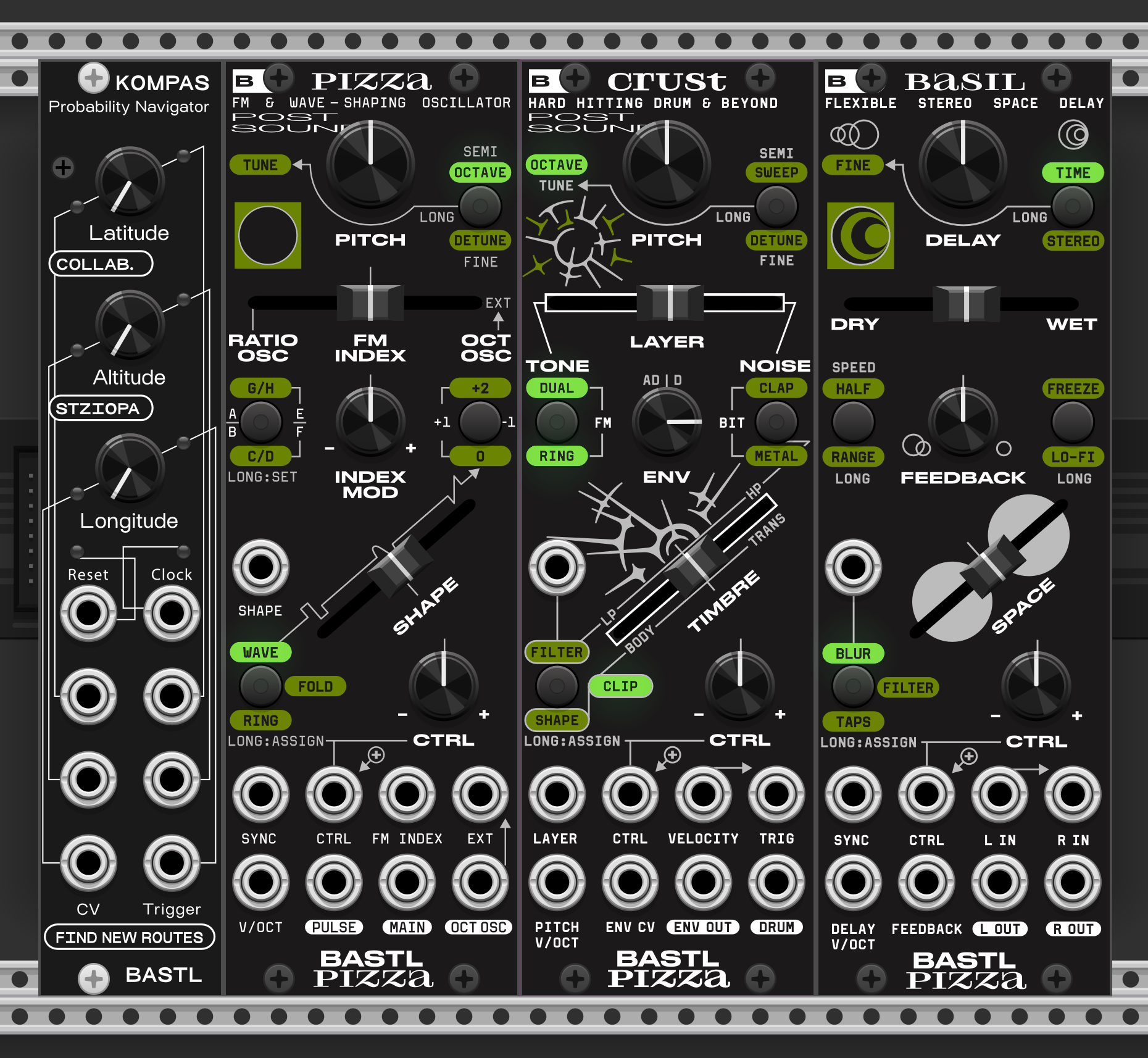
For all the zillion modules available on the Rack ecosystem, some just stand apart. And quite a few of those come from developer Ewan Hemingway of A Forest Full of Sines. You could pretty much check out that portfolio as an end user for tips on some of the best Rack software modules available. (You’ll find Befaco, Vostok, Black Noise, and Rebel — all recommended; see the notes.) That means work on modeling analog circuitry and just making sure everything looks and functions as you’d expect.
And the four Bastl Instruments modules are a must in Rack. Here’s why.
Bastl Instruments modules in the VCV Rack Library
For one example, this is what happened to my Sunday afternoon as I decided to put the full PIZZA family to the test (almost all Bastl modules, plus one Bogaudio Low Pass Gate, a MindMeld mixer, Impromptu clock, and standard VCV modules for sequencing and LFOs):
Basil
This stereo delay is a great balance of flexible features and a playable layout — even with the mouse, having those big faders can be useful in performance (and then you can MIDI map them, of course).
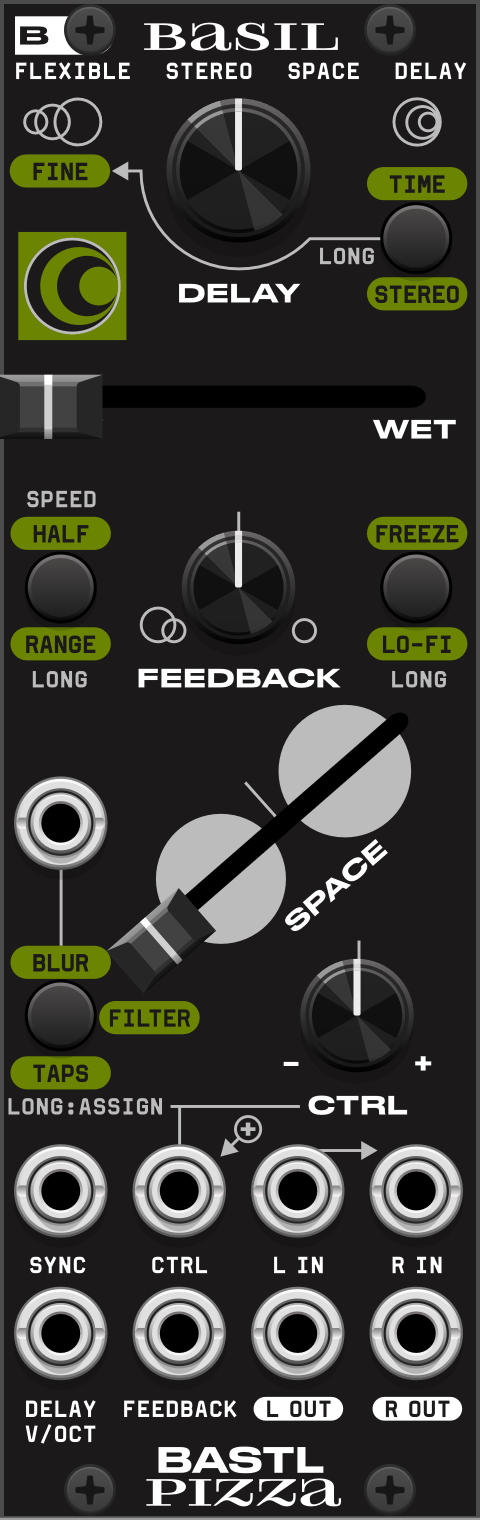
Highlights:
- You can do Karplus Strong synthesis (thanks to short delays and a v/oct input)
- Both normal feedback and stereo ping pong feedback modes
- Unique time controls: fine-tune, sync, quarter/eight speed, etc.
- Lo-fi mode (disables anti-aliasing filter)
- Freeze micro looper — and creates ambient washes (or nice whooshing frozen stuff in techno, too)
- Constant power-curve dry/wet
- SPACE control has diffuse blur, filter, and multi-tap features
All of the extras tucked in there are really appealing. It certainly makes me crave the hardware. But one bonus in software: you can just spawn as much Basil as you want, including using one for flanger-ish coloration fed into another longer delay and so on and so forth.
Here’s a good example:
And then…
Crust
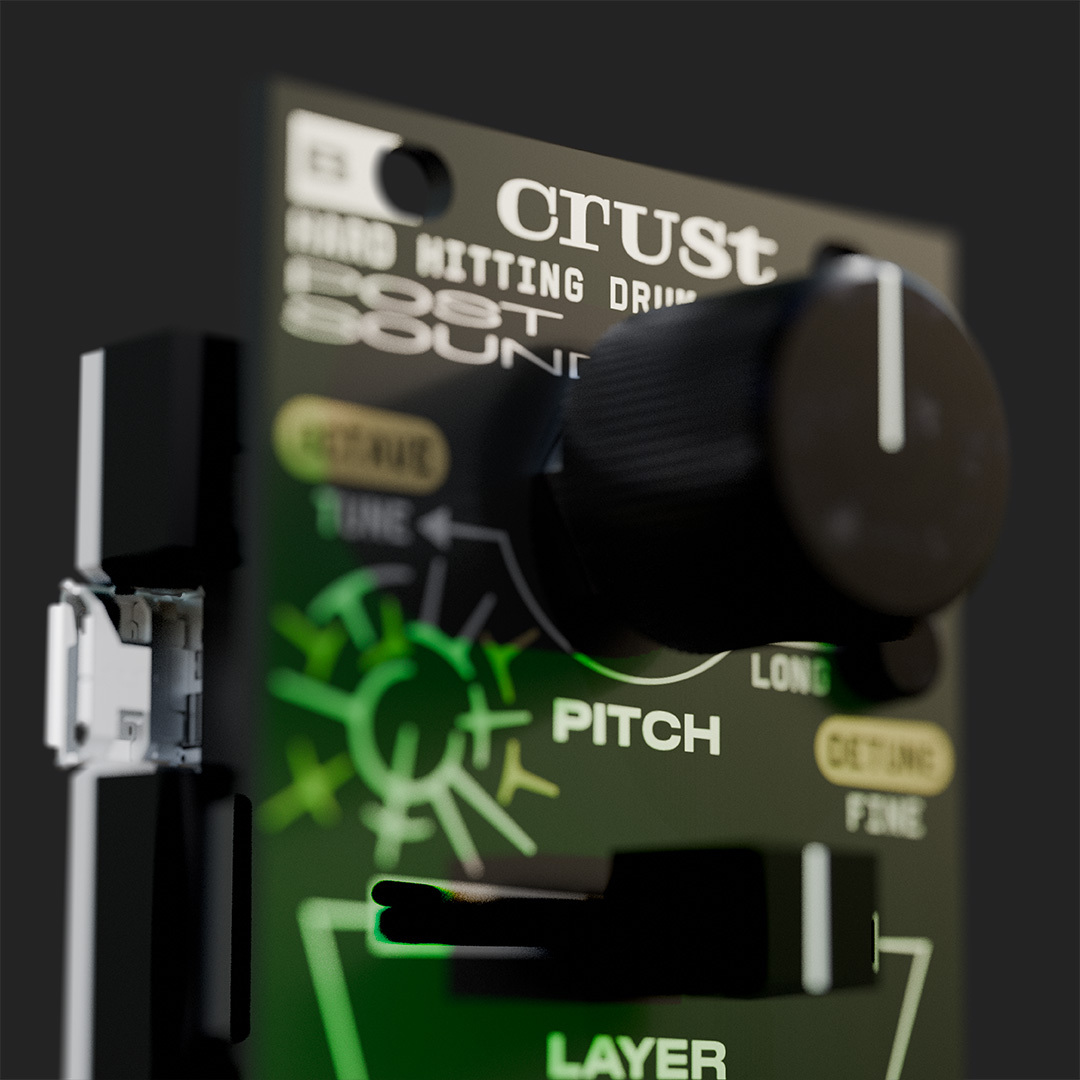
I can never get enough percussive voices with noisy FM-ish things, but truly this is one of the best. You combine a dual-oscillator TONE layer with four shaping algorithms (FM, FM2, RING, and DUAL), a four-algorithm NOISE layer (WHITE, BIT, CLAP, METALMETALIC), and then dial in envelope as you like with the LAYER controls. There’s also a clever combined ENV control.
Like a lot of percussive voices, you can use this as an oscillator with integrated envelope and VCA, and not just a “drum” per se. It can be really dirty if you want, as you hear in my patch which has an absurd number of them.
Here’s Bastl’s own Václav showing it off — but check the (hardware) module page for a whole bunch of patching ideas including a cookbook and preset sheets:
Pizza
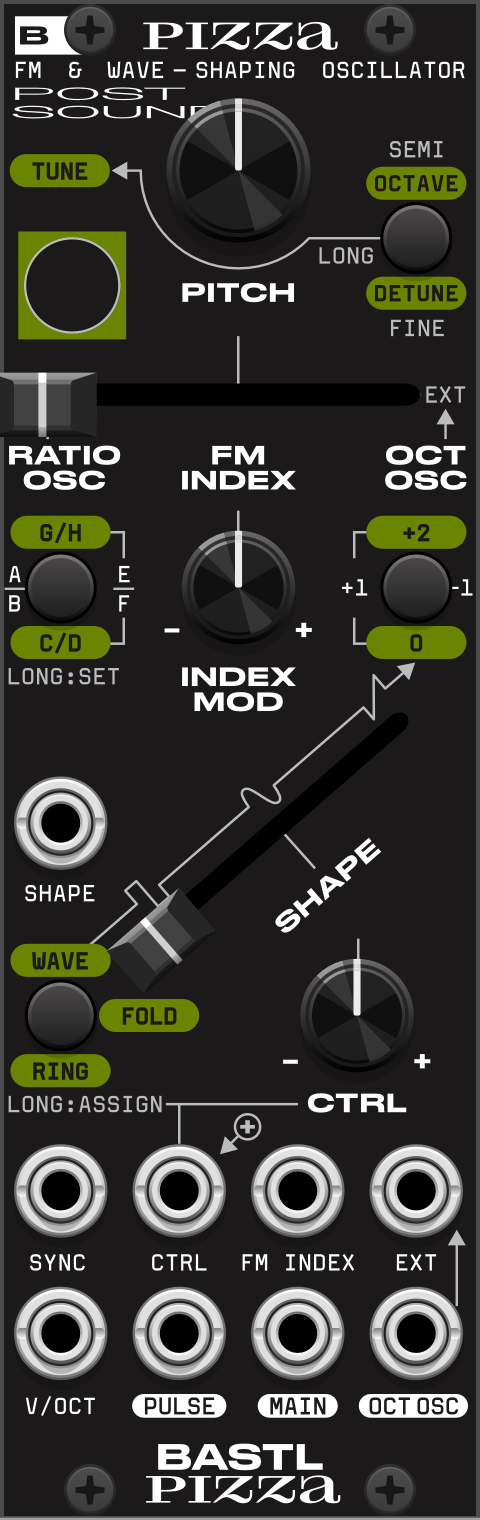
The one that started it all: Pizza is a complex oscillator (in the West Coast sense), but it uniquely combines everything into a compact layout — 3 internal oscillators with phase modulation (FM), wavefold, and ring modulation modes, an FM index crossfader, a SHAPE section, and lots of handy control and tuning options.
Again, you’ll find a ton of ideas on their product page.
Actually, that’s also what I love about the Rack ports. These aren’t necessarily new modules, but do they need to be? You actually want some time to explore, and they’re just as relevant now as before!
I like this manual, because it’s quick, short, has great musical ideas, and some pizza footage:
Kompas
Last but not least, there’s Kompas, an excellent “probability navigator,” built by Bastl collaborators with Ewan and Stefano Manconi.
It’s just hugely useful — maybe the most handy of the modules in Rack that let you quickly spawn unexpected triggers from a clock input. (This module has life as a workshop, too — built in Arduino!) You get 3×32 step pattern generators with “traveling” algorithms — thus giving you three axes of interlacing patterns. You can control even more with CV (that’s the jacks on the left). The software port lacks the 2/5/10ms selectable trigger length on the hardware, but in Rack you don’t really need it (and if you do, other software modules can fix it).
This one is fully open-source hardware and you can DIY it. I love that it’s a workshop — all the early input on “vibe coding” suggests we still need coders, and ironically the AI hype means there may be a shortage.

DIY and hardware
You can buy Bastl’s PIZZA family as hardware:
If you buy something from a CDM link, we may earn a commission.
Perfect Circuit:
Basil Flexible Stereo Space Delay
Thomann:
But as they all run on the same platform via firmware, the faceplate is available on GitHub so you can make your own front panels — or even custom ones.
https://github.com/bastl-instruments/pizza
And in addition to these free-as-in-beer software clones (plus the free-as-in-GPLv3 Kompas), Bastl has done open-source hardware — it’s how the company began:
Okay, just to keep on the pizza vibes — nothing in the following ad is in any way dated now: