Dennis DeSantis is known by a wide swath of the music production community as a face of education at Ableton, including the Making Music book. His new role is at the Eastman School of Music, where he’s helming their new BM in Music Creation and Technology. Let’s talk to Dennis about that program, and more broadly, how to think about music technology and education.
Dennis is now Associate Professor of Music Technology at University of Rochester’s Eastman School of Music. Having known Dennis through many phases of his work at Ableton, back to when we both were in New York — plus his work as a founding member of Alarm Will Sound ensemble — I was personally excited to see him pop up at Eastman. There are only a handful of degree programs that explicitly tackle this combination of music and technology. The MCT program is unique in that it promises to combine the rigor of Eastman’s conservatory music education with the engineering know-how of the University of Rochester.
And Dennis has always been someone interesting to talk to for deep reflections on what it means to learn — and challenge — music technology. Making Music: Creative Strategies for Electronic Music Producers was more than a manual. I was curious to hear about the degree program, but also how Dennis is thinking about teaching and technology.
CDM: We’re at the stage of reimagining how to teach these skills. What will the curriculum look like?
Dennis: The idea isn’t to come here and just learn some tools. The idea is to come here and learn creative thinking, make a lot of music, and then get to the point where it’s inevitable that you’re going to break things — or you’re going to make your own Max for Live device that subverts something about the way Ableton Live’s affordances work.
Because of course you are. You have to find a way to realize this musical idea, which is not well afforded by the existing tools. And one of the fun things is that we’re pretty tightly tying Eastman to our engineering school for the purposes of this degree.
Students will move back and forth between doing music theory, music history, and performance that Eastman is well known for, plus doing computer science, audio engineering, and electrical engineering over at the main campus of the University of Rochester. There’s already a Bachelor of Science and a Bachelor of Arts possible in audio engineering. Students will learn how to use a recording studio, but they’ll also learn how to breadboard and do Arduino and stuff.
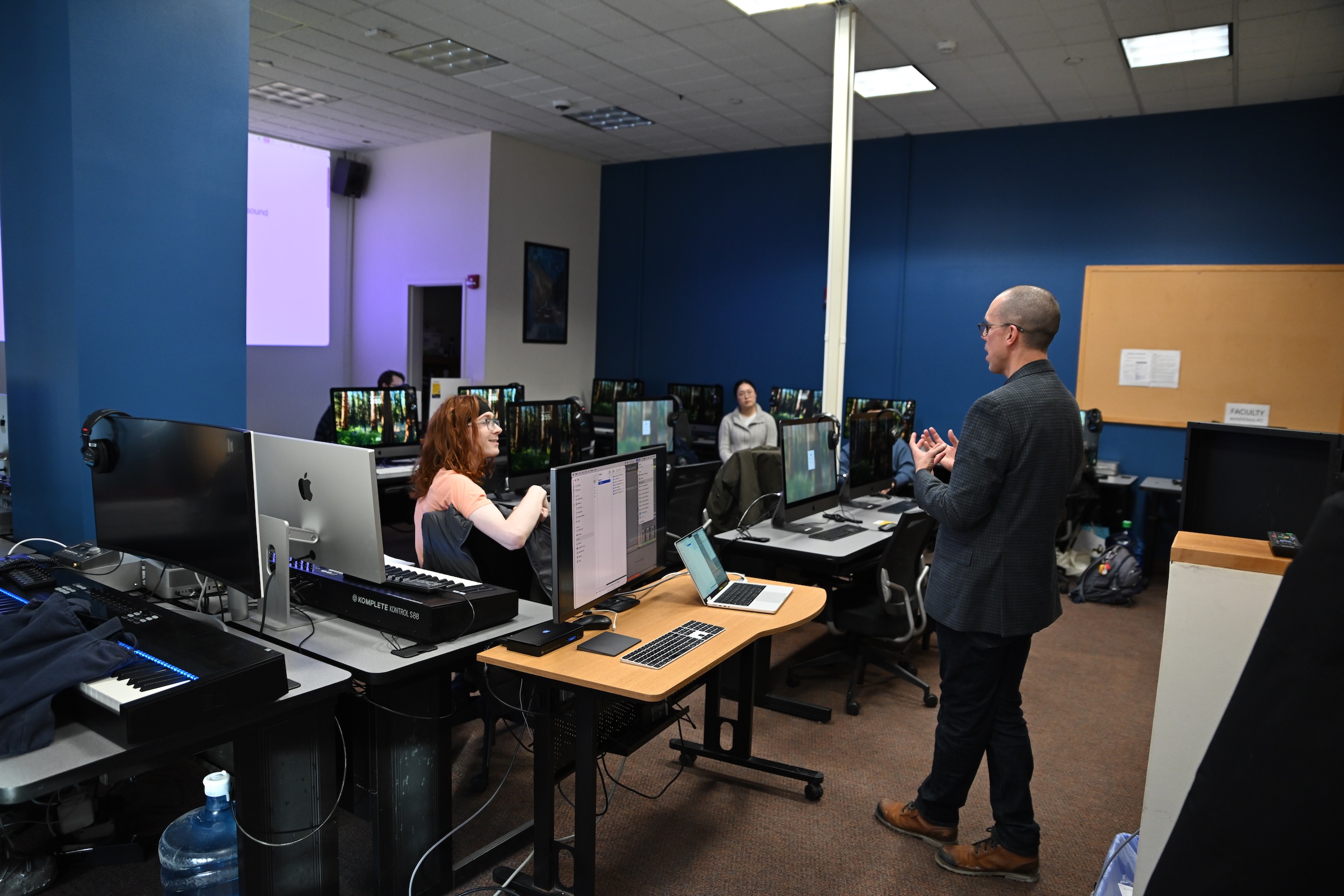
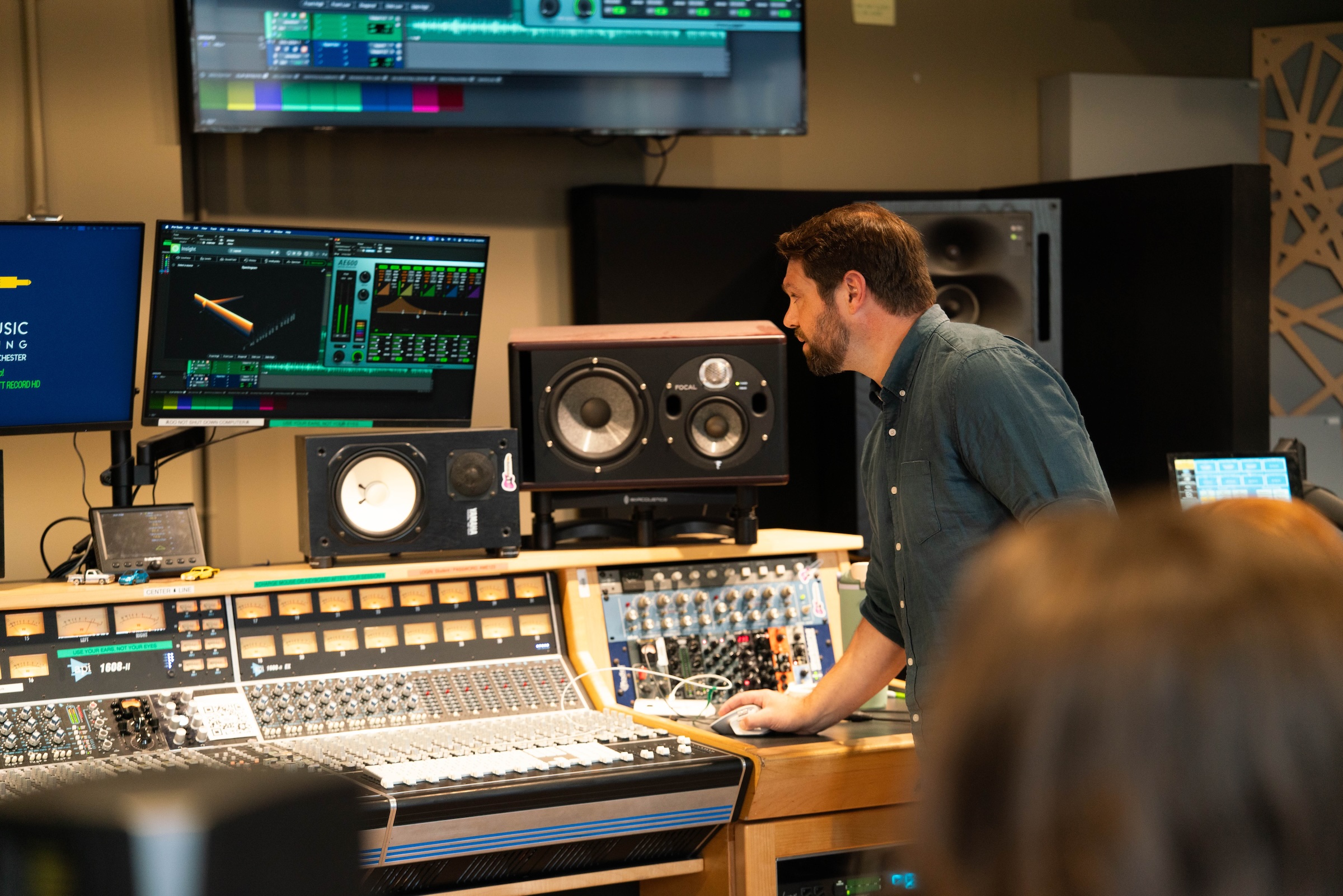
Above, from top: Dennis teaching Beal Institute for Film and Contemporary Media students at Eastman; demo session by Stephen Roessner at the Gavett Audio Studio at the University of Rochester.
That’s something that’s still rare in music education, right? There are composition programs that are paired with theory or musicianship or musicology, but not with engineering.
Yeah, we want both in this program. We want students in Eastman’s program to be extraordinary musicians first — that’s what you need to do to come to school here. But also have strong enough audio engineering, computer programming, and electrical engineering chops. They’ll have rich opportunities for collaboration at the highest levels. These amazing musicians are also going to be working with people who are engineers first, but have an interest in music.
When those audio engineers want musicians to record, they’re going to be able to come to Eastman to get them. And when these Eastman students want new perspectives on engineering, they can collaborate with their classmates. Getting these people together is going to be pretty exciting.
“The idea is to come here and learn creative thinking, make a lot of music, and then get to the point where it’s inevitable that you’re going to break things”
Course lineup:
Introduction to Music Technology
Sound Design
Intro to Max/MSP
Advanced Max/MSP
Performing Electronic Music
Creative Strategies for Electronic Music Producers
Rhythm & Groove
The Studio as an Instrument
Electronic Music Analysis
Electronic Music Product Design
Music of the Last Six Months
Art and Tech of Recording
Introduction to Computer Programming
Audio Electronics
It’s exciting to me that you’re describing expanding skills, even in the face of AI. Right now, it can feel like we’re in a world that’s being rapidly deskilled—or where skills are being devalued.
Yeah, absolutely. I mean, the AI question looms large over all of this. There are still going to be violinists tomorrow. And there are still going to be electronic music makers tomorrow. It’s because you desire to do the thing, not to have the thing done for you.
We can do all kinds of amazing things with technology, but they aren’t all benefits. I’m not an optimist about what AI is doing. Of course, it’s going to be hugely disruptive to careers and incomes for people who do creative work — but people are going to do creative work anyway. And if they get good enough at it, they will be able to subvert what these tools do in the same way that they’re going to subvert what DAWs do. Like what I’m excited about with AI is the way people figure out how to culture jam it.
What does it mean to challenge the default functionality of tools and the way they deliver an end product?
I just want to provide an alternative. I’m not necessarily proposing that the only thing to do is to make your tools entirely from scratch. I think there is value in learning the tools as they are. I also want to encourage people to think beyond that —or at least be aware that there is always something beyond it.
Even those recipes for particular reconstructions of sounds – that stuff is super valuable. It’s so powerful, maybe not so much because you can get that result, but because you get an insight into the way somebody else thinks. You see things in a way you never would have thought of.
And then you might think, how else does that person think? Or if I reorder the signal chain this way, what are the results? And now you’re experimenting again.
If there’s a question that’s very concrete — like I want to do X. I’m always saying, I can think of five ways to do it. Let’s not just explore one. Let’s explore all five. Then you might think about why you might use one versus the other, and what other paths these might lead you down besides what you were looking for. Because each one is a different way of thinking.
A lot of the time you might wind up with terrible results, but they might be interesting anyway — or interesting for the first beat of the music and then never again.
There’s so much to explore, beyond the stuff that’s on the surface. And I’m interested in both.
The surface level of these tools, there’s a lot there. You can make a lot of music using just what the tools tell you you should be doing. That’s why I was perfectly happy writing user documentation as well as writing creative strategy materials — because you need both. And the creative strategy stuff makes more sense as you learn what the actual button does and why somebody thought it should do that—understanding the designers’ intent.
I think people who know your writing, as an Ableton user or having read Making Music, will be curious about your experience writing them. Which documentation did you write for Ableton, actually?
I wrote the manual from Live 7 through somewhere between Live 10 and 11. I didn’t start from scratch; I mean, there’s text in the current manual that’s been there since Live 1, probably. It was a well-written manual from version 1 already. So I was picking up and continuing a legacy of careful, thoughtful user documentation.
But you’re part of kind of an interesting group of people — who’s not a developer, but is helping define how we document and talk about the tools. And then the book that you did for Ableton — it felt like it had a lot more impact than you might have anticipated.
It felt like a thing that was missing, and I’m grateful to Ableton for recognizing that, too. It was never my plan; I never really considered publishing it through Ableton. But I give Gerhard [Behles] a lot of credit for recognizing that it would be useful for the company. It came out of these very organic conversations that I would have with people, when I would realize over and over again that people had these questions that didn’t really have to do with the software.
They had to do with deeper creative thinking. For many people, it’s very difficult to understand where your own input and creative drive begins and where the software ends. You can’t inherently know what comes from you and what comes from the tools until you’ve used them for a while.
And the manual can’t help you with thinking about those problems. The manual is generally there to tell you what the buttons do. And it’s already hundreds of pages long because there are a lot of buttons. So it’s useful to have another kind of document that’s more about, here’s how you might think about bass lines.
What do you imagine people might do with this degree? What sort of possibilities do you hope it’ll open for them?
I think it can prepare people for a huge range of possible careers. There’s the kind of traditional trinity of music jobs — you could be a composer, performer, educator.
People might go into the music tech industry — what I did, or things closer to the engineering or design side of things. Maybe they actually want to go into the business side. I want to talk about the life cycle of hardware products, and how these tools are made. There’s the world of playback engineering.
I want students to be open to crafting their own path, putting together a bunch of what already exists, and also inventing a bunch of things that don’t.
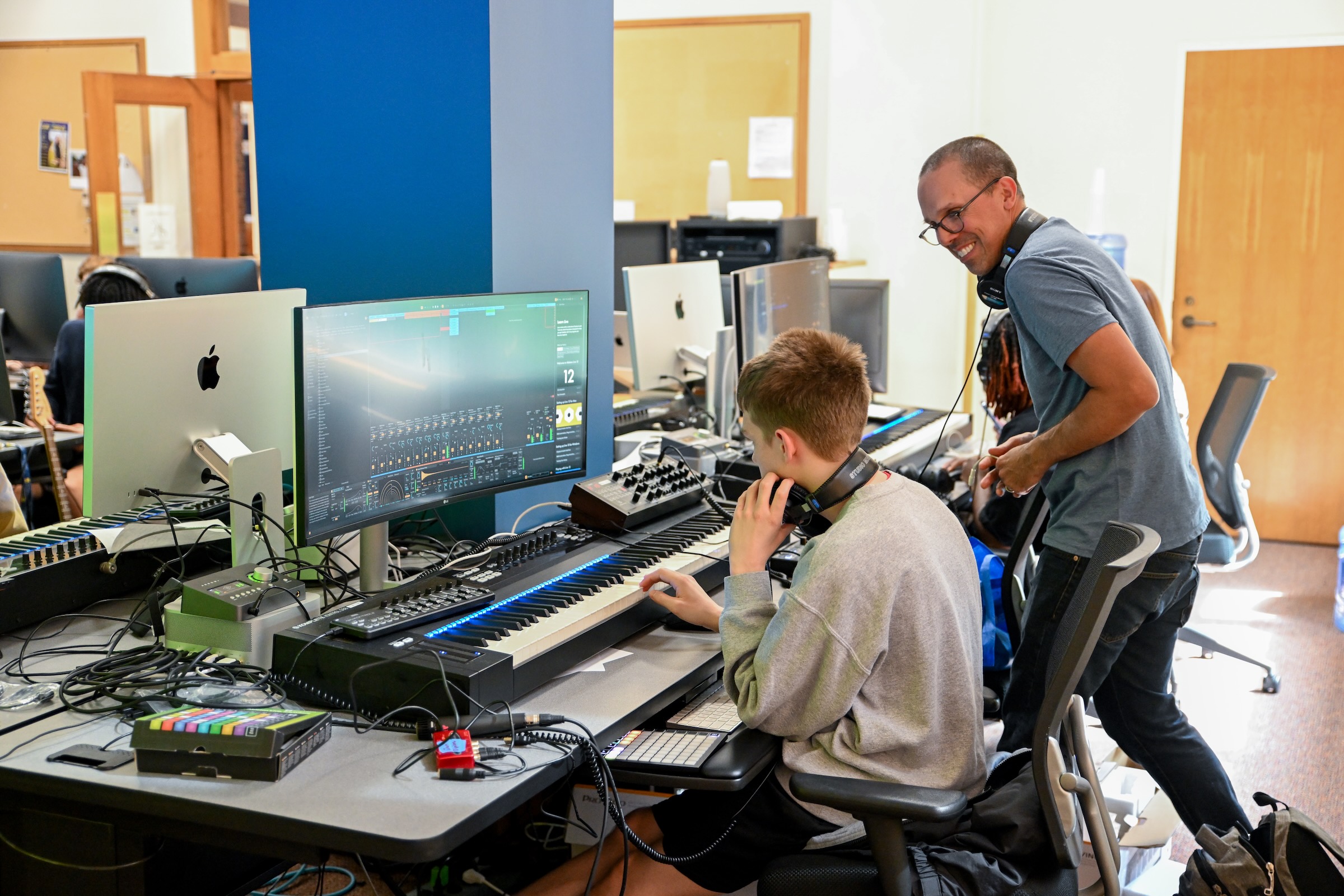
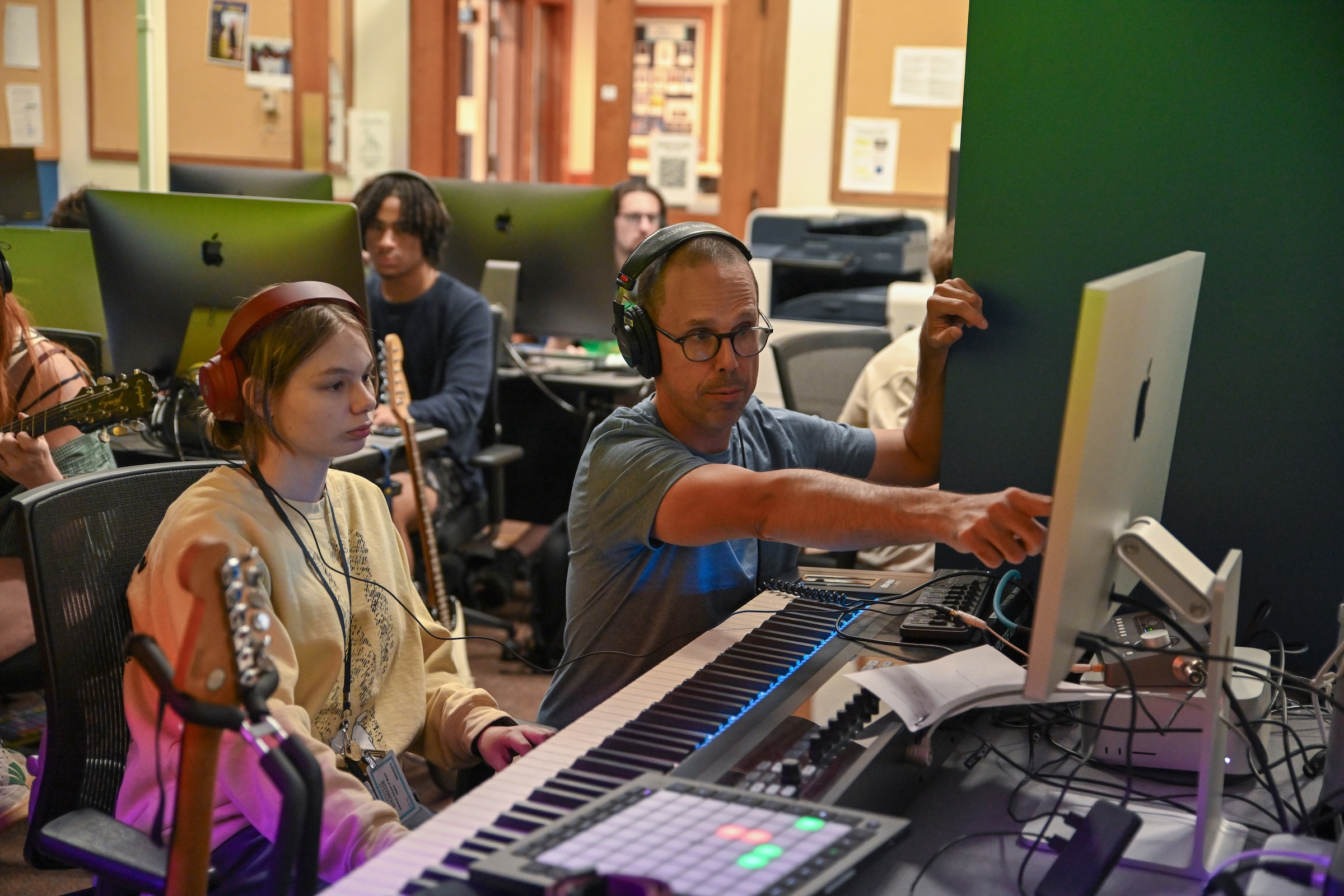
Images from the Summer Music Production Institute, teaching a future generation. See our previous story.
“I want students to be open to crafting their own path, putting together a bunch of what already exists, and also inventing a bunch of things that don’t.”
There’s a lot of pessimism in the world right now, but it sounds like you really see a lot of pathways forward.
Honestly, the students here make me feel optimistic. When I was a student here, we put together interesting projects—I was one of the founding members of Alarm Will Sound and left that group in 2007, but they’ve gone on to do fantastic things.
The students here now are amazing, and they’re going to chart paths through the weird career nebula of music-making in ways that we haven’t really thought of yet. I’m optimistic because I see their ingenuity — their perseverance and their talent. I’m just excited to bring in a new class of those kinds of students who see themselves as electronic musicians and music technologists first, so that’s their primary instrument.
I know these people are out there because I’ve seen them working with Ableton for years. People who are extraordinary musicians, but either with or without a traditional instrument as part of their toolkit.
Eastman School of Music: Music Creation and Technology
Previously:
And also worth a look:
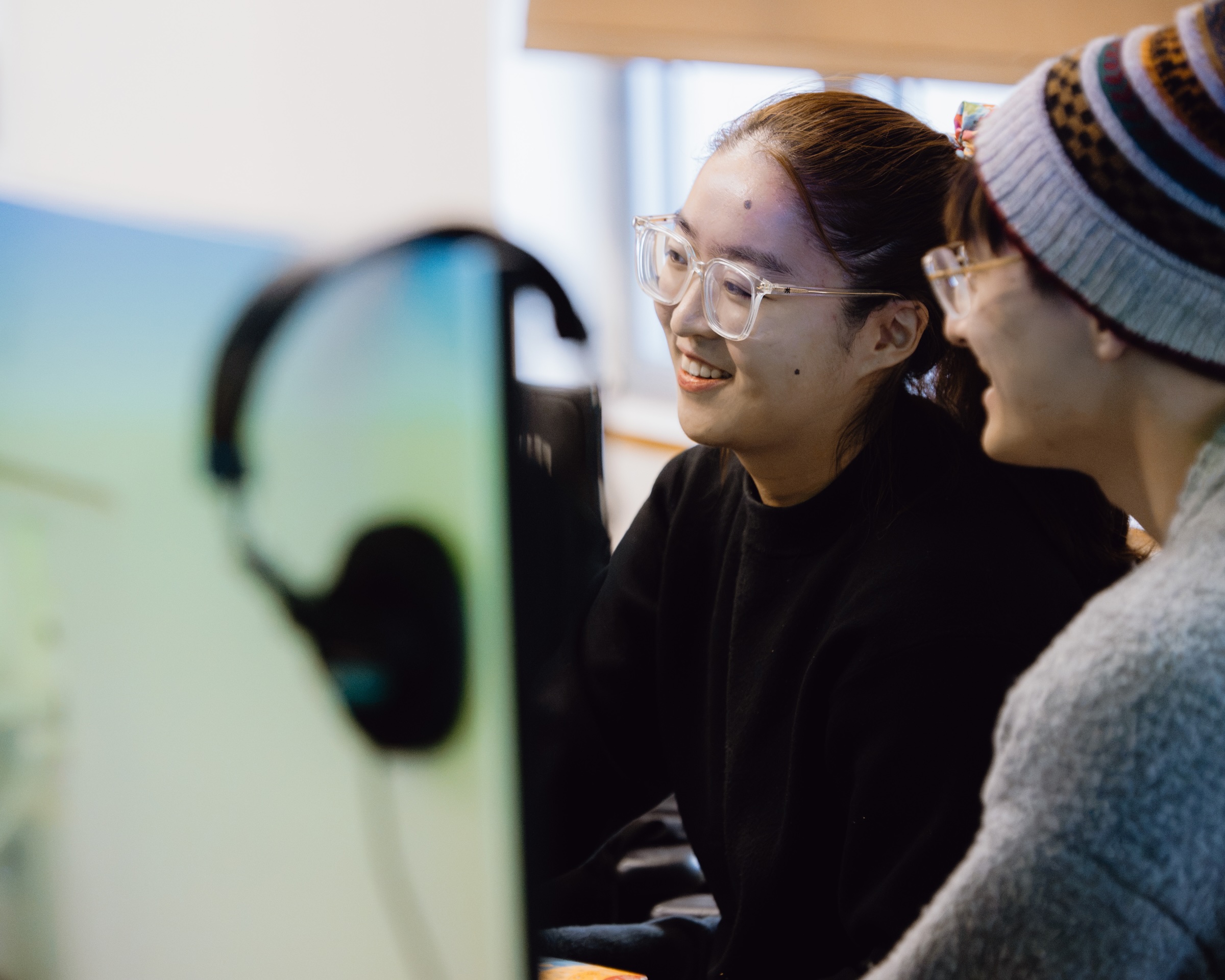
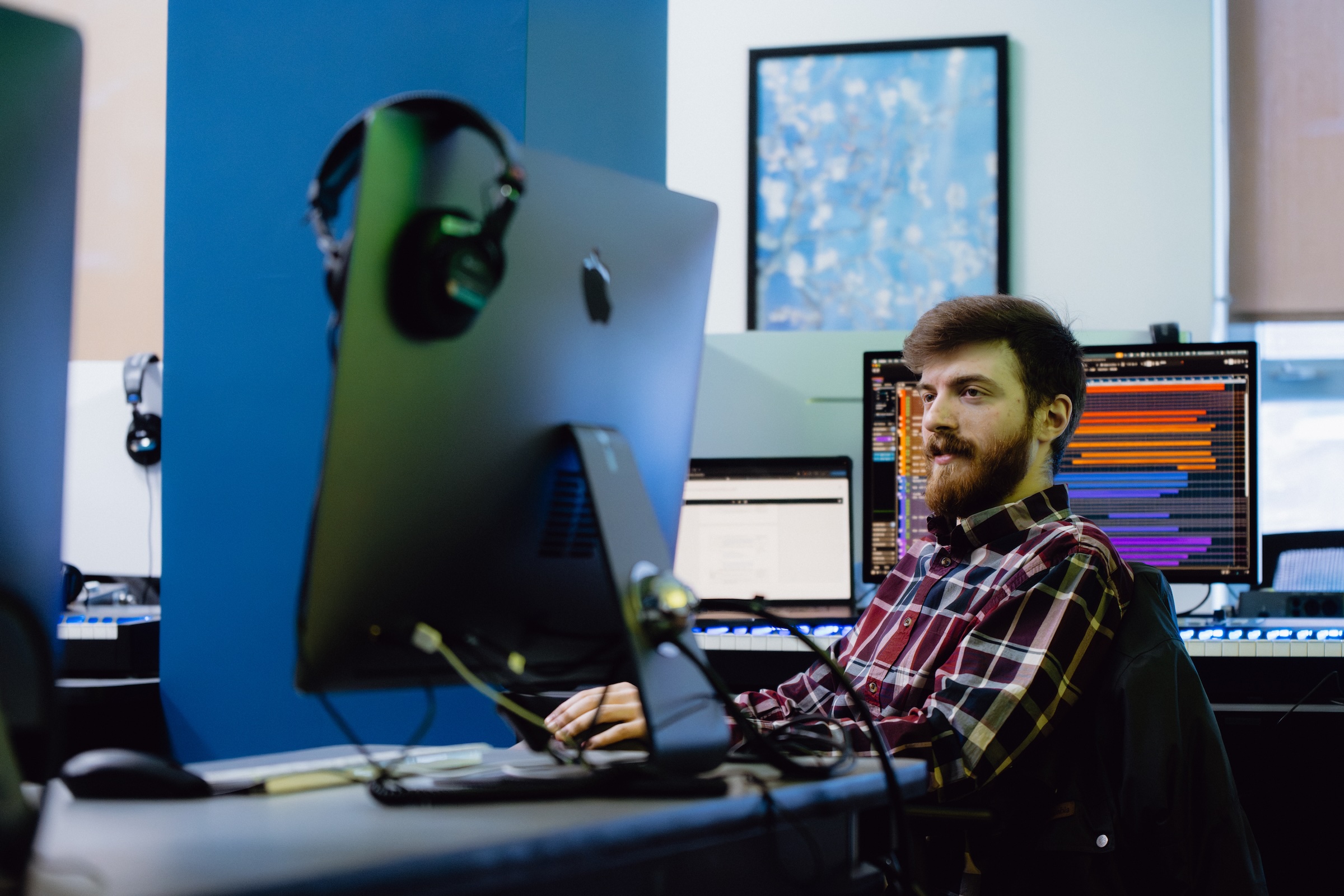
All photos are courtesy of the Eastman School of Music at the University of Rochester.