Earlier this month, NASA’s Voyager 1 spacecraft traveled beyond 25.902 billion km from Earth, a distance light would travel in 24 hours. Now is a great time to listen to Laurie Spiegel’s contribution to that record — a dizzying sonic model of Kepler’s Harmonice Mundi.
An Earth day is essentially meaningless now that Voyager 1 is far from its home planet, but suffice to say the spacecraft is now, in our scale, really far away. It’s a reminder that this whole project was an interstellar equivalent of tossing a bottle into the ocean, with no real chance of ever passing into another star system, let alone being found. So the project, in the words of Carl Sagan at the time, “says something very hopeful about life on this planet.” It’s a reflection on Earth’s life as much as the near-void around.
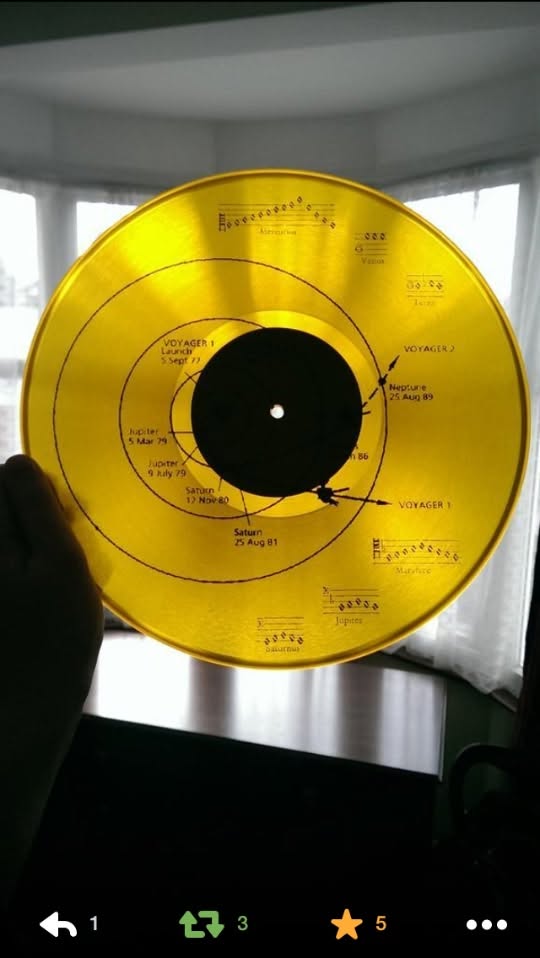
Voyager’s Golden Record would seem a little anachronistic to young humans now if they were to find it. It comes with instructions and a handy accessory pack including a needle and cartridge — we are literally talking a phonograph record here, albeit one printed on copper.
Laurie Spiegel’s own composition, then, is both the least-mentioned detail of the record, and perhaps the most forward thinking. I actually wonder if it was fully appreciated by Sagan’s committee at the time; I understand just an excerpt made it on the record. And maybe the reason it doesn’t get mentioned in NASA’s music section is that a lot of 1970s ears didn’t really consider this music. And yet — give it a listen. Kepler’s Harmony of the Worlds is a hypnotic, sonic expression of geometry. (The re-release is sold out as physical, in case you had a spacecraft you wanted to glue it to, but is available as digital download.)
It’s an exquisite piece of code and composition.
The music collection is compelling — maybe more creative in its non-Western choices. (Kudos to Carl Sagan for the breadth of ideas here, though; that kind of spirit is something we could use more now!)
The sound choices, from humpback whale song to a kiss, are to me the most fun to listen back on, a 1970s sound portrait of humanity. And that’s ultimately the thought experiment, asking us to consider our place on a cosmic scale. It’s not the Total Perspective Vortex — more like a reflection on an Earth perspective.
The greetings are sweet:
The ISS crew sent a message to Voyager 1, leaving that spacecraft a little less alone:
The original press release:
Voyager Will Carry Earth Sounds Record
And more, from NASA/JPL:
What are the contents of the Golden Record?
Where are Voyager 1 and Voyager 2 Now?
And Smithsonian Magazine:
What Is on Voyager’s Golden Record?
And of course, let’s hope this doesn’t happen. Uh, sorry — spoilers. I guess. (You’ve had since 1979; too late. See, maybe if they’d done what the ISS did in the movie, they wouldn’t have had this catastrophe.)
Previously on CDM:
Photo at top: NASA/JPL. (public domain)