The Digital Audio Workstation can never quite escape the timeline and its roots in multitrack tape. Tweakbench’s new Noemi, which entered alpha last month, starts from scratch. What if music in the DAW could constantly evolve and change? What if the DAW were non-deterministic?
Some readers will instantly say, wait, I’ve seen this before. That’s like Bespoke Synth or other modular environments. Or — no, it’s really closest to Usine Hollyhock, a fully modular audiovisual environment that can be a modular DAW if you need it. (And yes, actually, if you need something mature, Usine Hollyhock is fantastic and apparently has a new release — let me write that up separately.)
But Aaron Rutledge, the creator of the legendary Tweakbench plug-ins, has doubled down on this concept and brainstormed a pretty broad menu of generative possibilities. From the KVR launch discussion:
With Noemi you can:
- have a euclidian form generator train a markov chain to play your synths.
- modulate just about everything with lfo’s envelopes noise and step sequencers.
- have a fibonacci l-system make up chord progressions.
- have every midi clip genetically mutate each time it loops.
- rip random audio from youtube to a sampler via keywords or urls.
- play a single wave or midi file 4 times in various speeds and directions.
- save entire scenes of the entire app and tween them across beat lengths.
- play with all 63,050,394,783,186,944-128 frequencies of full microtuning.
- explore very rare world scales applied to your normal western brained notation.
While there are other node-based environments, few are as focused on generating material. There’s a probabilistic note engine, too, dense with features for adding rhythm and expression, so you don’t have to ever touch deterministic sequencing at all. Piano rolls have polyrhythmic playheads and act as nodes, not timeline regions or just “clips.” And you do get a drum sequencer and sample player, so you’re not entirely tossed out an airlock into open space. But you can combine these freely. There are multiple engines:
- Pattern playback with MPE, mutation, polyrhythmic playback and more
- Rhythm 8-land step sequencer
- Generator probabilistic note engine (L-Systems and Euclidean patterns, too)
- LiveCode for live coding
- Waveform audio sample player which also has four independent playheads
- Slicer with automatic transients and even REX2 support
- Granular synthesis engine
And those combine with instruments — subtractive, wavetable morphing, formant voice, drum synths (one based on synthesis, one on samples), and external plug-in hosting. And a modulation matrix.
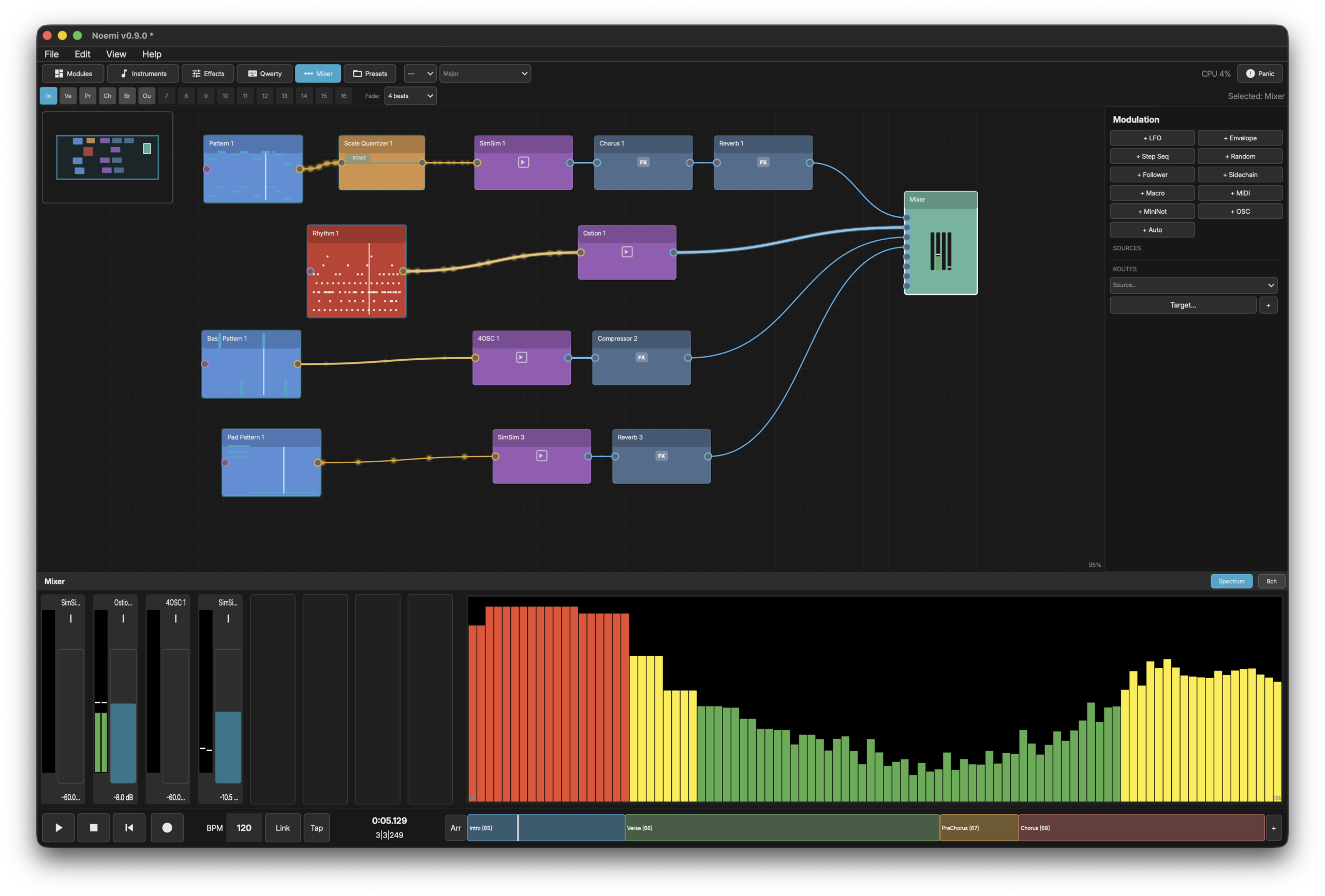
This is labeled alpha software, so judge accordingly. (Be patient; document and report bugs. Be the sort of person who likes living dangerously and enjoys crashes.)
For me it was reliable, but with an experience that I would say feels aggressively alpha-ish!
V 0.7.0 came hot on the heels of the first release, with even more cool stuff:
LiveCode node — text-based generative sequencing with mini-notation engine (TidalCycles-inspired patterns, euclidean rhythms, chord progressions, snippets library)
CLAP plugin hosting — host CLAP format plugins alongside VST3/AU
Envelope follower modulator — modulate parameters from audio amplitude
Audio sidechain modulator — trigger envelopes/gates from audio input
Macro knobs — user-defined knobs mapped to multiple targets with MIDI CC learn
Per-route modulation curves — custom response curves (exp, log, S-curve) per route
Modulation rate multiplication — double/halve modulation speed relative to tempo
Cross-modulation — modulation sources can target other sources’ parameters (e.g. LFO rate → another LFO)
MIDI-to-modulation — map incoming MIDI CC/velocity/aftertouch/pitch wheel as modulation sources
He’s now on 0.9.0.
macOS, Windows, Linux. (It’s not on iOS — that link goes to Tweakbench Studio which gives you AUv3 instruments and effects from the Tweakbench library, designed for iPad.)
The Tracktion audio engine is underneath, so this really is a reimagining of a DAW.
I’m excited by this concept. And it might even make people reconsider other modular environments for non-linear / non-deterministic music making. There is something kind of soul-sucking about everything being fixed on a timeline, even if a linear output is your goal.
I might just go back to my other modular and live code environments, but I love all the ideas around there.
https://www.tweakbench.com/alpha
And this very new thing comes just after the return of some very loved old things: