Tokyo-based startup Dreamtonics is doing unparalleled work with AI-powered voices; their Synthesizer V Studio enables a level of precision that combines that of recording and synthesis. Add that to Steinberg’s Dorico scorewriter, and you get a machine mockup of solo singers and choirs that we’ve never heard before. But there are a lot of details involved — so let’s hear from an expert.
Dreamtonics’ vocal software is the first I’ve used that I really enjoyed. It has the level of synthesis versatility of something like Yamaha’s Vocaloid, but now with machine learning-powered models. And yet unlike the typical, blah “prompt and get an output” banality of most AI vocals, you get an editing interface that’s reminiscent of Melodyne, plus intuitive macro controls. There are also voice models across several different languages and styles (Japanese, Korean, Chinese, etc.). With a developer like Dreamtonics, you also have transparency about the human singers used to train the model. (Another project checking out in this field, and it’s also been great about supporting artists, is Voice Swap — Benn Jordan’s involvement is a good sign.)
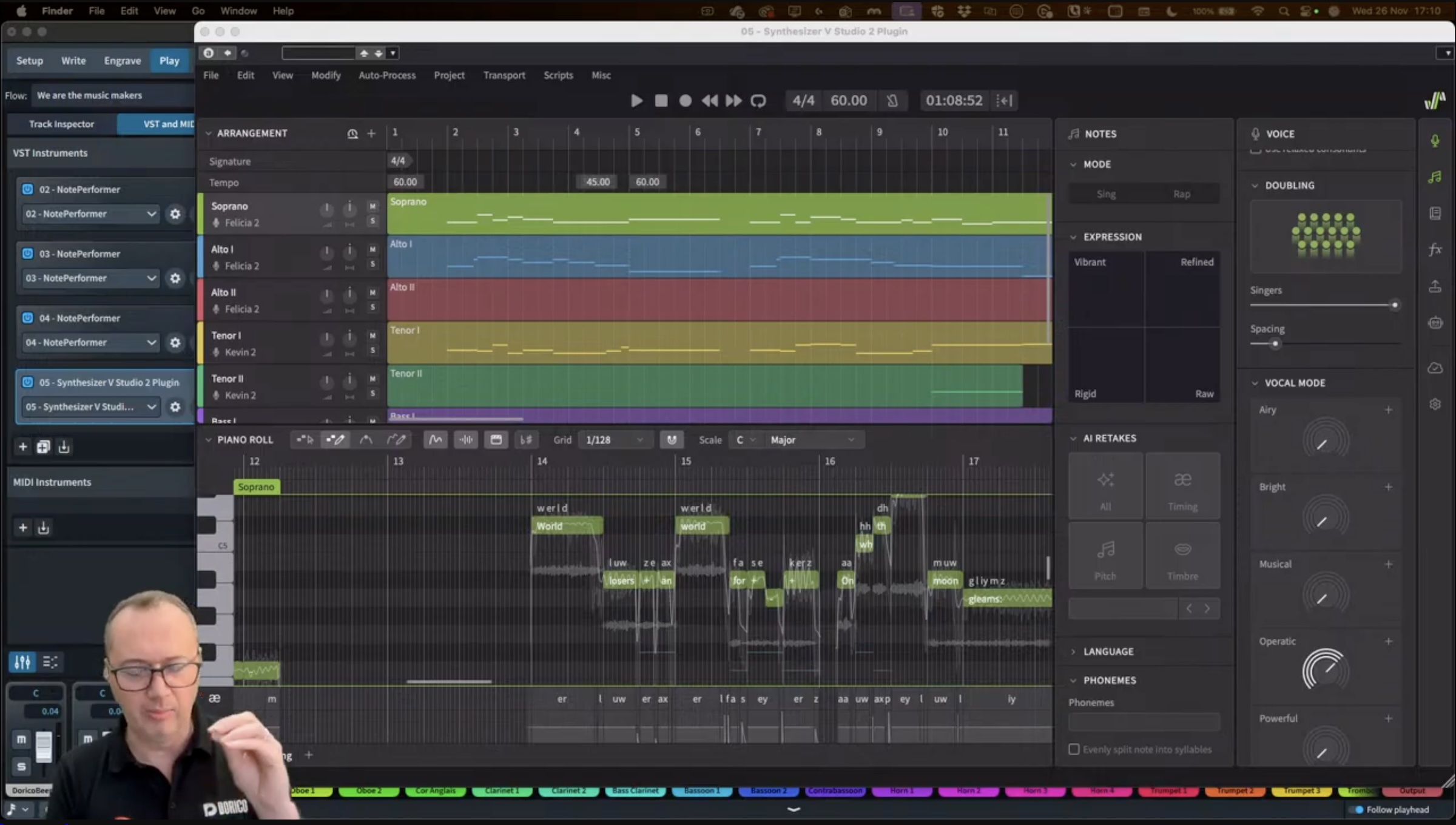
I’ll write about Synthesizer V Studio separately, but I want to point to this use case. Remember when I talked about looking to music beyond Western bias? Well, let’s go the opposite direction, though with the hyper-American pop-sounding choir that comes out of this, I’m sure our English colleagues squirming. (It has me squirming a bit, even; where’s our King’s College model? Anyway…)
This has been a long time coming. Instead of the “oohs” and “aah”s we’ve had since Roland Sound Canvas and General MIDI for over three decades, we get some human-sounding examples running as a VST plug-in inside Dorico.
There are a lot of details to making this work, so enjoy the full video:
Praise Jesus. Uh… well, anyway, praise VST.
Dorico, Sibelius, and Finale all had a major hand in the evolution of sampling and orchestras — see Garritan Personal Orchestra, for instance.
The key here is the ability to run as a plug-in and to fine-tune the results. The point here is really the opposite of automating or replacing human vocalists; on the contrary, just as with other playback features in notation software, these tools are used for producing demos (and checking errors). The end goal is always human players and the nuances and soul their performances bring, or you wouldn’t be investing time and money in notation software in the first place.
It’s really the instrument to beat for now. Dreamtonics has a 30% off Black Friday sale on now through December 1, though I’d advise as this video does that you try a free trial first.
Dorico and V Synthesizer Studio are also available from Plugin Boutique:
If you buy something from a CDM link, we may earn a commission.
Dreamtonics at Plugin Boutique (includes bundled voices)
Dorico Pro at Plugin Boutique (discount on now through December 7)
Indeed, I think the complaint about even software as sophisticated as this plug-in is that it doesn’t have enough control over the results — and it goes beyond anything else I’ve seen on the market yet.
But if you want more of an AI holiday, I’m excited for this coming up this Black Friday. (Real-life) director Sergio Cilli has been cleverly pointing out what doesn’t work about AI actors. I think AI advocates might easily dismiss this as him poking holes at technical limitations, but watch the whole series. The technical gaffes are amusing, but it’s really about the play between human actors and director. (I also appreciate that an actual cast member of the Mickey Mouse Club 1991-92 showed up in comments to complain about a comparison.)
And all of this fits music just as it does acting. Just look at how much the product above benefits from human, manual interaction.
I mean, music notation software isn’t even supposed to exist anymore, and yet here we are.
Still …
Hark, the herald AI sings!