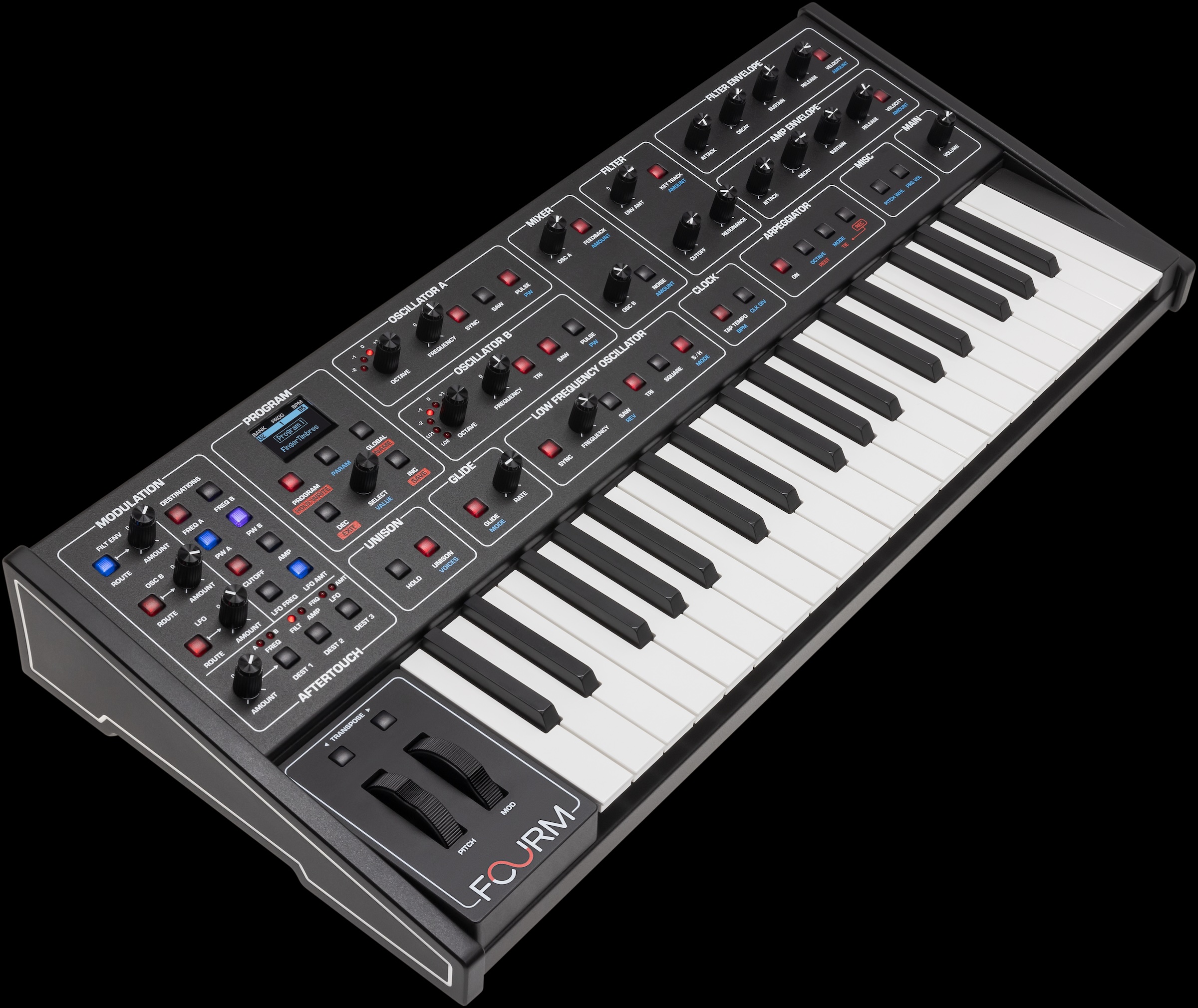
Sequential’s new Fourm is a 4-voice polysynth with an all-analog signal path and polyphonic aftertouch and a price under a grand. To pull it off, Sequential designed an all-new expressive keybed and adapted their signature analog circuitry from the Prophet-5 (and Prophet-10). I spoke to Sequential about their instrument and the engineering that made it all happen.
Fourm is a new instrument, built from the ground up, from analog circuits to the in-house key mechanism. It has shades of two beloved Sequential instruments, the 1978 Prophet-5 and 1983 Pro-One, in a modern rendition. And it’s at $999 USD or € 949.99 / £799.99 including VAT for UK and Europe (€ 798.31 | £666.66 without).
Available now:
If you buy something from a CDM link, we may earn a commission.
Sequential Fourm [Perfect Circuit – USA]
Sequential Fourm [Sweetwater – USA]
Sequential Forum [Thomann – EU]
I haven’t played this keyboard yet, so I can’t personally attest to whether the Fourm delivers — more on that later. But at the risk of watching the making-of featurette before the movie, I couldn’t resist talking to the folks at Sequential to find out what’s really inside Fourm, beyond just the specs and press release. We’ve got David Gibbons, Sequential’s CEO, and Carson Day, Product Designer, to tell us more about the work their team has done.
For anyone designing or DIYing modules and synths, it’s especially fun to hear how they work — but to the rest of us, it helps us to better understand the instrument. Plus, it gives some insight into how Sequential is carrying on the design vision of its founder, the late Dave Smith. It’s pretty easy to imagine Dave being excited to see the results, and it’s great to see a younger generation of designers and engineers carry on the instrument-making tradition. You can think of this like a reviewer’s guide for the design-obsessed.
Connect Fourm
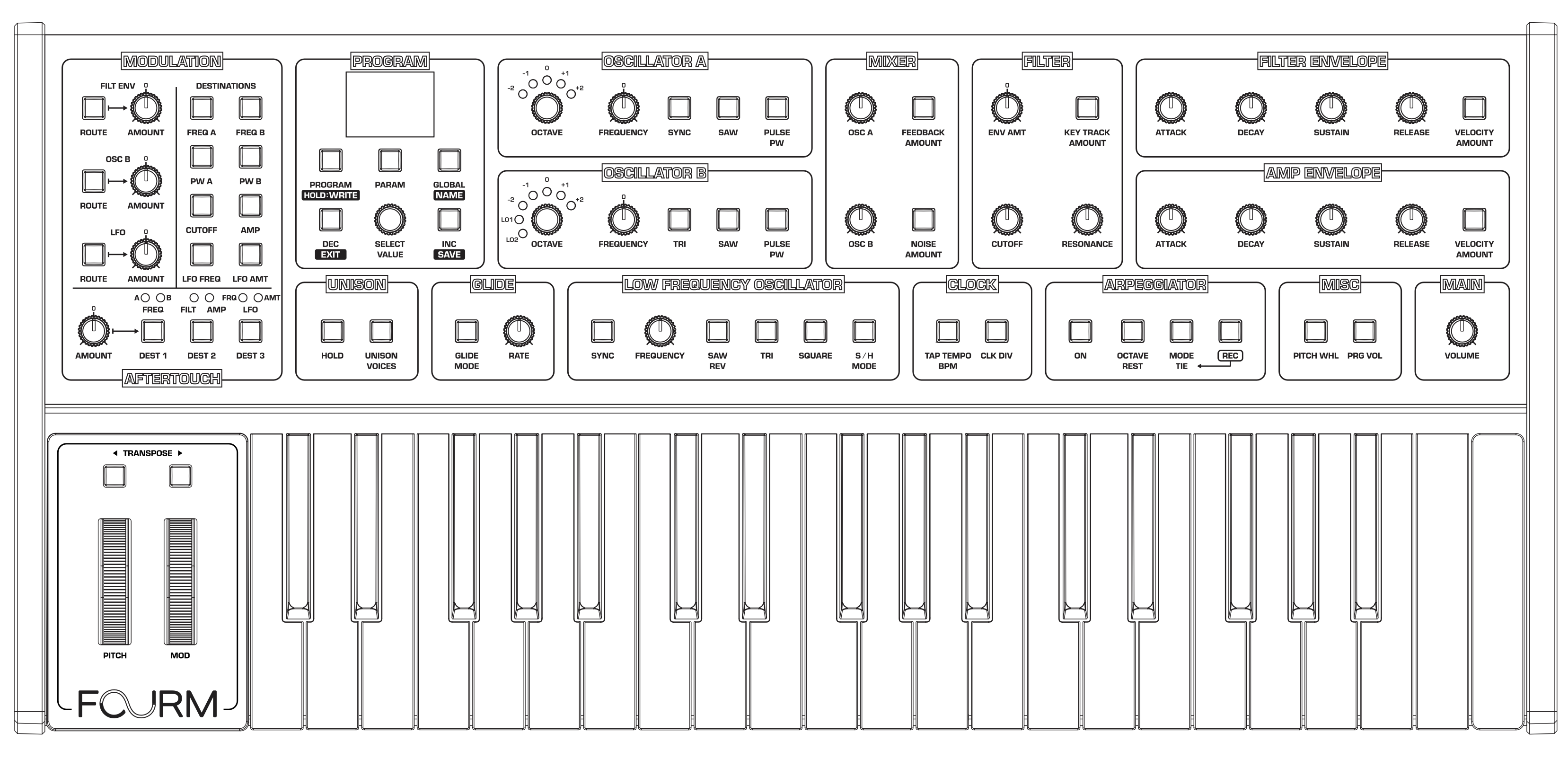
First, the keyboard. That’s pronounced “FOUR-M,” as in “form,” not “foorm” and not “forum,” so watch your auto-complete. It looks a bit spartan at first glance, maybe because there’s no signature Dave Smith/Sequential wood grain. But then you realize that this has a Prophet-style, 100%-analog voice architecture. Plus, behind the friendly simplicity of the Prophet-derived panel layout, there’s also a full modulation matrix.
Fourm borrows many of the key elements of the Prophet, and that “quintessential Sequential sound” as David describes it. But there’s more it can do, because it’s also able to riff on that legacy. “You hear things from it that feel like it’s going in directions the Prophet-5 doesn’t go because of its limitations,” David says. “We didn’t mess with the Prophet-5; the current Prophet-5 is almost identical to the signal path of the original. So there are things you can’t do with those constraints that this little guy will be able to do.”
There’s also a powerful synth engine, including custom tuning support. (64 tunings are included, and you can add standard tunings over SysEx.)
And then there’s the expressive keybed. Fourm has slim-line keys to fit a compact form factor, built to be “professional-grade” according to Sequential, with poly-aftertouch. Polyphonic aftertouch allows the continuous pressure applied after you depress a key to be registered per-voice, rather than across the whole instrument at once, allowing you to apply nuanced expression underneath your fingers, just as you would on other non-keyboard instruments.
That’s ground tread by the ASM Hydrasynth in the sub-$1000 class, but Hydrasynth is a wavetable synth with digital filters, not anything like this Prophet-inspired analog synth. At least what the Hydrasynth has demonstrated is that people can embrace slim expressive keybeds like Fourm’s. And even with four voices of polyphony, there’s a lot you can do with your fingers applying per-note expression after you’ve pressed down the keys, especially when combined with different patches and the arpeggiator (see below). (This part I can say from experience, having played with poly-AT and MPE on various other controllers.)
I was going to say this is the first analog synth of its class with poly-aftertouch, but seeing any analog synth with this feature is rare. (The far pricier Moog Muse, for instance, has just channel aftertouch, so you can’t add expression on individual notes.) Synth collectors, now is the time to pull the manual on your instrument and check if it implements MIDI receive for this feature, because then the Fourm is an instant controller.
“Nothing else is combining polyphonic aftertouch, all analog from end-to-end, and this price point,” David says.
Polyphonic aftertouch and expression
“We discovered so many more things you can do with poly-aftertouch than you would think — performance gestures, ways of using it in an expressive sense that are not just about bending pitch or opening the filter. Like, one great example was that you can hold an arpeggio and while the arp is cycling, use aftertouch to pull different notes out and change the perception of the rhythm.”
And it opens the instrument — “you’ve got four voices, it’s single timbre, but we realized pretty quickly as we played with it that it almost can sound like another timbre” as you play with poly-at.
There are a lot of ways you might apply these poly aftertouch techniques. Sequential sent over some ideas, including:
- Creating the sense of two sounds by playing a melodic line with separate pressure, over a bass note or chord
- Evolving arpeggiators with different sounds or even additional notes (routing to LFO depth or amplitude level)
- Tremolo and vibrato, typically just on higher pitches (or do the opposite of what my reviewers’ guide is telling me and do it on the bass for all of us more experimental types)
- Modulating bass pitch (since you can assign to frequency and scale amount by octave)
- Pitch articulations
- Complex modulation
- Rolling chords
In musical terms, four voices is really quite a lot, especially if you consider homophonic music traditions. (Heck, even most western music is really at most four-voice polyphonic, and often less.) So maybe a better way to describe this is finally you can play with both hands on the keyboard and be expressive. The problem with every other expression method on a keyboard is that it requires one hand somewhere else (knobs, wheels, D-Beam, whatever), or that it applies to all notes at once (expression pedal, channel aftertouch).
If you’re wondering why you haven’t seen polyphonic aftertouch combined with analog synthesis, it’s because it requires a ground-up approach to voice architecture, allowing for per-note assignable modulation. You can’t just graft expression onto an architecture that didn’t imagine expression on each individual note beyond velocity response.
“That decision really flows into the way that you design the voice, because you have to provide for individual control,” David explains. Since it’s an all-analog signal path, this has to exist at the level of the analog connections, not something that can be added in software later. “One of the big decisions with an analog synth voice design is you have to figure out where will the control voltage actually go,” says David, “which things will be per-voice?” From there, the microcontroller controls presets, modulation mapping, and real-time variations.
And yes, you could use this with other hardware and software synths, many of which receive poly-aftertouch. “We certainly started to get that feeling from the sound designers as they started to engage with it,” says David. “They were just like, wow, I could use this to control other things. This could be my go-to controller that I take along with me on gigs.”
(Incidentally, this is also true of many MPE instruments that can also be configured for poly-AT; it’s all in the MIDI spec. We can delve into that separately sometime.)
Analog circuitry
So, this is a four-voice, Prophet-derived instrument, but it’s not a copy of a previous Sequential instrument or a clone. “It’s the Sequential sound, but now you’ve got this Pro-One-style modulation matrix. There’s something of interest for you if you’re a close follower of the history and designs of the company; there’s still something that’s novel and relevant for you,” says David.
Carson goes through the technical elements, by chip — these are new versions of the integrated chips used on the Sequential analog classics from years ago. (An IC simply packs that analog circuitry into a single chip rather than on a full board.)
- The new SSI 2140 chip, the new revision of the 2040 from Dave Rossum, as in the Prophet-10 rev4
- SSI 2131 oscillator chip (the Prophet-5 rev4 used the CEM 3340 oscillators)
- SSI 2164 analog VCA
The envelopes are all-analog, modeled on those on the Prophet-5 rev4. “We actually did pretty extensive listening tests and graphing of the filters or envelopes in an old Prophet and recreated those in software, which was quite a lot of work,” Carson says.
It’s not exactly the same circuit, says Carson; it’s the same tone, but the circuit design uses different gain staging, “harkening back to the Pro One, having a little bit more punch and drive available, especially with the feedback added into that.”
“Dave [Smith] would always say, the magic’s really in the filter,” says Carson. The oscillators are different than those on the Prophet-5, but the “SSI chips are really, really great,” and then you get the same filter. “It’s really about the filter, and how that hits the VCAs, how that goes through the entire path. And [Dave] would really tune that by ear. He always wanted to get a little bit of grit going into the filter and drive it.”
“The idea was to give some power and force to it. The feedback circuit adds a lot there — it really can go from subtle warmth to active distortion and feeding back on itself. You can get on this hairy edge of instability and get a little wild, as well. That’s something Dave always liked, going back to the Evolvers and tune feedback. He really liked distortion.” [laughs]
“It’s how you differentiate between instruments and sounds and get a unique sonic fingerprint on different instruments: it’s all that kind of stuff, gain staging, feedback, distortions, obviously parameter scaling is a big one — tuning those things is pretty important in giving an instrument a specific character,” says Carson.
“We had our hardware engineer, Steven Morkert, on this, and we said here’s what we’re trying to capture, you know, something fun and new and gritty and dirty, but still has that classic tone,” Carson says. “And I think he really nailed it.”
Keybed, mechanical engineering, and design
More than two years of work went into the new, Sequential-designed keybed alone. The company went in-house rather than going with an external choice like Fatar.
“We got a different result, and we got a result that we were able to wed to the engine and architecture,” says David. “It’s a big mechanical engineering demand, and an easy-to-underestimate one. Part of it is digital capture, refinement, response curves, velocity curves — how do we get the kind of consistency that we want from it, as well?”
Carson explains this interaction of mechanics, data capture, and engine: “Establishing the range for the parameters it’s touching was a really important one — you have one amount for multiple destinations, so finding a sweet spot for how you’re modulating these different destinations, you keep going back and forth between the mechanics of the keymech [key mechanism] and the operation. So we’re playing with it. We’re asking people around the team to play with it, saying, okay, is this a little too extreme? Should we scale it back a little bit?”
To me at least, especially having grown up with the piano, what Carson and David describe draws some comparisons between acoustic and electronic instruments. Once you hear the process of adjusting the keybed and the synth engine, you appreciate the decision to bring the process in-house.
“It could be somewhat exhausting at times. [laughs] You’re turning an oscillator pitch up and down, pressing a key, just for hours. People in the office are going crazy,” says Carson.
“it’s a huge mechanical and electrical undertaking — a lot on the mechanical side,” Carson says. “The keymech itself is plastic, and the tray holding the PCB is all plastic, so tooling up is not cheap. You’re looking at models, doing everything in SolidWorks [CAD software] saying, I think this is how it goes together? Is it stable enough? Is it going to bend? We have an amazing mechanical engineer. It’s a really big undertaking; you have to make sure, one, it’s going to last, things twist and move, when you press this key, is that going to affect the response down the keymac.”
“The way the keybed sits in the chassis affects the feel of the keybed,” David says. “We were keen to make something with a steel chassis and a pro feel. We realized we had to redo this grid of stuff on the bottom just to give it the strength and rigidity it needed. The amount of give becomes an important feel factor, but also a technical factor in your response. So we kept redesigning that subframe so that it sat on the steel chassis and gave the right rigidity.”
“We’re getting a lot of great feedback from artists and sound designers,” says Carson. “It was nerve-racking to work on; a keymech is a really difficult thing to work on. I know Dave had lots of fears about doing that, never wanted to do it on his own after doing Pro-One and [1983] Prophet T8 and hearing former employees about having to calibrate the T8 with the optical sensors. So we’re really happy with how it turned out.”
Oh, and by the way, if you’re hungry for more poly-aftertouch keyboards, you heard it here first from Sequential’s CEO: “We’ve already started the design of another instrument that will use the same keyboard, because we feel like this is something to invest in and keep moving forward with.”
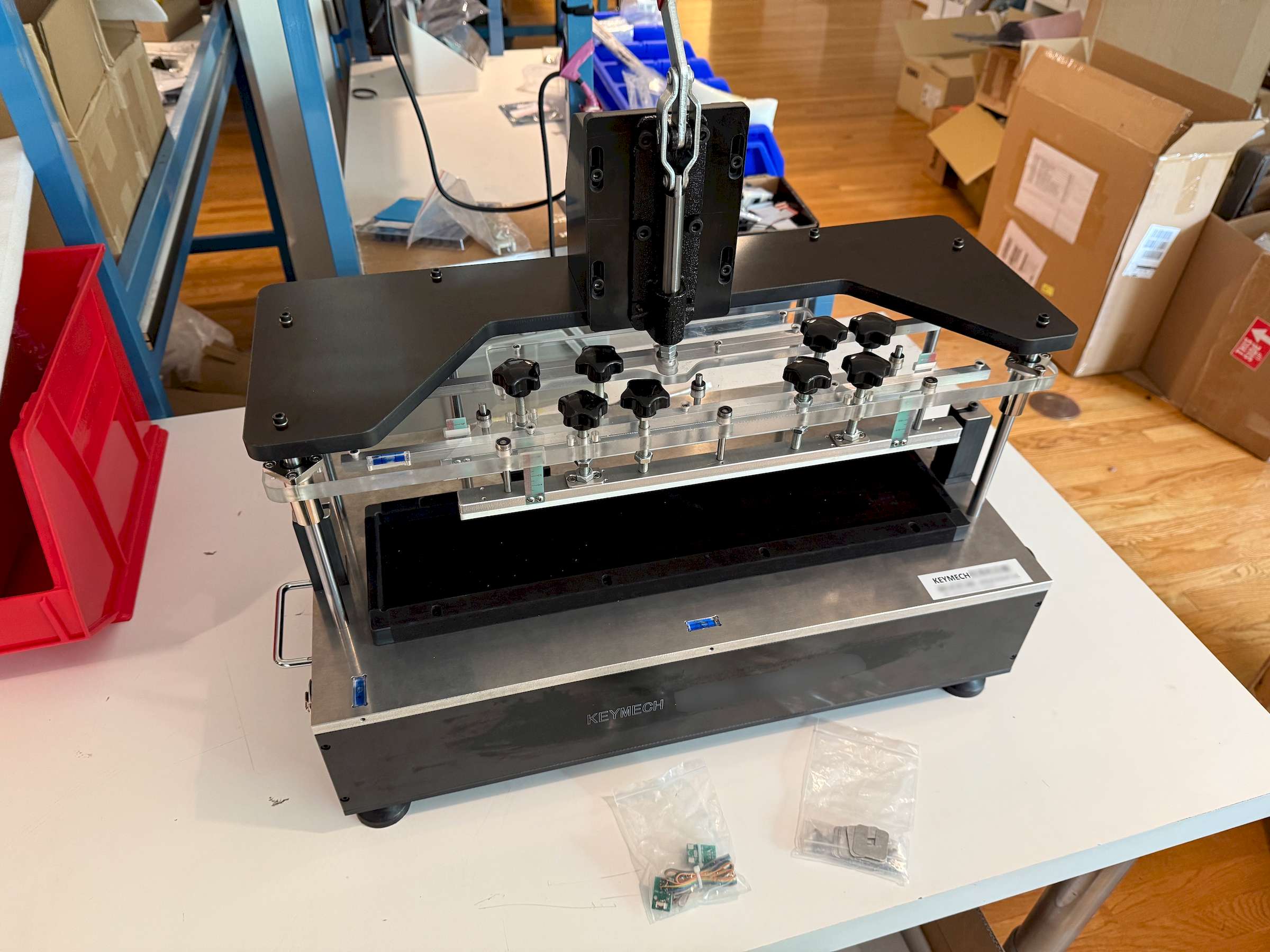
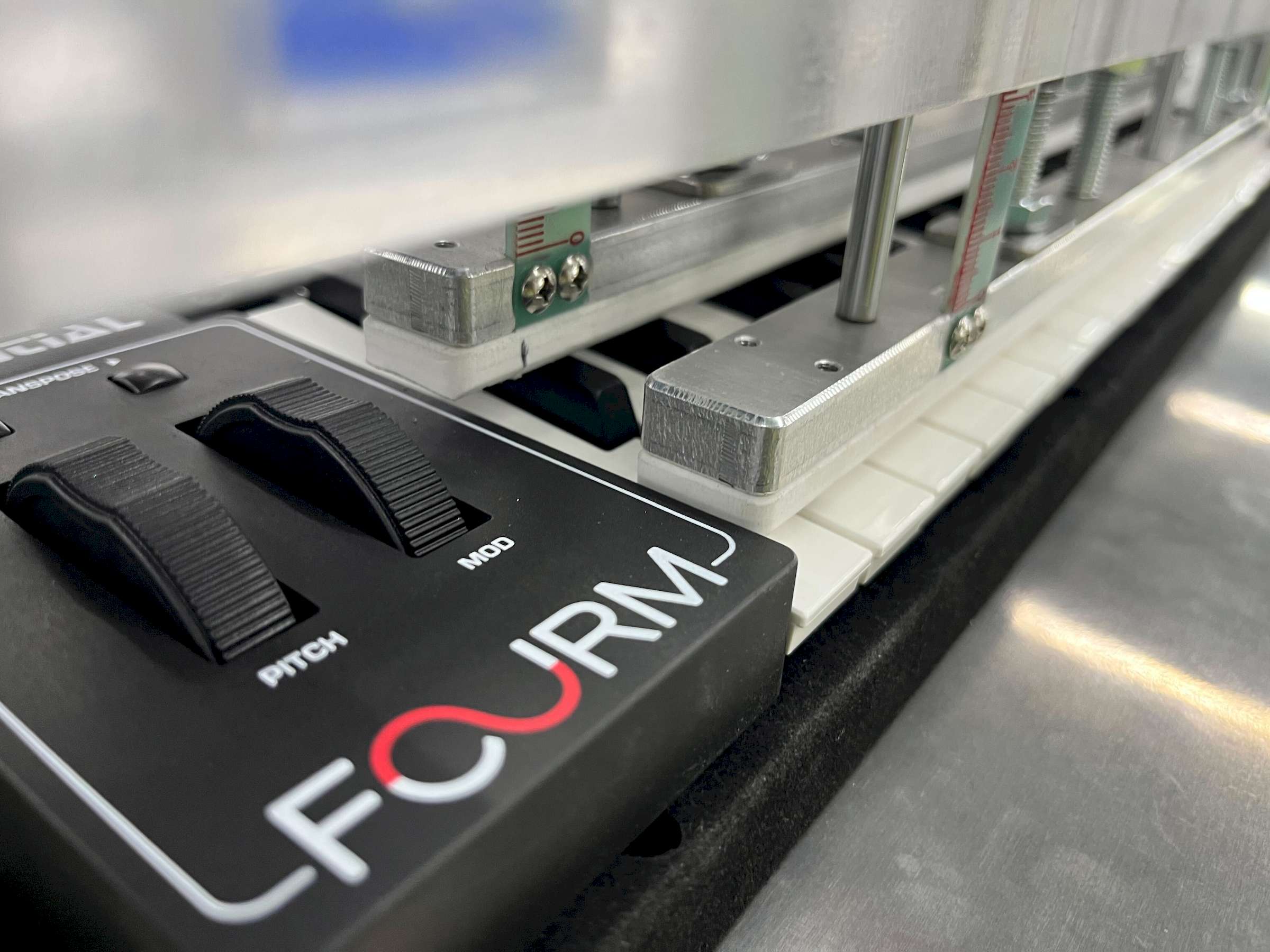
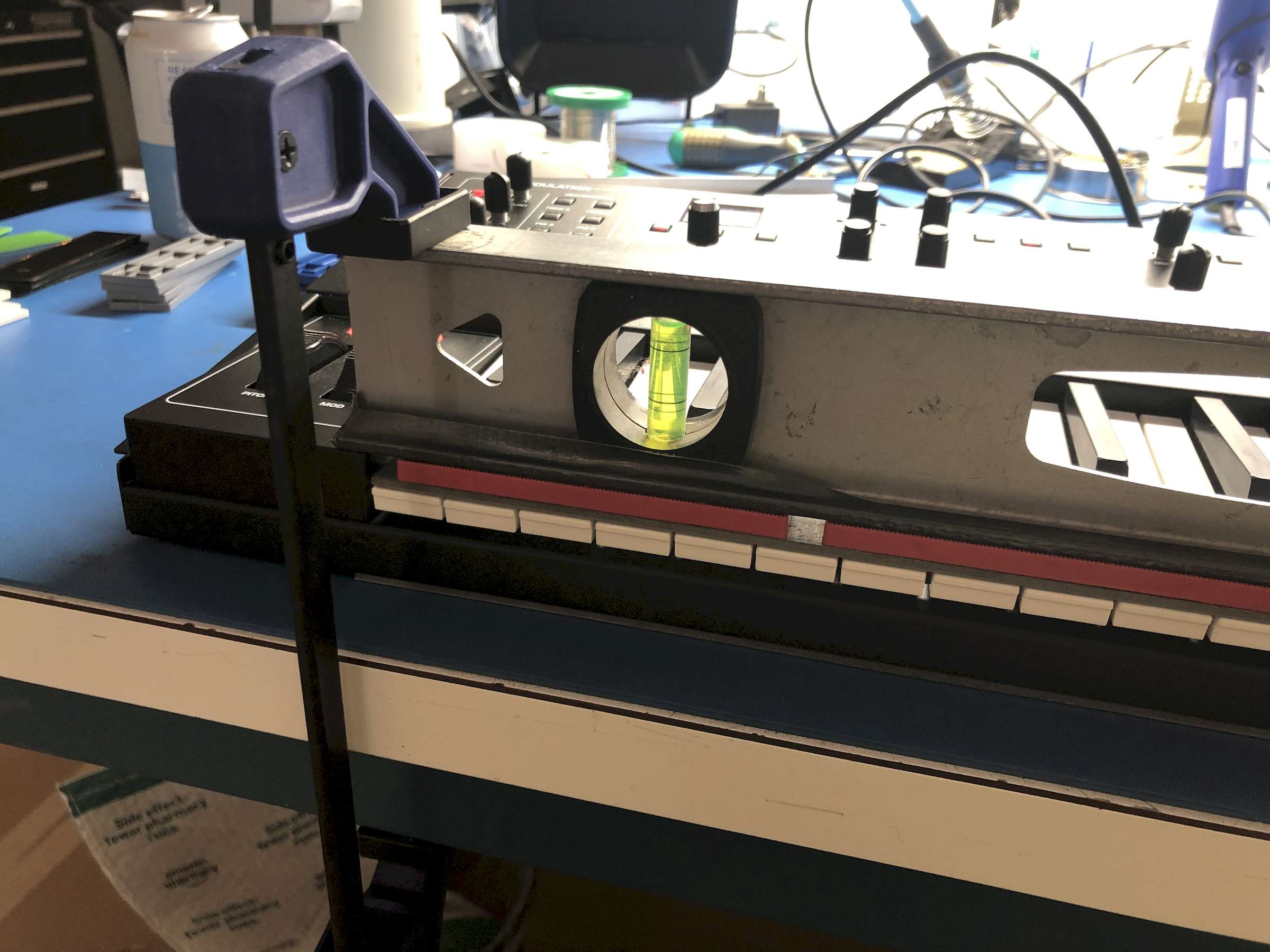
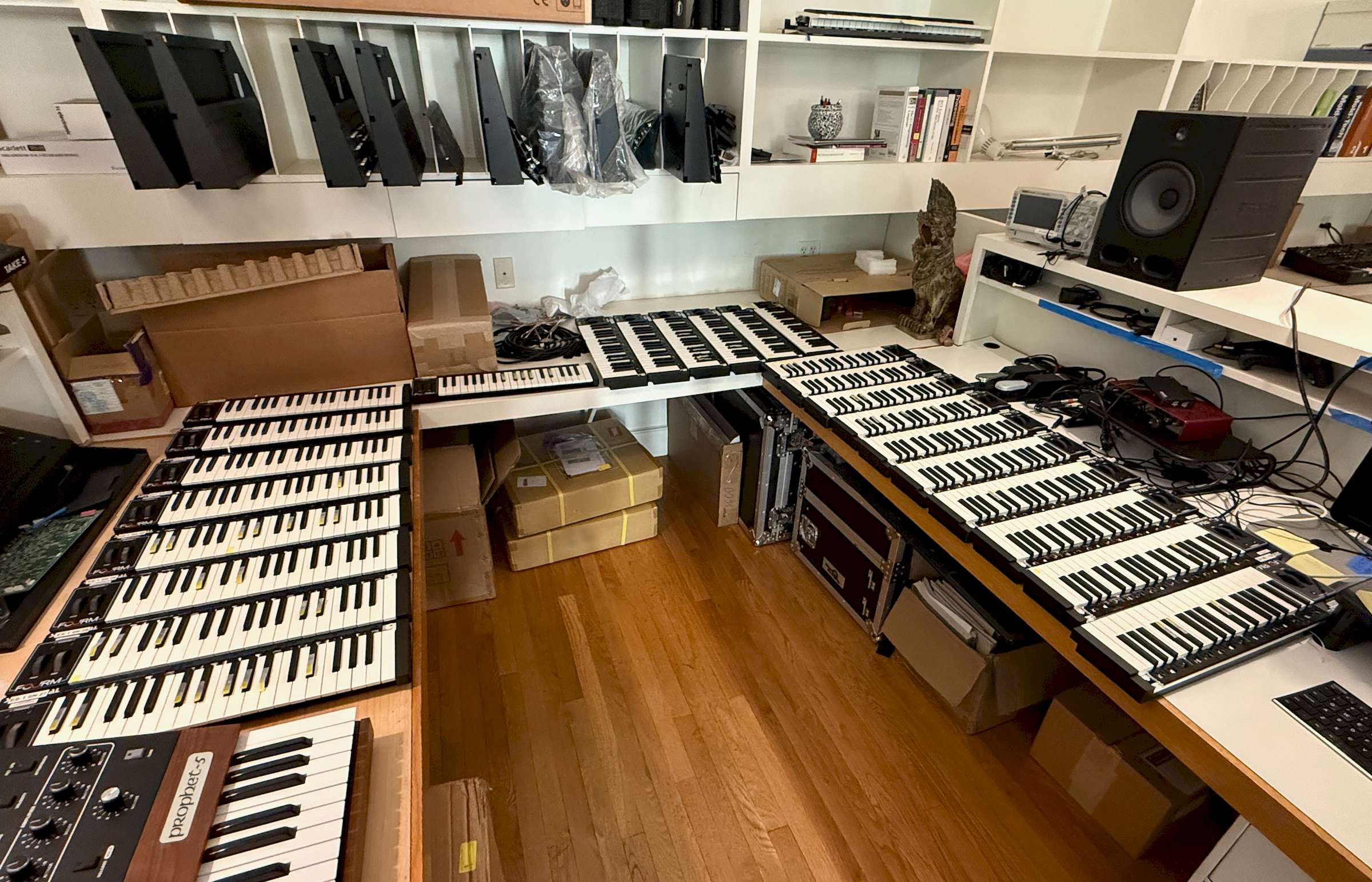
Thanks to David for these photos. Yes, we got the CEO of Sequential snapping pics of the dev setup for us.
Keymech PCB:
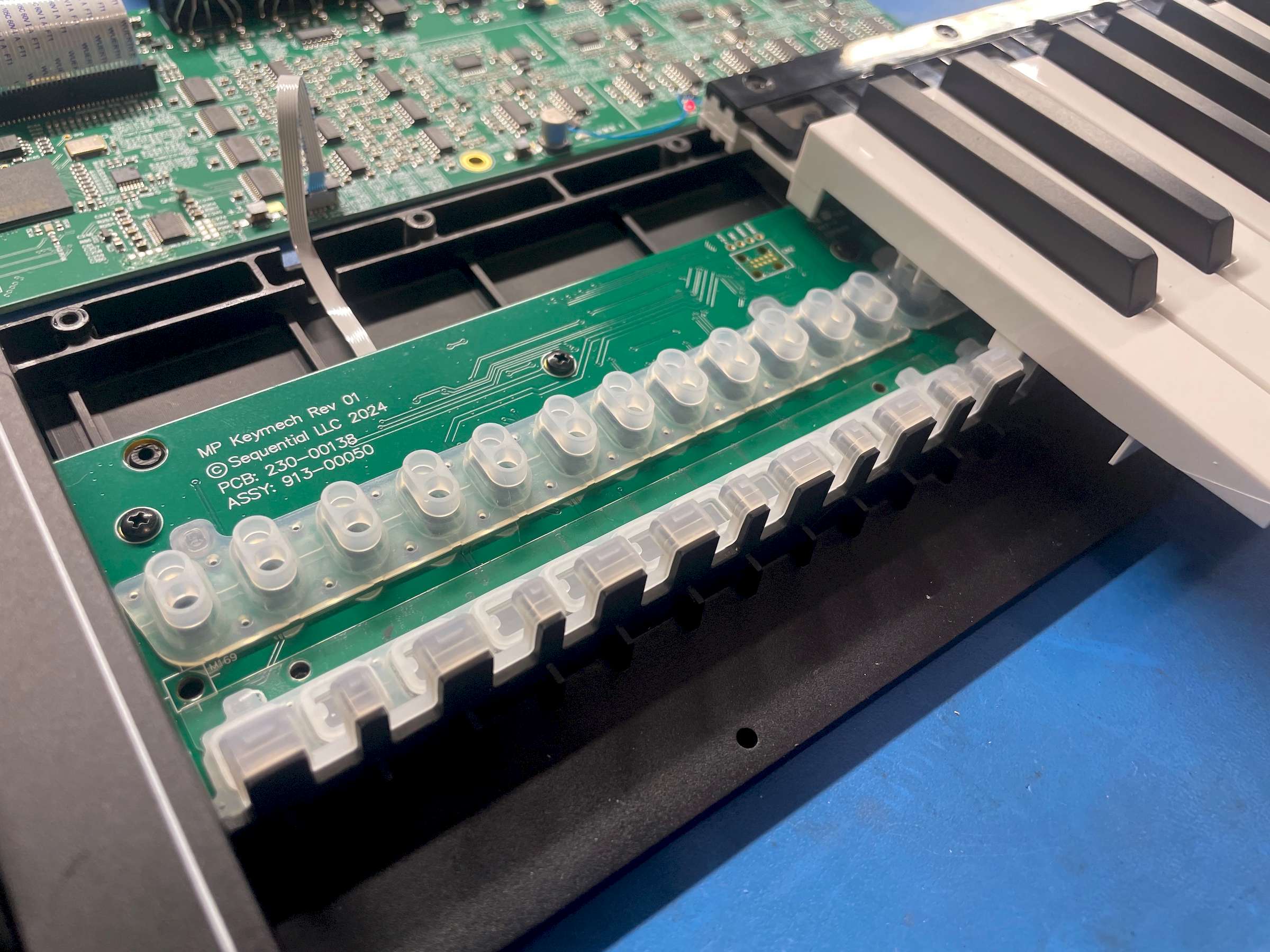
Early key pressure testing jig with fine-increment adjustable key depression.
Pressure plungers testing key-to-key consistency.
Checking uniformity of key loading.
Comparing multiple keymechs to validate unit-to-unit consistency.
Voicing and completing the synth
Prototyping and iteration also apply to the top panel of Fourm, as with any new instrument, says David: “Our mechanical designer, a guy named Steve Starkweather, started to figure out how you could laser-cut some thick vinyl to make the panel design. It’s a great step in helping you see, does it feel right, is the spacing right, can you put your fingers around everything — you can print it out on paper, but it somehow doesn’t quite tell you that three-dimensional story the same way. If you wait until you’re down the road with sheet metal, it gets really difficult to change things then.
At some point, there’s a final design freeze, and it’s off to the sound designers — partly internal, but largely Sequential’s go-to group of 15-20 external voice designers.
“It’s always a tricky moment, because you have to stop messing with it now,” says David. “So you’re waiting relatively late in the design cycle before you kick that off. And with a product like this, there’s a beautiful discovery process for the design team where it’s like, oh, they just made it do that!”
So that’s why it’ll be great to hear what you think when you get your hands on Fourm to try it. (I guess I’ve just argued why there still need to be music stores and synth shows.)
“It’s hard to separate the effect of the polyphonic aftertouch from the experience of playing it,” says David.
Full specs (because why not, this isn’t print, we’re not running out of column space):
Synthesis
- Two Prophet-5 lineage analog oscillators per voice
- All oscillators have simultaneously selectable waveforms, including the LFO
- Oscillator B supports low frequency modes for use as polyphonic LFO modulation
- Classic Prophet-style Sync
- Variable square wave pulse width per oscillator (PWM)
- 4-Pole resonant lowpass filter drawn from the Prophet-5, revs 1 & 2
- Filter enhanced with bass compensation for thick sounds even with high resonance
- Filter can be driven into self-oscillation with the resonance control
- Filter Keyboard tracking: quarter, half, full
- Feedback with an aggressive drive circuit for extra edge
- White, pink, and violet Noise types allow for greater sonic variation
- Four-stage (ADSR) filter envelope generator for tone shaping and assignable modulation
- Four-stage (ADSR) Amp envelope generator for volume shaping
- Velocity modulation of envelope amounts for dynamic performance
- One global LFO for creating movement in the sound
- Seven LFO wave shapes: sine, sawtooth, reverse sawtooth, square, S/H (sample and hold), Noise, and DC
- LFO can synchronize to tempo at different step values
- Four LFO wave shapes can be selected simultaneously for complex modulations
Enhancements
- Up to six polyphonic aftertouch destinations selectable simultaneously
- Polyphonic aftertouch destinations: oscillator A frequency, oscillator B frequency, filter cutoff, amplitude, LFO frequency, LFO amount
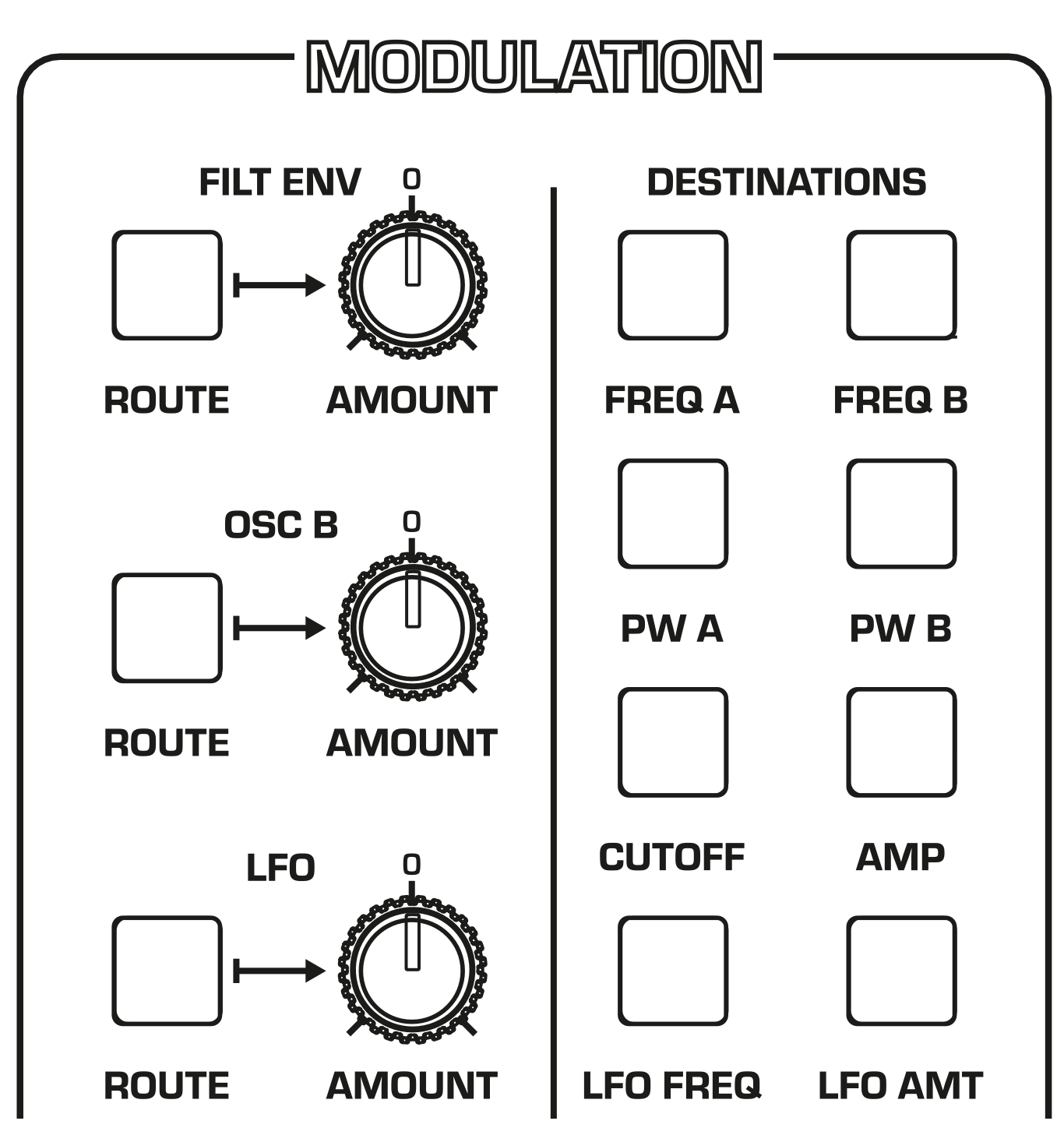
- Pro-One style top-panel modulation matrix
- Two modulation buses with multiple sources and destinations and the ability to combine both buses at the destination
- Top panel modulation sources: filter env, oscillator B, LFO
- Top panel modulation destinations: oscillator A frequency, oscillator B frequency, pulse width A, pulse width B, filter cutoff, amplitude, LFO frequency, LFO amount
- Polyphonic glide (portamento)
- Unison (monophonic) mode with configurable voice count, from one to all four voices, plus chord memory
- Vintage setting recreates classic synth characteristics by adding voice-to voice variations in component behavior
- Arpeggiator with step sequencer mode
- Polyphonic step sequencer with up to 64 steps and rests
- Sequencer supports acid-style glide per step
- Sequencer can be used as a modulation source
Hardware
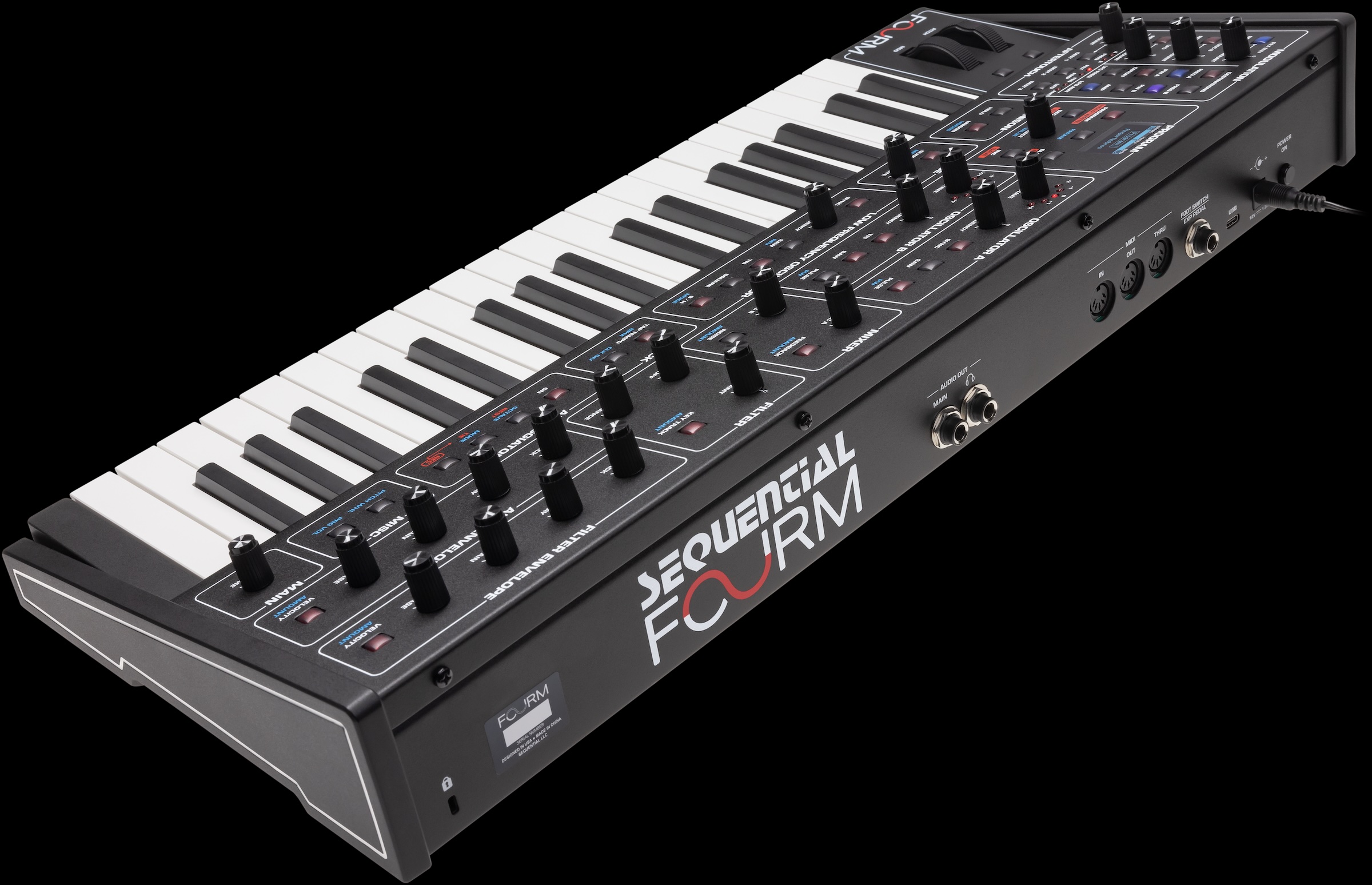
- Tactive™ 37-note slim-key keyboard with polyphonic aftertouch
- 100% analog signal path
- Intuitive, knob-per-function layout
- Spring-loaded pitch wheel with selectable range per program (1 to 12 semitones up and down)
- Pro-quality, all-steel chassis
- 22″ L x 9.88″ W x 2.75″ H (56.2 cm x 25.1 cm x 7.0 cm)
- Weight: 8.76 lbs. (3.97 kg)
Inputs and Outputs
- Main output mono (1/4” jack)
- Headphone output mono (1/4” TRS phone jack)
- MIDI in, out, and thru ports
- USB-C for bidirectional MIDI communication
- Footswitch/expression pedal input
- Pedal input also supports trigger and gate signals
- Separate power switch
- 12V DC 1.2A power supply, center-positive (included)
- Power supply can be plugged into an AC outlet capable of supplying from 100 V to 240 V at 50 Hz/60 Hz
- 14 Watts maximum power consumption
https://sequential.com/modern-analog/fourm/
I’ll be honest that I think it’s a little hard to get a feel for this instrument from the online videos — listen to the embedded sound demos on Sequential, esp. But making sure you turn up the quality settings on YouTube so Google doesn’t garble the sound, I think the easiest way is to check this video from Sweetwater just to get a sense of some of those presets.
Previously — and a great tour of what the Prophet-5 was about and some of the roots of the Fourm: