In case you hadn’t been watching KORG software releases lately, here’s a secret: they’re suddenly awesome. New models are coming far closer to the originals, featuring more and more perfect recreations of the best of KORG’s digital and analog back catalog. Today we get some bombshells: the flagship KORG grand piano engine, but most importantly, 1995’s Trinity and 1977’s PS-3300.
I’ve been playing with late builds and … KORG may now have the instrument catalog to beat. And today’s a big launch day.
Okay, the SGX-2 grand piano engine is nice enough, but more like an extra — it’s the flagship engine from KRONOS and NAUTILUS, it includes Italian, Japanese, and German editions in various grand and upright combinations, and it leans heavily on sampling — per-key stereo samples for each note.
That’s nice enough, but pianos you can get elsewhere. TRINITY and PS-3300 are the big story.
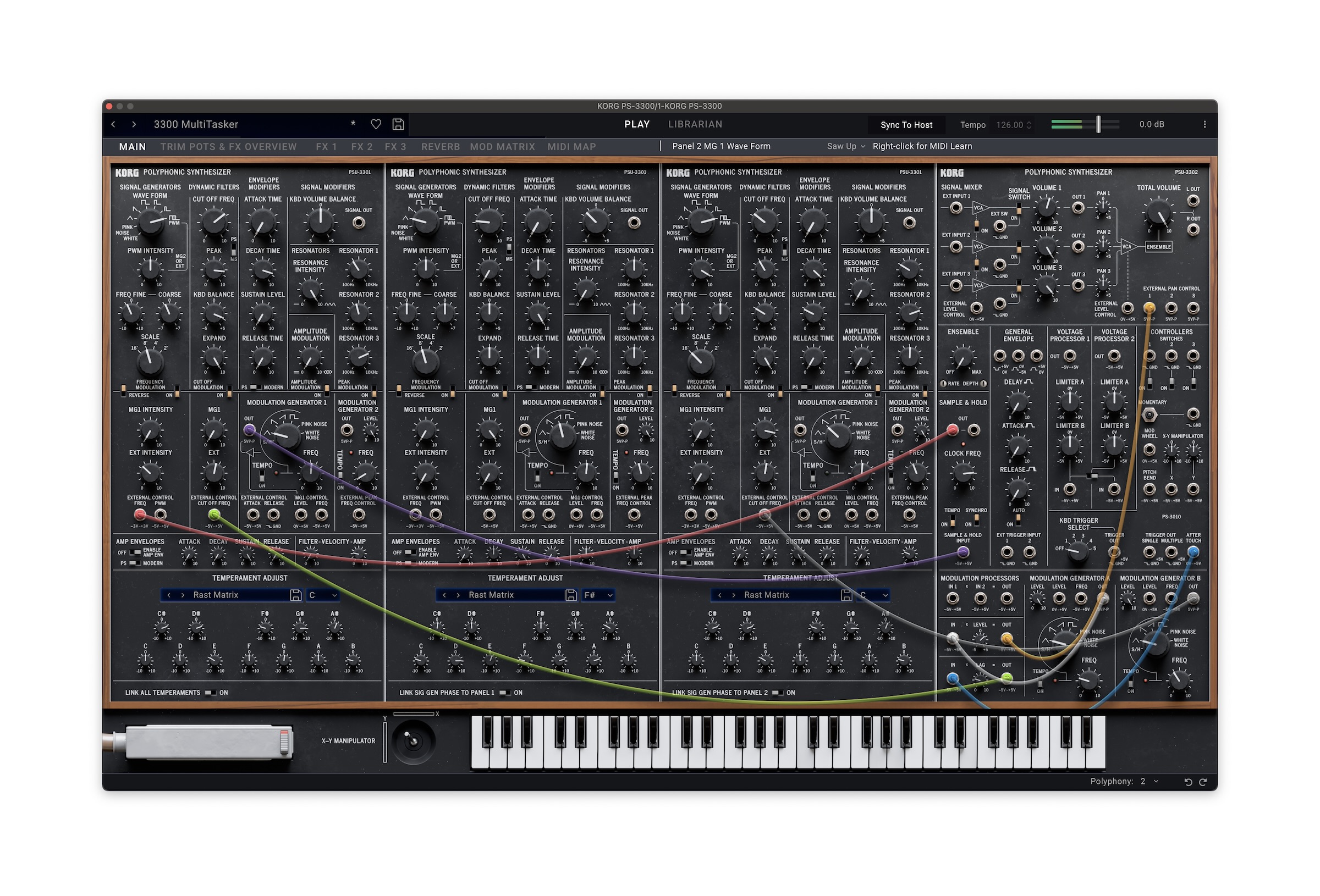
The PS-3300 is the polysynth too many people forget — which is a shame. Coming out just before the MS-20, this semi-modular beast had unique filters (not the MS-20 filters, though this software lets you choose), octave-divider oscillators, and a bunch of available patching and modulation. The onboard three-band resonators give you other unmistakable timbral control and effects. The software also lets you choose the modeled envelopes or modern shapes, plus a choice to use two envelopes (amplitude/filter) instead of the original’s one. We got to see some of KORG’s modernization efforts before; in 2024 they did a full-analog rebuild as a special edition. Now it comes to the rest of us in a more accessible, affordable software form. In this 2025 software edition, some other highlights:
- Additional Modulation Processors, including a Multiplier, Attenuverter, and Lag Processor, Generators (LFOs)
- Modeled Ensemble effect from the PS-3100 and PS-3200
- White and Pink Noise, Sample and Hold modulation options (for direct access, or the convoluted way they were available on the original, too!)
- Option to link inter-panel oscillator phase, for string synth and combo organ sounds
- Tempo sync throughout
- Expanded pitch range
- Mults and lots of other conveniences
You can also import programs from that hardware reissue — you lucky dog, you.
The funny thing is just how modern this poly can sound. Something about all that ’77 weirdness has come full circle and produced a unique synth that feels at home in 2025. It sounds “vintage” and fuzzy when you want it to be, of course, but you could also slip it into a composition and have people wondering, what is that? There’s even full tuning/temperament support in there. It’s just incredibly deep.
There’s not a video but I’ll try to make one up soon. But Marc Barnes (Angelstar Scotland) was on the beta and factory sound team and has this gorgeous demo of the native version — plus the “director’s cut” presets that didn’t make it into the software will be available on his account soon:
They’ve done a lot of modeling on this one, so it really breathes and comes alive. That’s the sense I got on their exceptional ARP 2600 recreation that was part of the last Korg Collection update (v5). Here, you get everything from details of the filter path and envelope-to-filter modulation to the way the noise works. Biggest of these is per voice variations, and — uh, let me let them explain:
A major aspect of the PS-3300’s sound is that each note on each of the three synth units has its own dedicated wave-shaper, filter, envelope, and VCA, for an astonishing total of 144 separate voice circuits (expanded to 180 in the software). Korg’s Component Modeling Technology (CMT) includes modeled component-to-component variations for each of those voice circuits, affecting almost every synthesis parameter. Envelope times, for example, can vary by up to 2x from note to note. Vibrato depths vary subtly, creating a fuller, more organic sound. For each individual program, you can dial in as much or as little variation as you like.
All of that nuanced, idiosyncratic analog variation is the opposite of something like a KORG Trinity.
Of course… the other thing we’re really excited about is the KORG Trinity.
Now, there’s something a little amusing every time we talk about “modeling” digital. (Each byte is painstakingly the same as the original bytes!) But before you scoff, there is some modeling on here: they did in fact model the original D/A converters for accuracy. Other than that, it’s maybe less accurate to say that they modeled the ACCESS (Advanced Combined Control Synthesis System) sound engine from the original as they reproduced it in full 16-bit/48kHz glory with all the editing and features of the original.
And there are a lot of details there, meaning the involvement of the original TRINITY developers really does matter here.
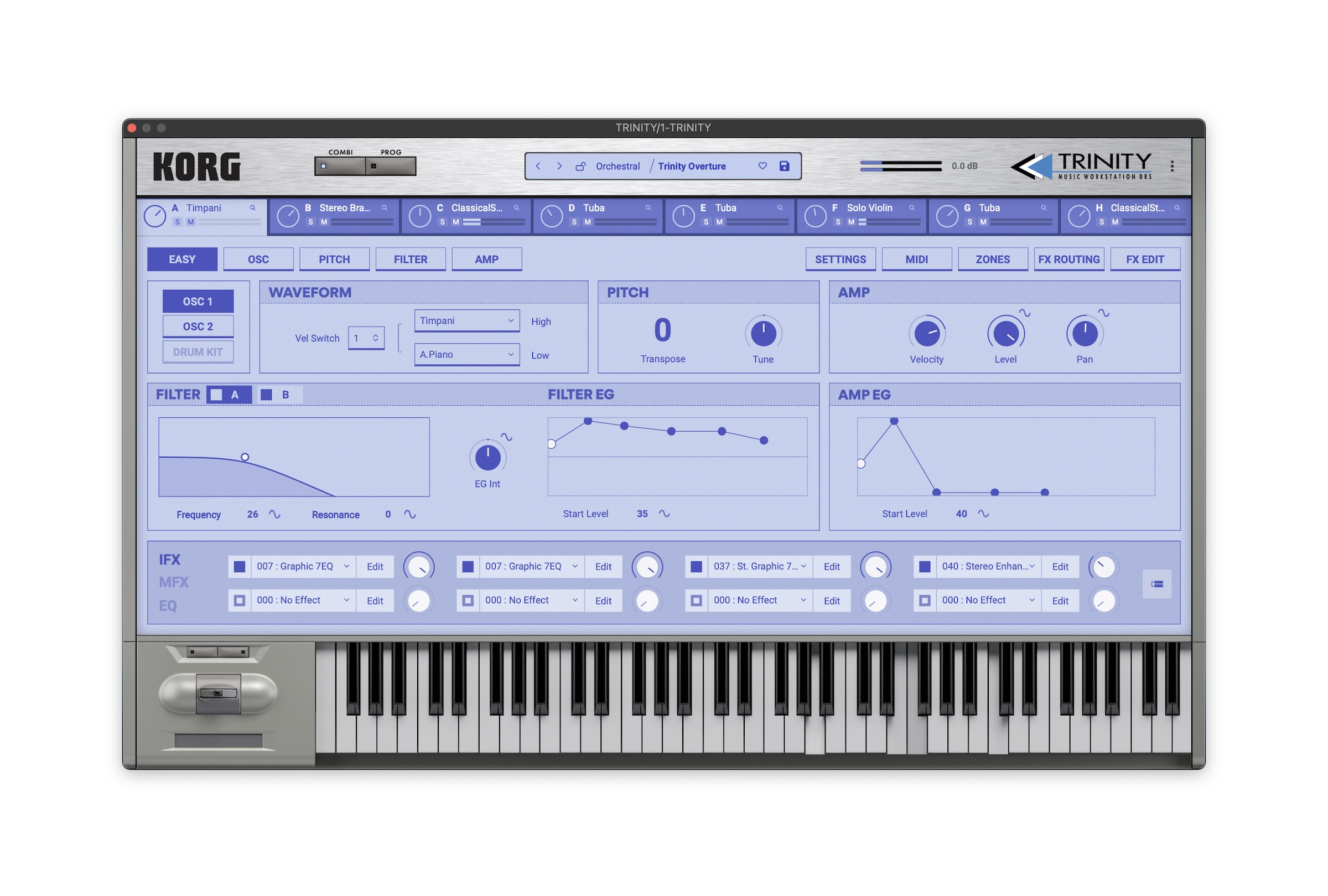
You get 2,000 Programs and Combinations to transport you back to 1995, and I have to say, I was really struck by how gorgeous these are. All the expansion sample options are there, all the tweakable parameters, in 8-part multi-timbral glory with 8 insert and 2 master effects.
I didn’t own a TRINITY, so I’m discovering these just like a new generation of plug-in users who weren’t even born yet. But that means TRINITY needs to hold up. Pure ’95 nostalgia would be frankly silly. The funny thing is, this thing is a wonderful combination of dreamy 90s lushness and modern, friendly UI, plus now-unlimited polyphony and effects inserts — until your CPU finally cries out for mercy. (Okay, yes, I may have tried some black MIDI on a multi and even my MacBook Pro does eventually have limits.)
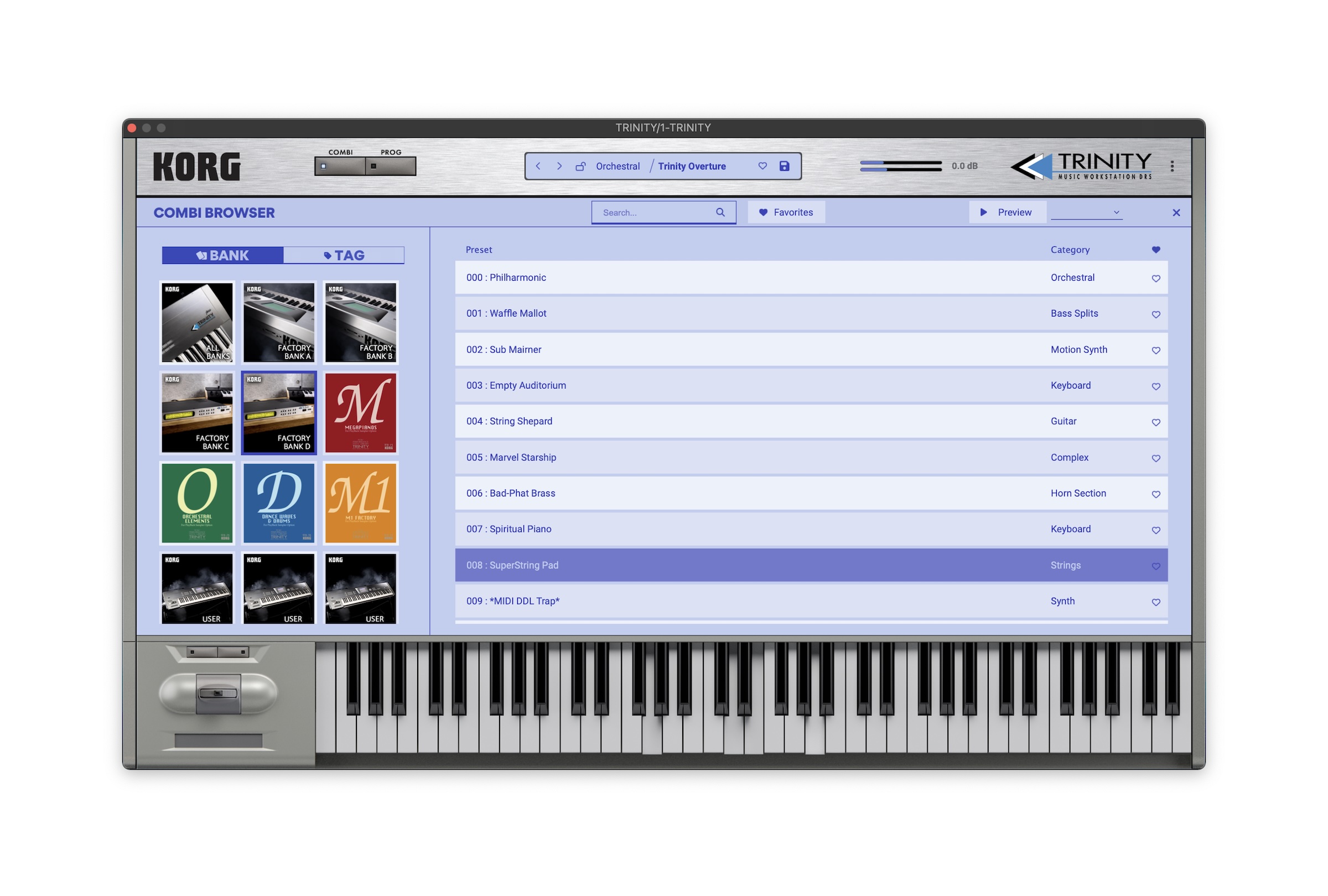
It’s also loaded up with extras: TFD-1S MEGA PIANOS, TFD-2S ORCHESTRAL ELEMENTS, TFD-3S DANCE WAVES & DRUMS, TFD-4S M1 FACTORY expansions are there, along with the 1998 TR-Rack.
There’s also a deep, deep effects section — the full range of KORG effects is also a big part of the appeal of KORG’s software reissues.
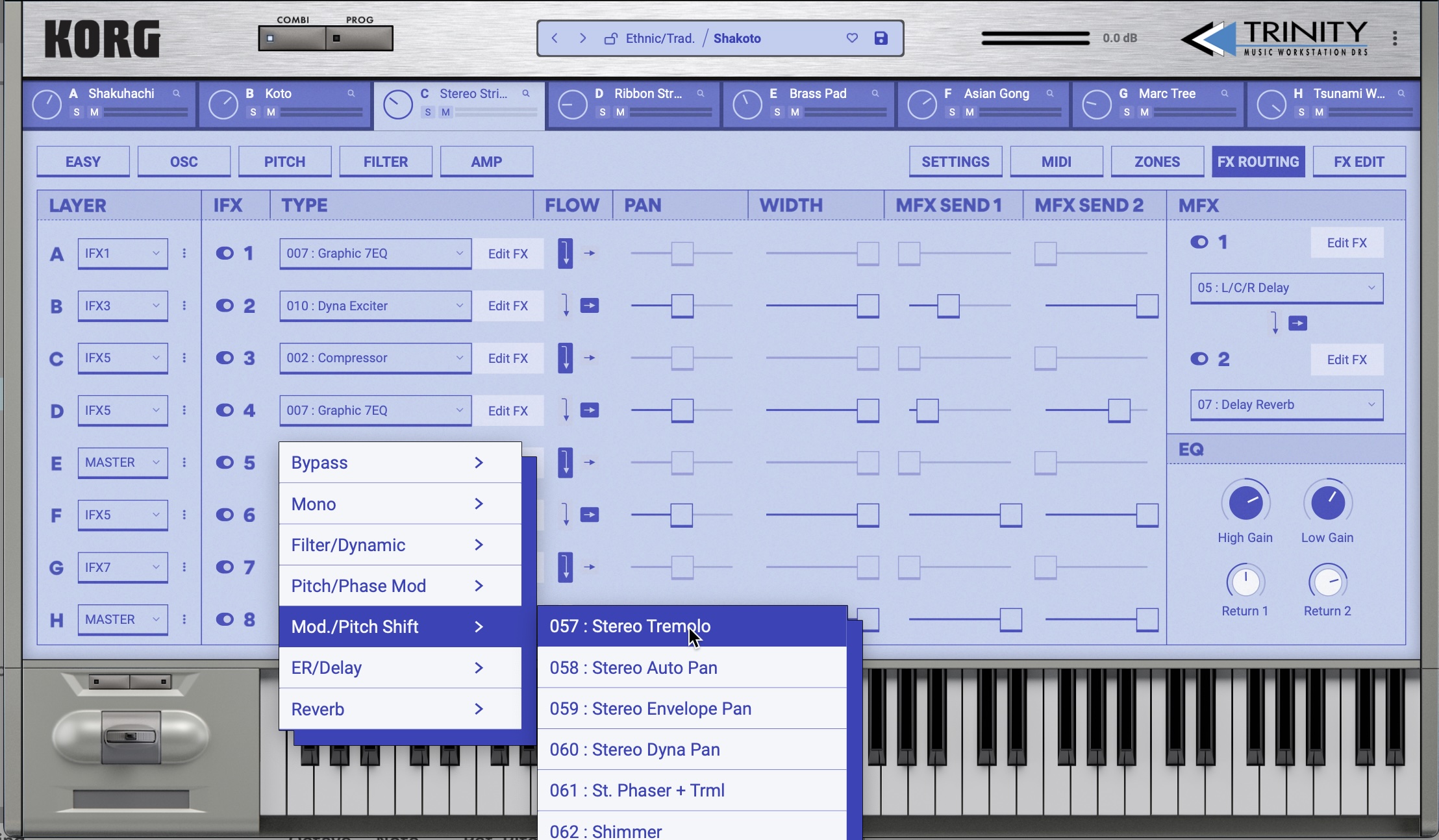
Crucially, you can also browse easily through this. Part of why I enjoy digging into the Roland Cloud 90s PCM synths is actually that you can’t browse them in any logical way, so you can just needle-drop on some weird PCM banks and build up your own sounds. But TRINITY really did need a guide, and this is actually (cough, Roland) how it should work.
But this is the most ’90s fun you can have in a single plug-in apart from the Spyro the Dragon collection I mentioned over the summer. You’ll know the sounds right away if you’ve ever watched 90s TV, for instance. In fact, I don’t even remember this part of the 90s all that well, and even for me, the TRINITY plus Spyro combo would be enough to hide out for months on end in some synthy 90s escapism.
There’s an intro sale on this now, including bundles, available at Plugin Boutique (plus the BEATSURFING giveaway I already mentioned, through October):
If you buy something from a CDM link, we may earn a commission.
You know, this is just too much 1995 not to do this — apologies to 2020s and 1977 (trigger warning, discussions of eating disorders and self harm):
Our version of this show, where it’s all TRINITY presets, would not have made great TV, but hey.