As part of CDM’s year-end coverage, I’m rounding up some of the best music and sound design in games. There’s nowhere better to start than Despelote, a beautifully designed and directed game that will move you by putting you in the shoes of a kid in 2001 Quito, Ecuador. It’s a master study in weaving sound and music in a way that both triggers sense memories and transports you inside a life experience.
This video explains the mechanics and why sound and music works:
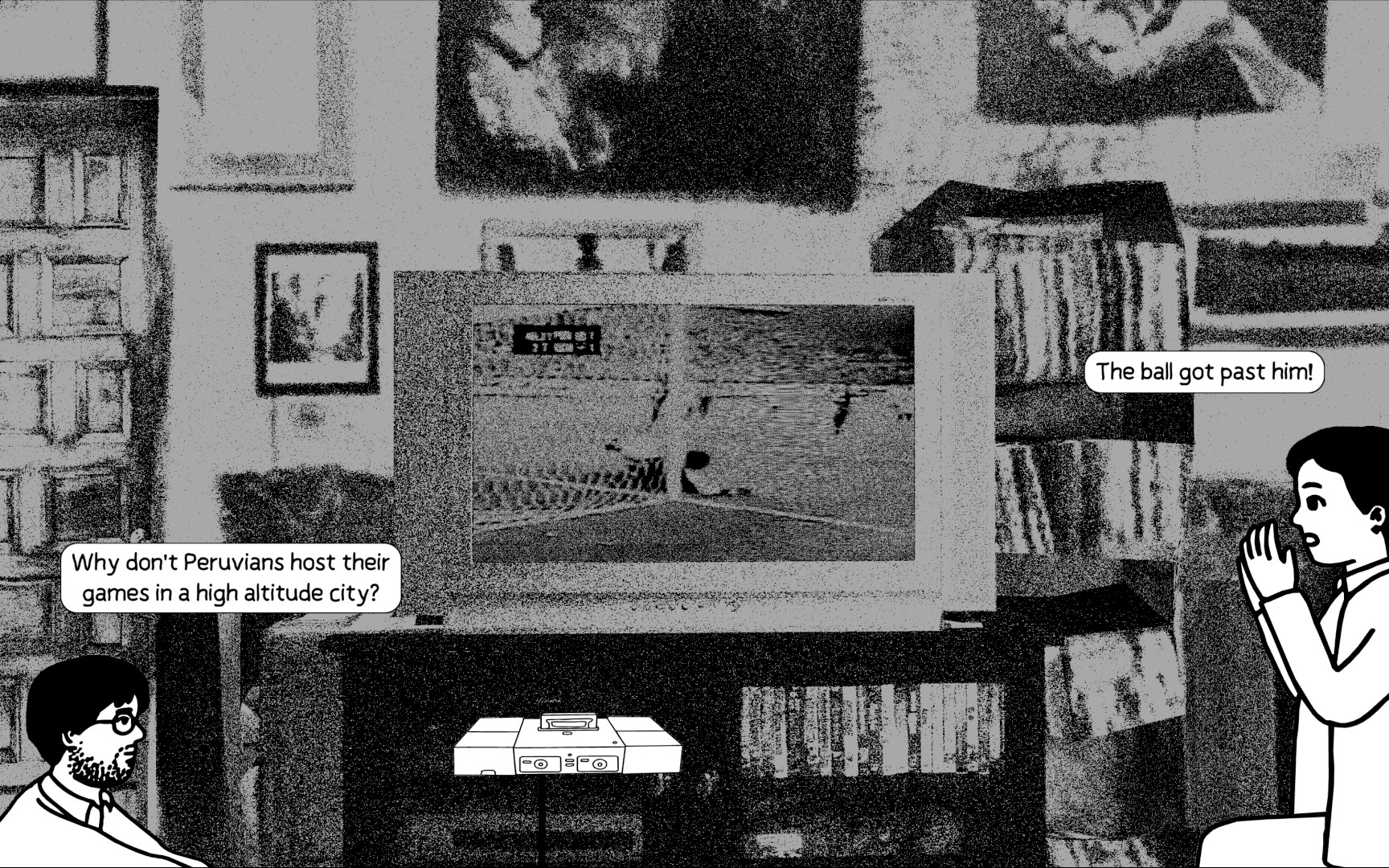
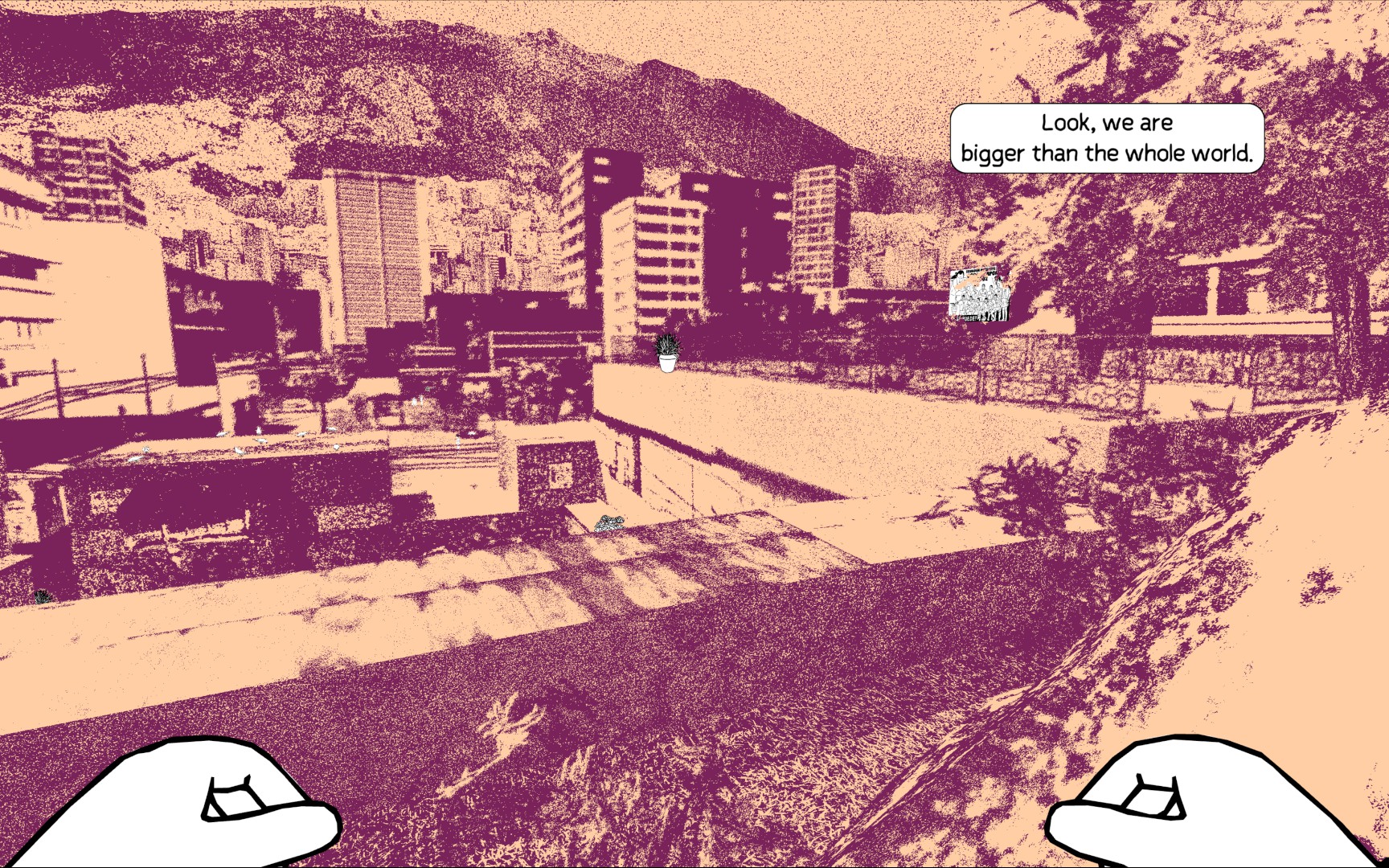
This title has already won plenty of well-deserved critical accolades and award nominations in the gaming world, but it also exemplifies the potential of field recording, spatialization, mixing, and music direction. Every snippet of conversation and ambient sound, combined with the game’s gorgeous duotone and hand-drawn art style, sets your imagination alight in Quito, 2001-2 and onward. Gaming as a medium can be an exercise in projection and empathy — even from angles that theater or written fiction might be unable to achieve.
I can see someone else is as enamored of all that sound work as I am, collaging together lots of the sounds, to give you a taste (and added reason to go buy this now):
Despelote is the work of creators Julián Cordero and Sebastián Valbuena — a creative marriage of coder/designer and composer and visual artist. And that has the feeling of a classic collaboration — Julián Cordero as librettist, Sebastián as sound and visual artist. Sebastián Valbuena also hand-drew all the characters, so if his sound is scenography, the scenography is his, too — and takes a theatrical approach, while retaining that kid-style charm, seen through those eyes. (The game is set as autobiography, starting with Julián’s eight-year-old self.)
They had a great mentor, too — Gabe Cuzzillo, Cordero’s prof at NYU, is the creator of Ape Out and its fabulous violent-jazz-improv premise, which also blurs the line between music, sound effect, and gameplay action mechanics.
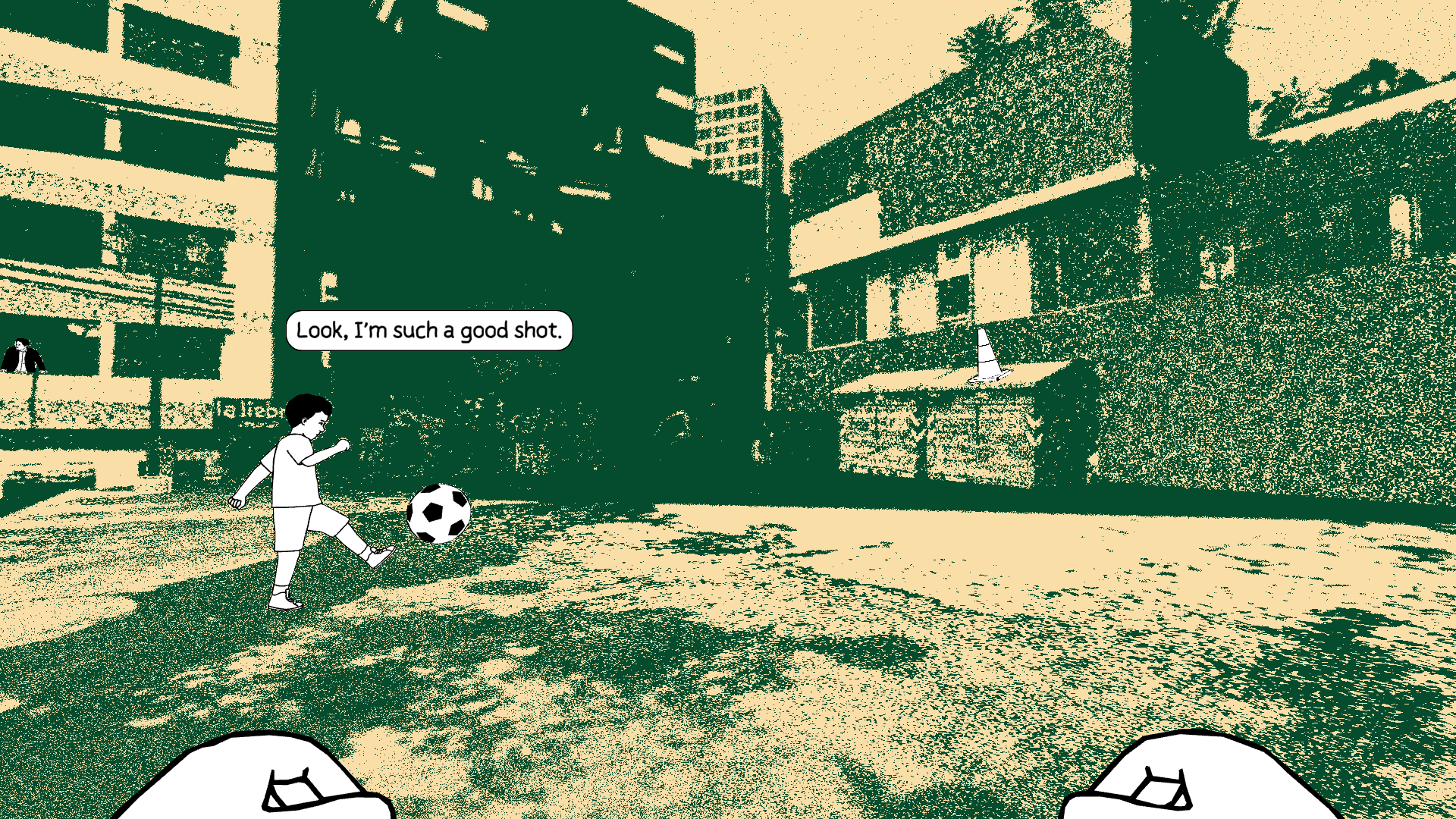
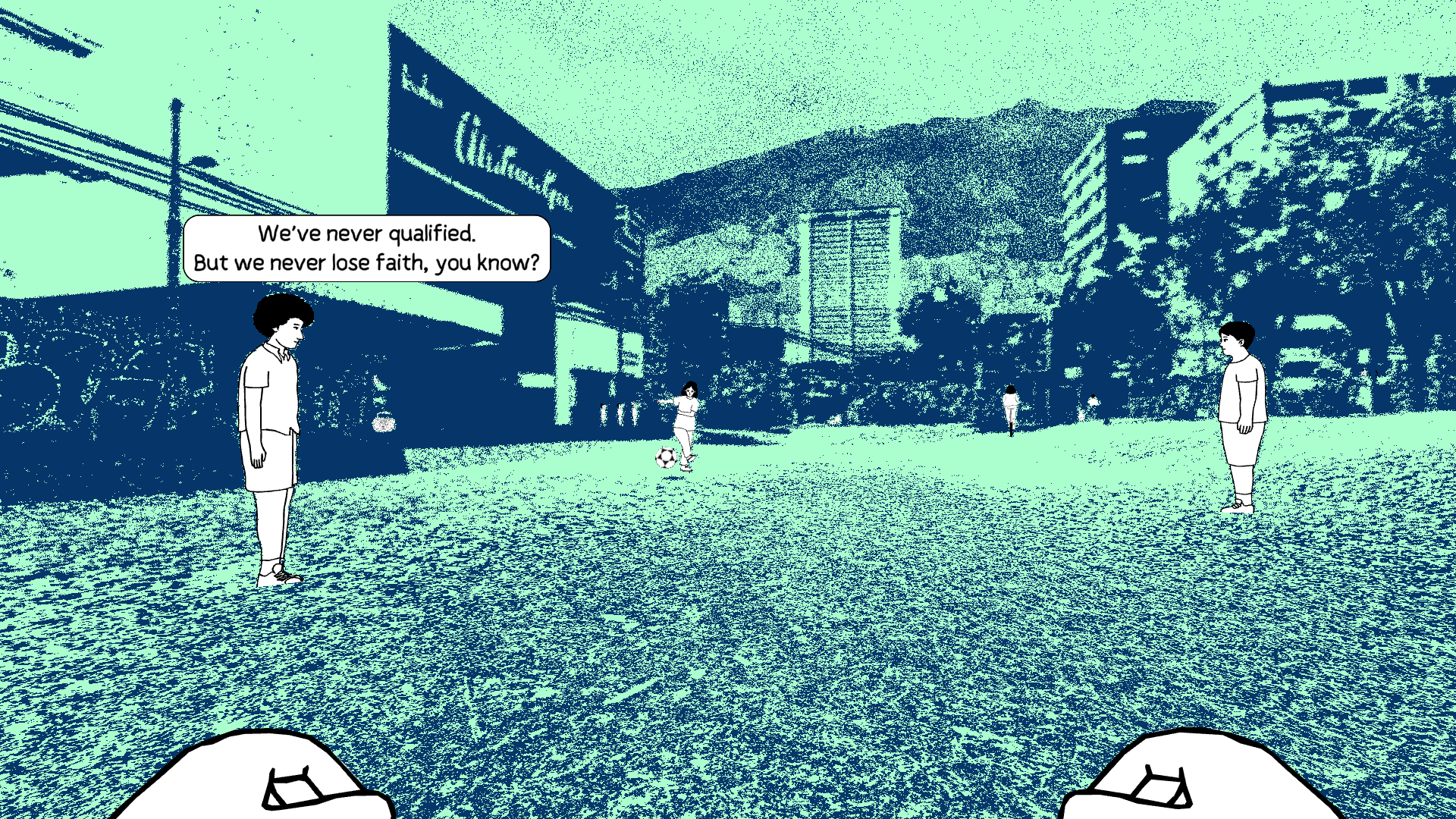
Valbuena’s music score makes the musical and foley fragments feel like a single, fluid texture — maybe more the way we really remember our own lives through music, mixed up with places and voices from our past. The game mechanic itself, centered on an ever-present soccer ball at your feet, requires a kind of constant motion, propelling the narrative forward through time. The music and sound add to that sense of momentum, but also give you the feeling of time stretching out. You’ll want to stretch out your time just like those kids bending the rules of when recess ends.
Under the hood, Despelote is built in Unity engine, with sounds in the ubiquitous FMOD engine. FMOD’s integration with Unity is particularly musical; if anything, this combination has exceeded a lot of the supposedly audio-focused tools for ways of weaving sound scores into the spatial, interactive environment. There’s an engineering model here as well as a compositional one. We might well ask why so many of our music tools are still rooted in 1980s studio production metaphors.
It’s well worth listening to the duo talk about the game — even though it feels redundant, in a way, in that all of this is so clear when you play. So much of narrative at the moment is squeezed through algorithms, short-form content, even books dealing with publishers — this is such a personal take, by contrast. It tells a story in a 360-degree way when other media are failing to do that.
Ian Berman worked as the sound designer on the title, which involved a trip out to Quito. It’s great that he also has some background in film; that cinematic quality comes across, too — working “on location, in the style of an indie film” with lavaliers even on the dialog (like the developer’s parents):
It’s real-for-real, despite all the tools. That feeling that you’re experiencing this like you’re there, of course, is because from the perspective of the sound, you are there. Dialog is in the room. Field recordings are from the location.
Oh yeah, and as a side note, there are some deep cuts as far as soccer game references in there, even as the game is trying to be an anti-FIFA.
Look, I was terrible at all sports. I was eight years old in Louisville, Kentucky, not quito, Ecuador. And I felt deeply moved from the moment I started this game. It’s pure magic the way this game has brought people together, and it’s about more than just a sport. You’ll find countless reviewers saying the same thing, often in different languages. “
“Never has a game put me squarely into the shoes of my own childhood and just said, hey, remember?” as this Canadian game reviewer puts it:
That speaks to the power of music and sound in emotion and memory. It illustrates what the goal of all that field recording and spatialization can be. It makes the sound into a time and space machine, an imaginative tool.
If you need a trip to another — even if you were a nerd and never cared about soccer/football — you just have to drop what you’re doing and fire this up. This is some Quantum Leap-level experience. You’ll find it takes you back to childhoods far away from Ecuador, and that by the end has you thrilling for the Ecuadorian team like you grew up with it.
And at a moment when people say that music and sound have nothing to say, maybe they’ve just been looking in the wrong places.
(Speaking of memory, I get an added twinge seeing Panic on here — I used v1 of Transmit, Coda, Audion, and Candybar.)