Surprise! We get a second free Robert Henke device for Ableton Live Suite, built in Max for Live. And this one is inspired by 60s techniques of Andy Moorer and Manfred Schroeder, and eminently hackable if you’re ready to dig into the patch. It’s “not exactly a realistic room simulation.”
Robert is sharing these as he builds them for a project, but that’s the way. For anyone wondering how to dedicate themselves to building, having a project in mind and even making up a deadline is one solution. The cave photo above is from Robert’s project page — explanation why is below.
I’ve been thinking a lot about AI and how it removes context, even in coding. I remember talking to Artemiy Pavlov about how he developed Sinevibes’ Hollow while on a beach in Greece, and put that feeling into the DSP. For Lanzarote Verb, we get the cave pictured above. As Robert writes in the description:
“I especially like the rough, scattered reflections it produces when diffusion is low. Imagine crashing waves on black volcanic rocks in a cave. That’s why I named it ‘Lanzarote Verb’.”
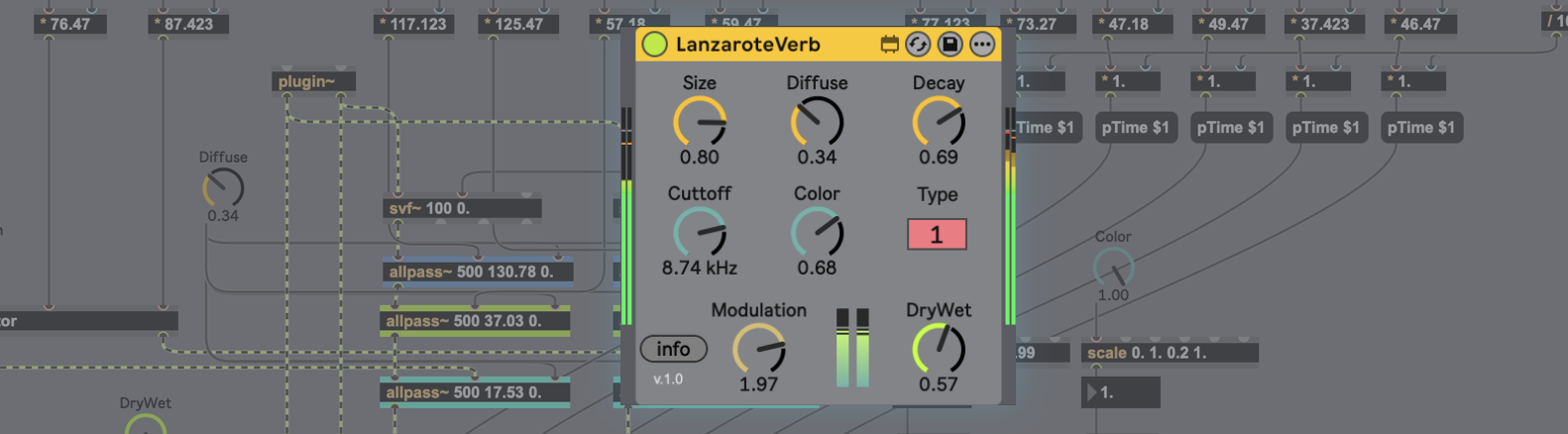
The key here is that the oldschool techniques here — “classic allpass- and comb-filter delay configurations” as found in early 60s reverbs — gives you reflections that you hear as distinct delay taps. It’s almost like a reverb deconstructing itself back into the delay network on which its based. But as Robert observes, that has its own aesthetic, and its own analog in nature in environments where you hear distinct reflections. (For me, I can hear the sound against the rocks in an enclosed grotto near Jounieh, Lebanon. And and… I could think of these all day.)
Here’s a quick experiment with AAS Multiphonics CV-3.
I’ll leave the rest to Robert.
https://www.roberthenke.com/technology/lanzaroteVerb.html
But again, for patchers:
“This device is hacker-friendly. If you have some Max programming knowledge, you can easily replace or expand the 12 delay patterns.”
And I love that. I can imagine different reflection patterns, resonances, and so on. It’s a reminder that sometimes looking back is as interesting as looking forward. Enjoy!
Want to know more? (erm, or want to know Moorer, even? sorry… I’m tired…) The great Tom Erbe has this wonderful paper explaining reverb topologies and some of the history Robert mentions above:
https://tre.ucsd.edu/wordpress/wp-content/uploads/2018/10/reverbtopo.pdf
And you’ll find lots of folks implementing things like this, which can be worth a read while you’re looking at the patch:
AdVerb: Building a Reverb Plug-In Using Modulating Comb Filters
https://github.com/auxeon/MoorerReverb
Plus if you’re into this stuff, you should obviously follow Airwindows, who talks endlessly about just this kind of exploration of reverbs and other effects! Ironically, just as “vibe coding” is becoming more popular, now may be the best time to explore the craft of how a reverb is built, all the way back to the 60s — with a lot of the wrinkles and quirks that just prompting “give me a reverb” woudl miss.
From yesterday (with thoughts on how you might get into Max and gen~):