No, this is not one of the slew of weird new DAWs people just vibe-coded. Lost Robot spent 20,000 hours on this over several years, making a free, graphical DAW in secret. And from deep, sample-accurate performance to a wild, glowing Star Trek-but-it’s-real UI, this is first contact with some new alien software.
Lost Robot invented a new programming language called B++. He invented a code generator. That hyper-optimization means you can go way beyond rational limits, into the far frontier of the downright unlistenable.
Weird as I’m making this sound, it’s actually reasonably easy to follow along with the tutorial. Bonus points for anything introduced with “this will sound terrible, but let’s try it.”
From there, you see some stuff you’ve seen before — node-based UI, check, patch up your music free-flowing like it’s a modular, okay, and there’s our sine wave.
Then… pomegranates start appearing. No, like really. This is a pomegranate-based modular. The keyboard shortcut is “P.” But it is also “Z.” Z and P are equivalent, or my name isn’t Zeter Kirn.
And it isn’t only patchable: you can freely add advanced operators to the patch cables.
Patterns, set to any tuning you like, can be patched in freely.
All of this you find by navigating like you’re in the overhead map in Mass Effect. Welcome to Black MIDI: The Next Generation.
Everything is modulating everything, all sample-accurate (for phase modulation of things you never modulated before). Eventually you’ll make your own plug-ins. You create instruments and (soon) UIs.
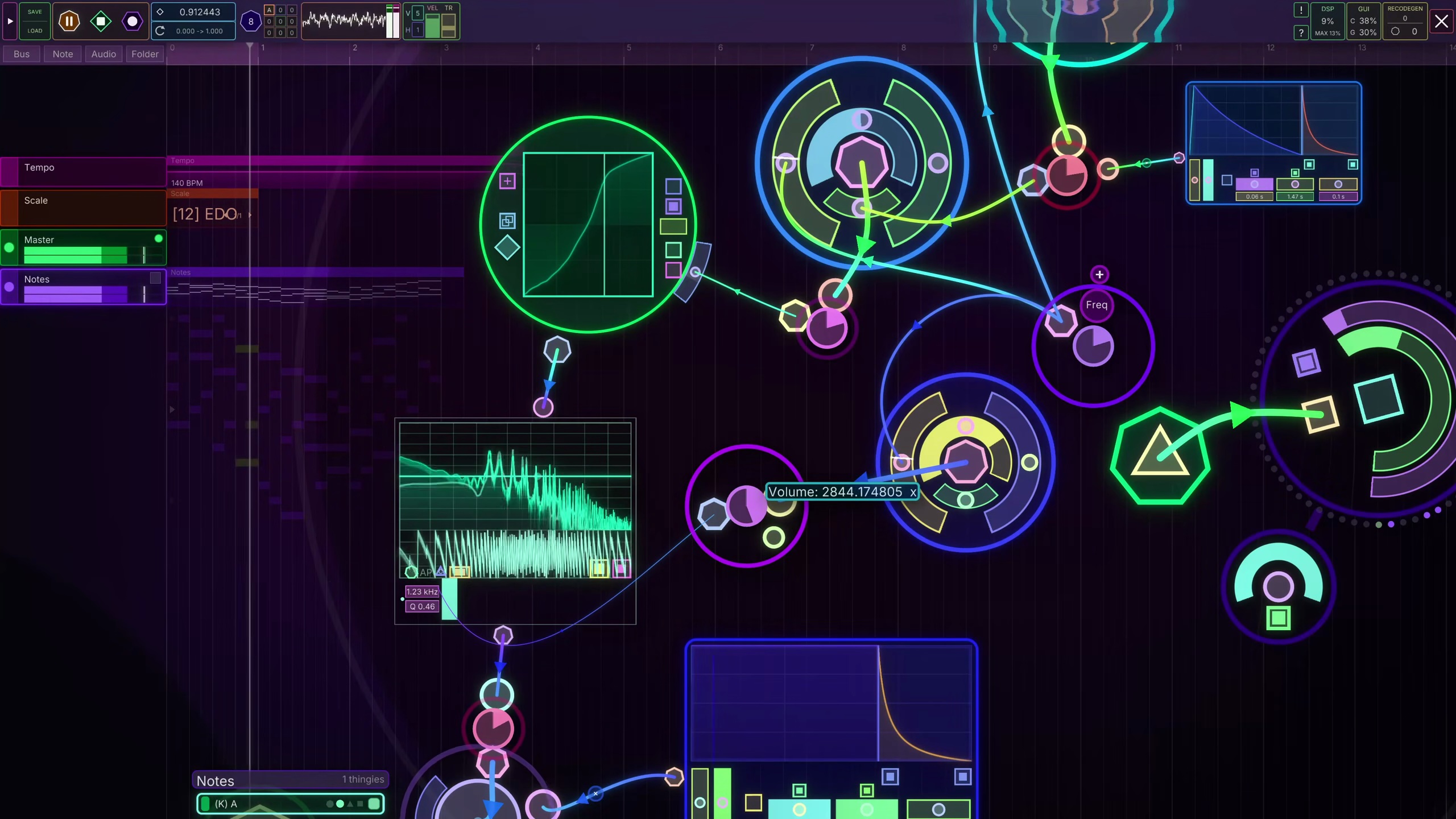
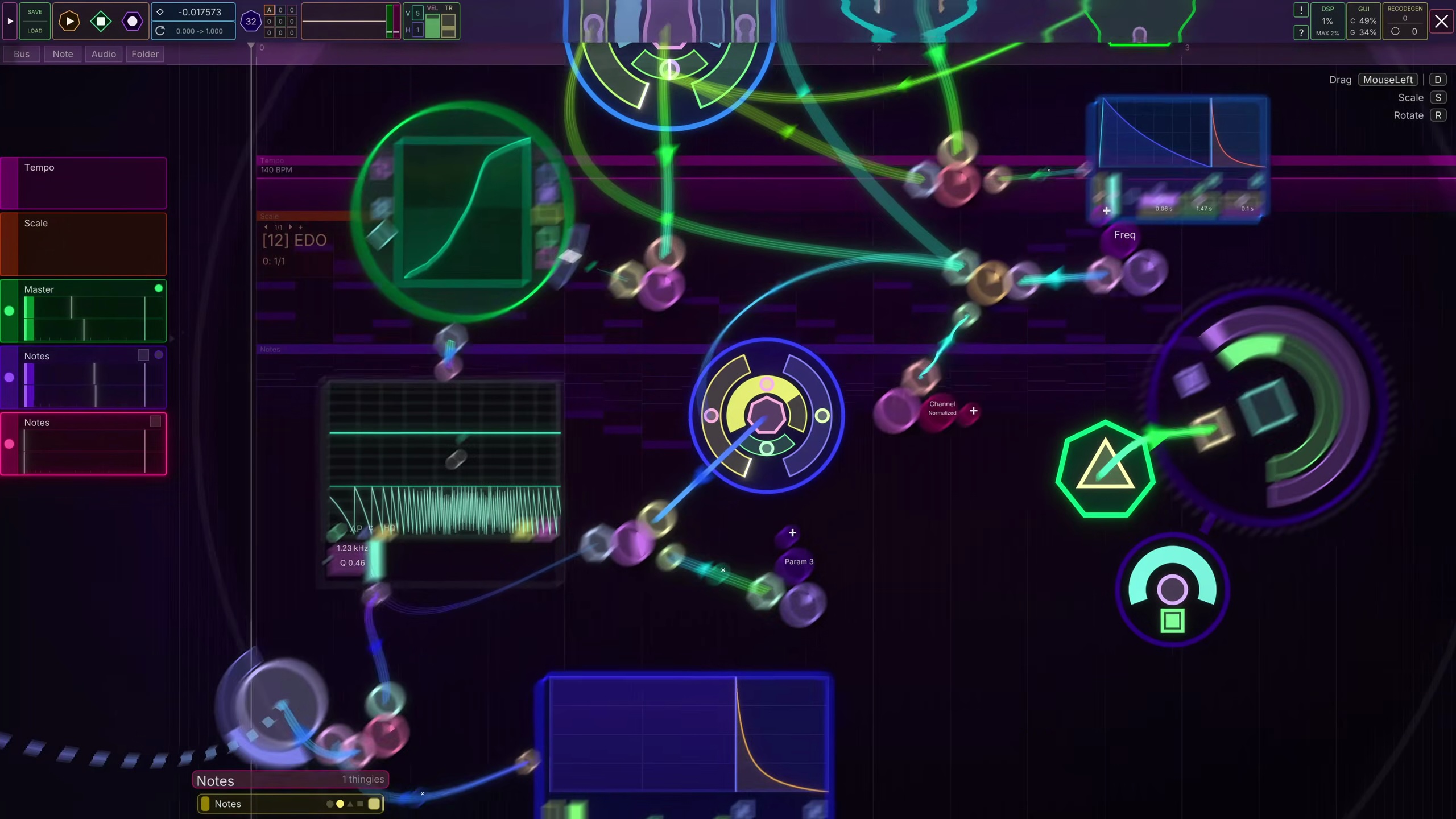
In short, features:
- Make your own instruments and effects
- Full modular DSP engine
- Unlimited oscillators
- Freely create feedback loops
- Use an infinite, tunable/microtonal piano roll
- Share instruments and effects (so you could see an ecosystem growing around this)
- Pomegranates… so many pomegranates
And more:
- use hundreds of voices in monophonic or polyphonic arrangements
- sandboxed / “impossible to fully crash the program” / don’t lose work
- SF2 file player with microtonality
- yummers (not sure what that means)
See, if this were the 1990s, six people would know about this tool. Five of them would wind up teaching in academia (no shame in that), and the sixth would wind up being Richard D. James or Thom Yorke or whatever, thanks to being British and so on. But no, it’s 2026. You’re here with me. We can all go stark raving mad learning Septabee together. Maybe we’ll all create our own genre, even if we just meet in dive bars with portable PAs and play for one another.
Where do you get this? From this absolutely horrible website (like the worst you’ve seen in years — mad respect!):
[warning — it plays sound — really like we’re back in the 90s]
From there, you’ll find other resources, including a Discord community.
Some folks are already making stuff with this. Also from a terrible website (in the burning-your-eyes way, not in the owned-by-a-techbro way, so like the good kind of terrible):
First Steps of a Little Bee – Made in Septabee!!! [newgrounds]
This is typical of the #septabuzz spreading across Blue Sky at the moment: