This is why you get intimate with code, line by line. Artemiy at Sinevibes obsessed over details, breaking a filter model by rewiring its internal connections — and now, with v3, giving it precise modulation in a wide variety of shapes and a powerful new oversampling algorithm for massive glitch. Now, like kids kicking over a sandcastle, we can take that handiwork and apply it to total, absolute destruction.
“Circuit bending” should be properly credited to Reed Ghazala, inventor of the form — of course his site is in http, not https; now go enjoy it. That involves physical “bends” across circuits. But even though this is a hacked filter model in code, you can almost feel voltage surging through it. It can take any audio input sound and make it sound like it came from some circuit-bent machine — like the lovingly produced mods at circuitbenders.co.uk, for instance. Underneath it all, though, is what Sinevibes calls “a unique experimental algorithm: a filter model whose internal connections have been intentionally tampered with.” Think of it as a virtual circuit bend.
Now, if you’re a fan of Sinevibes but haven’t thought about Malfunction lately — or even remembered it — you’d be forgiven. V2 is years in the past. That clever filter mod is still there, so if you do remember it, V3 doesn’t subtract anything. But it adds enough to be almost like a new sound-mangling instrument.
There’s a freshly reorganized interface and visualizer, a ton of new modulation, and sound tweaks and improvements in almost every corner.
The engine is also enhanced, which turns this from a degrader into something that can spawn precise, brutal new sonic glitches. Sinevibes explains the technical changes under the hood to CDM:
“The plugin now features 4x oversampling to make the sound much less harsh while retaining its core “circuit-bendness”, and also introduces a second bend scheme producing an even more fierce and glitchy effect.”
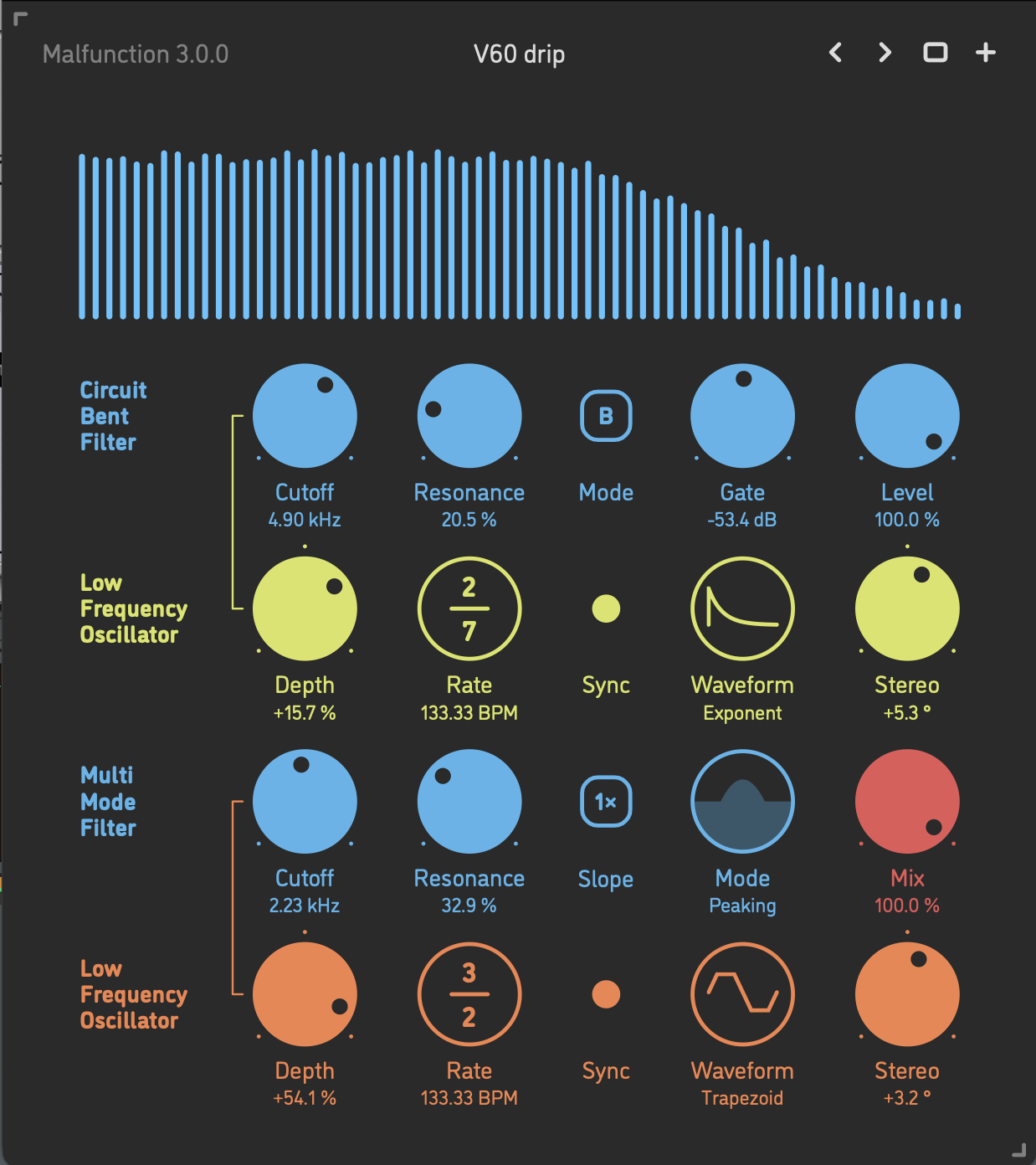
What’s new:
- “Circuit-bent” filter algorithm with two modes (A and B, which sound very different) plus aliasing suppression with 4X oversampling
- Input noise gate with adjustable threshold
- State variable filter (LP, HP, BP, Notch, Peaking; 1-4X slope)
- Two through-zero LFOs (free, synced) with variable stereo offset
- 15 LFO waveforms
The “B” mode is all new, and it has an entirely different character with much meatier bass — enough to rattle the floor of my studio, quite literally, through subs.
And this being a current-gen Sinevibes plug-in, you also get lag filters on parameters so you can tweak without clicks, flexible mono and stereo routing configurations, neatly organized, color-coded elements, and up to 200% window scaling.
Let’s talk about those LFO waveforms in particular. In addition to the usual sine, saw, triangle, square, and pulse, you also get trapezoid, “flip,” parabolic, cubic, S-curve, exponent, fin (as in shark, not as in the end of a French film), spike, and stepped variations divided into thirds and fourths. That gives you the ability to create wild, rhythmic variations or nuanced shifting, including stereo shifting.
There’s just a ton to play with here. Definitely check out Artemiy’s demos as well as mine; I went a little wild processing everything at once. But you can hone in on very simple, sparse sounds, or even one-shots, turning the most vanilla of sounds into flamboyant flourishes of noise and frequency. We’re listening to all of this bone-dry, too; obviously this into other effects can produce a broad range of textures and styles.
If you have a host that will split frequencies and whatnot, you can also apply different variations to different bands. Or add extra LFOs to more experimental parameters. But I do appreciate that Sinevibes has retained some simplicity while maximizing depth.
Malfunction is a must: maximum filter mayhem.
Available now for macOS, Windows, and Linux. $29.
I love these demos, too — yep, I’ll be playing around more with this to see what secrets I can unlock.