Daniel Schürmann of the long-running libre/free DJ software project Mixxx has a compelling proposal for uniting efforts to develop their DJ software on embedded hardware, from emerging cheap “open” hardware to DIY projects. It could mean a chance for openness to have a moment — while avoiding the chaotic slop of countless separate forks and hacks.
There’s something lifeless about the technology of the modern DJ scene. It’s great to be able to count on Pioneer decks just waiting for you in venues and just working. But DJing has its roots in experimentation and creative misuse, from Kool Herc to Grandmaster Flash. Figures like King Tubby built their own electronics and sound systems. (King Tubby even built his own radio transmitter.) And that can mean independence rather than dependence and conformity.
I don’t want to only focus on the technology; playing techniques matter just as much. But that also requires access to decks, and now, your data. DJing wasn’t built on “standardization” as delivered by a manufacturer. Yet in the current landscape, DJs have to adapt to those standards, rather than the standards adapting to them.
Mixxx has long been an answer to that, with broad, robust support across macOS, Windows, and Linux, multiple architectures, and controllers that follow open standards (MIDI, class compliance, HID, etc.).
Schürmann recently wrote up how the project could evolve to support so-called “open” devices, which promise to allow easy loading and modification of custom firmware. Published yesterday on the official Mixxx blog (with an open invitation to collaborate officially):
Unlocking Standalone DJing: Mixxx on Bare Metal
It’s significant that the Mixxx project is taking the initiative. They’ve got years and years of development and community support behind them; it’s a deeply mature platform. There’s also a ton of existing DIY work. As I’ve written before, that’s exciting; I’d love a world where digital DJs show up with their own heavily customized decks the way that vinyl DJs tote their vinyl crates.
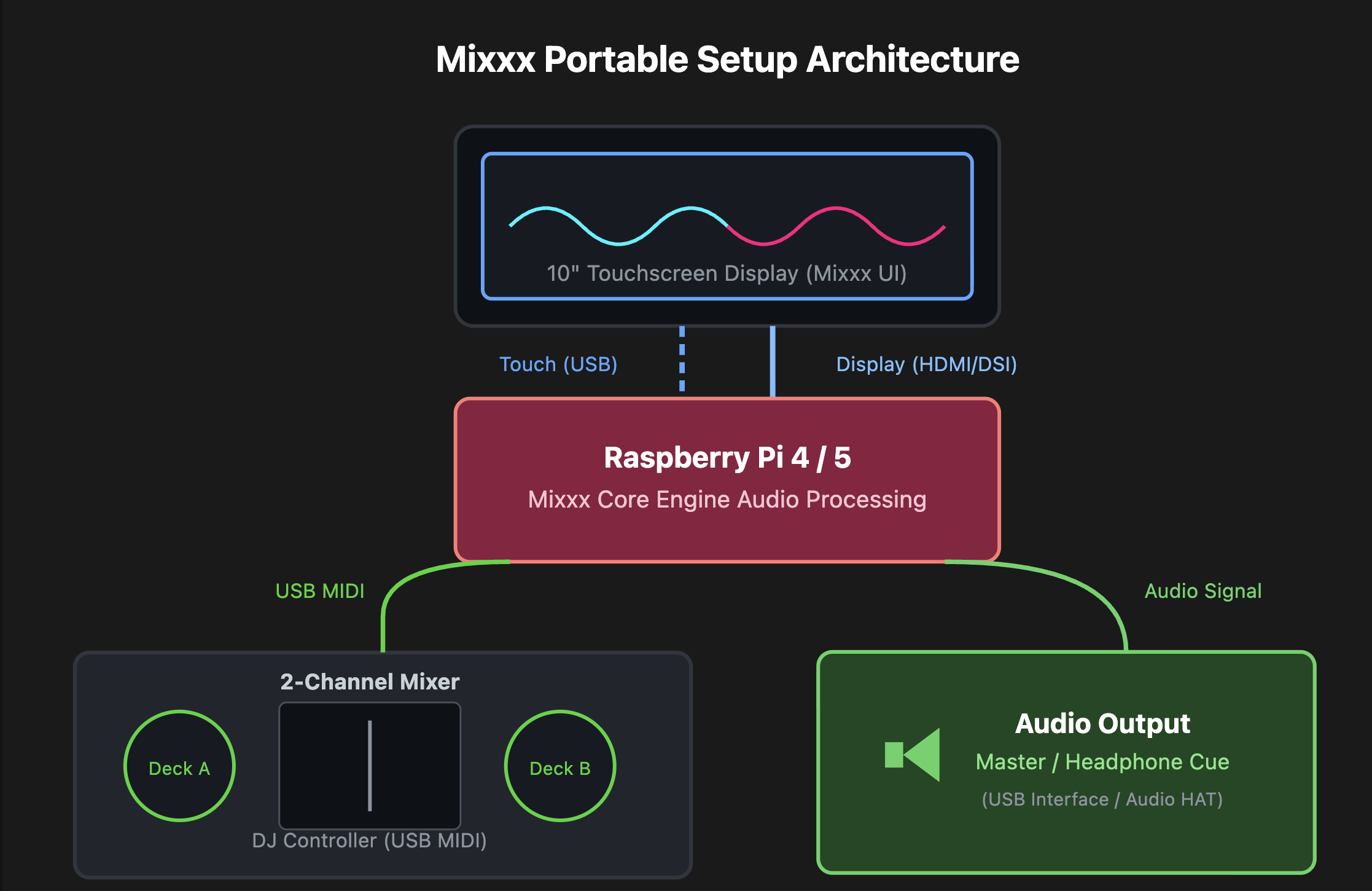
This is obviously prompted by a certain manufacturer teasing an “open” device, but the work to do this in the Mixxx community long predates that manufacturer or the “vibe coding” scene. In fact, you can go DIY your own hardware right now, if you like — no need to swap one Giant Corporate Entity for another.
DIY Open-Source DJ Controller (DJC-DIY) [Mixxx discussion]
DJC-DIY – The World’s First DIY DJ Controller: https://github.com/mandiclab/djc-diy
And on the topic of making the software itself run in RasPi (full credit to Daniel on these links):
The smallest possible digital DJ-Setup
People are already experimenting, too. As noted in the article, you have work like this, modding the Denon DJ SC Live 4 with the help of Mixxx (more links in the description of that video):
And a concerted effort may be all we have left to avoid a Tower of Babel situation. Everyone going out and buying new hardware, bricking units, creating more e-waste, and destroying the livelihoods of engineers and support staff sounds more dystopian than hopeful. Just in August, Pioneer revealed they had found a major security hole; imagine spawning a bunch of internet-connected devices with random vulnerabilities.
As Daniel puts it:
By unifying our efforts, we can break down the silos of individual forks, integrate them into a single upstream codebase, and ensure that anyone building an embedded DJ setup gets a rock-solid, officially supported build right out of the box.
If big manufacturers do decide to “open” their hardware, the real action will be in the years of investment in the software ecosystem. But there is a chance to reverse course on closed file formats and vendor dependence. He points to the encryption and lock-in used in AlphaTheta’s OneLibrary / Device Library Plus.
A DJ’s track annotations, playlists, and crates belong to the DJ, not locked away inside a manufacturer’s encrypted vault. Bringing Mixxx to bare metal guarantees an open alternative where track metadata remains unencrypted, user-accessible, and portable forever.
I think AlphaTheta has an opportunity to balance security with letting DJs control their own data, too. Given the massive investment of venues and often artists in their gear, why not give the DJ ownership of their own information? For encryption features intended to provide security, there’s also the possibility of an on/off switch. (Think of Apple’s FileVault, for instance.)
“By unifying our efforts, we can … ensure that anyone building an embedded DJ setup gets a rock-solid, officially supported build right out of the box.”
Daniel Schürmann, Mixxx
Tech bros love disruption for its own sake — including disrupting safety, people’s livelihoods, and generally anything remotely fragile in our world. But there is a chance, especially early in this sea change in tech, to target disruption. I love the DIY projects, because then instability is something you essentially own, including hardware you build; that’s a terrific learning experience. But the free software community has a decades-long track record of showing what happens when we work together, and that open projects don’t have to sacrifice stability (quite the contrary).
So I’m very excited to see where this could lead.
Quick addendum: speaking of community, Mixxx has done interesting work integrating the open-source Zulip software for its community. It seems another thing we don’t particularly need in the current software revolution is more use of Big Tech social media platforms.
Case study: Mixxx open-source community [Zulip blog]
Oh, and one more: Ferry Gouw and Dr. Walker each made fantastic t-shirt designs for the 25th anniversary of Mixxx, available on the Mixxx shop: