Applied Acoustics Systems’ flagship modular, Multiphonics CV-3, gets four powerful modules in “the FM+ update” out this month. Here’s a dive into what those modules can do — and if you’re pondering picking up CV-3 for the first time, it’s discounted now, too.
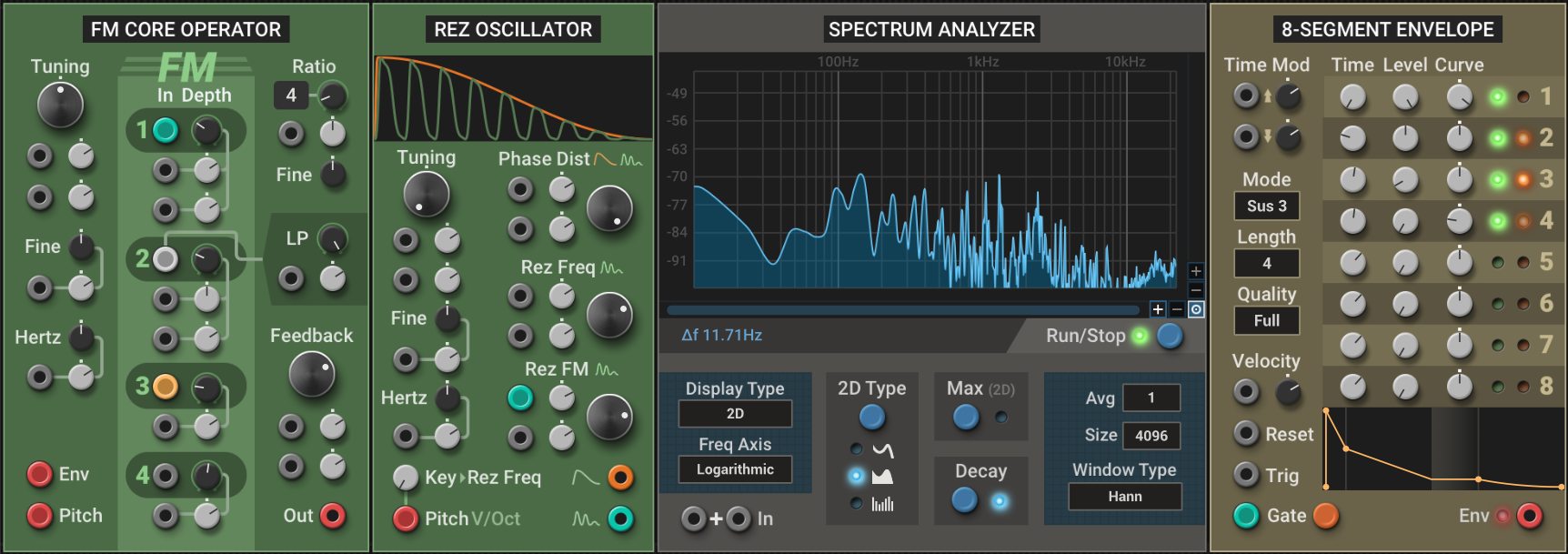
There’s a lot of “plus” in that “FM+” — you have four modules, and only one of them is really strictly speaking about “digital FM.” There’s the FM Core operator (oscillator), Rez oscillator with phase distortion, a Spectrum analyzer (with a lot of extras), and an 8-segments envelope generator.
If you’re curious what this all sounds like together, I built a patch that’s focused on the FM core operator and new envelope generator, with one of the FM sources being that rich Rez oscillator, and a Spectrum analyzer so you can watch. And you can a rich, aggressive sound with tons of knobs to tweak live for performance or composition.
Now, the modules. The documentation for each of these is exquisitely written with a bunch of details, so I do seriously recommend reading along when you get into it. It’s one of the real advantages of AAS’ environment; it’s just copiously documented and has patching ideas inside a lot of the docs.
FM Core Operator
Okay, first — didn’t Multiphonics CV-3 already have FM? Answer: yes, that’s the 3-operator Digital FM module. It’s “digital FM” because this is technically “80s-inspired” phase modulation. That’s a typical substitution even now, and it’s rooted in the techniques of the first digital FM synths.
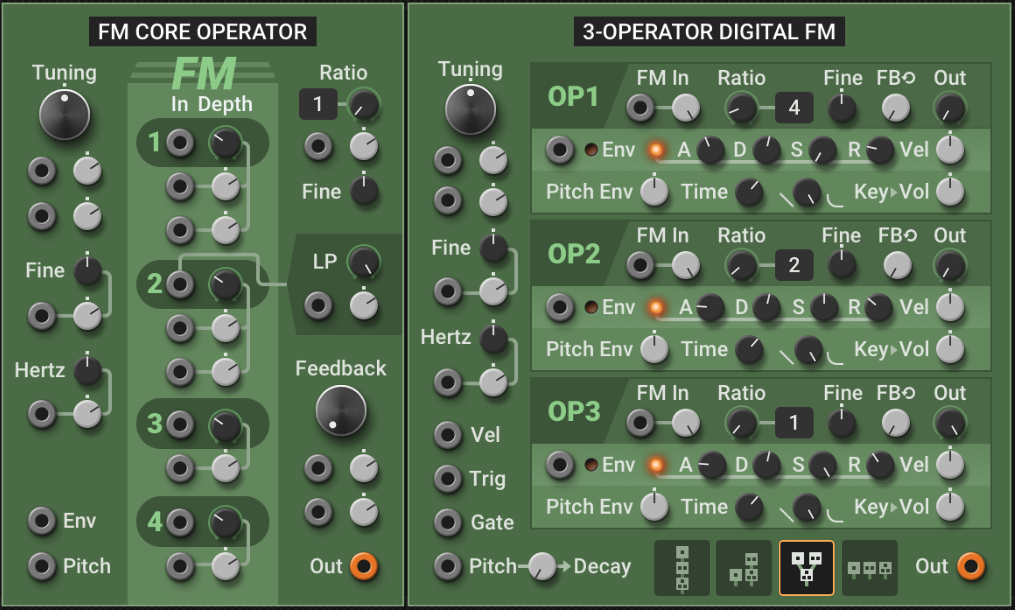
The 3-operator module from AAS puts those three FM operators into a single module, and then lets you choose modulation algorithms. It also has an internal envelope generator with ADSR pots, plus per-op feedback.
FM Core Operator is far more flexible. You get four FM inputs — the first three of those with two inputs each. And there’s modulation just everywhere; you can even modulate the ratio control. The layout is far more legible and the knobs are bigger, too. You do need to add an envelope input, but now you can do that with the new 8-stage envelope generator.
All of this adds up to mean that you can easily combine three of these modules to get the equivalent of the original 3-operator FM — but with a ton of additional modulation and inputs. And from there, you can get even fancier, mixing and matching FM sources and adding operators. Why not do FM with Multiphonics CV-3’s physical modeling capabilities, for instance?
As long as you have one or more inputs into this FM core module, you’ve got FM. Heck, without an input it’s even a nice non-FM oscillator.
Just to hear a more basic version of the patch above, focused on three operators of this new module, here’s one more example:
Rez Oscillator
This is another 80s-style oscillator, and really, this is yet another module that’s only in Multiphonics CV-3 in this form. As I’ve written in the past, Multiphonics CV-3 is really like having an extra modular skiff with a unique, complete system even if you’re addicted to other software modulars as I am. Think phase distortion + hard sync + FM + amplitude modulation (AM) and easy controls.
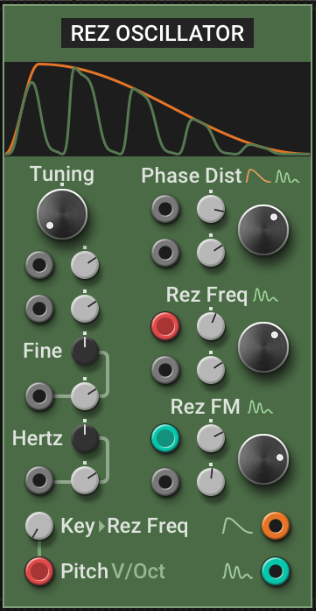
This is obviously a take on Casio’s phase distortion approach as used on the CZ line. (The manual refers obliquely to “a clever technique developed in the mid 1980s to simulate resonant low-pass filter sweeps without actually needing a low-pass filter.” But “Phase Dist” is right there on the panel, so there’s not much mystery!)
And wow, it sounds fantastic. Plus, remember, we’re in Multiphonics CV-3. So … we have the OBJEQ Filter handy.
Actually, wait. Let me interrupt writing this article and see what that would sound like. (Notice you have a separate pot for Key > Rez Frez above the Pitch V/Oct input, as well as a Rez Freq CV input with its own attenuator pot. Say what? Uh, basically there are just lots of ways to handle pitching the frequency of this module and the pitch of the OBJEQ Filter and detuning them.
I sound vaguely scientific, but I don’t want to rob the fun of patch up a bunch of stuff and start messing around, which is the whole point. Here’s an example:
You don’t need these endlessly rotating sequencers, either: Multiphonics CV-3 has deep MPE support and works polyphonically. So you could make this a more improvisational patch, too, though the groove is kind of fun.
8 segments envelope
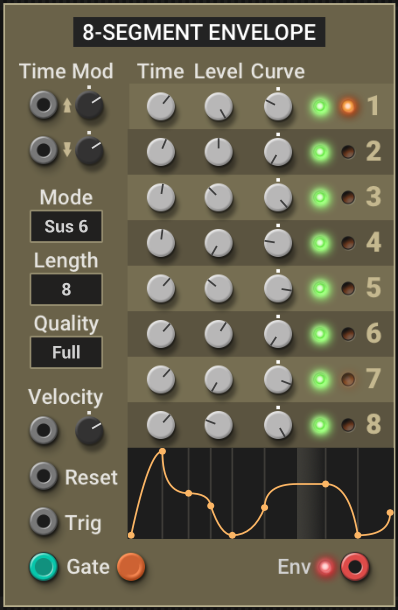
Welp, I’m going to use the heck out of this one. This is a terrific balance between advanced features and a straightforward layout — too many multi-stage envelope generators just wind up being too complex, doing too much, and taking up too much space. And they’ve packed in six modulation inputs, the ability to set the sustain stage wherever you want, and even the ability to dial back the quality in bits for retro-style envelopes..
Spectrum analyzer
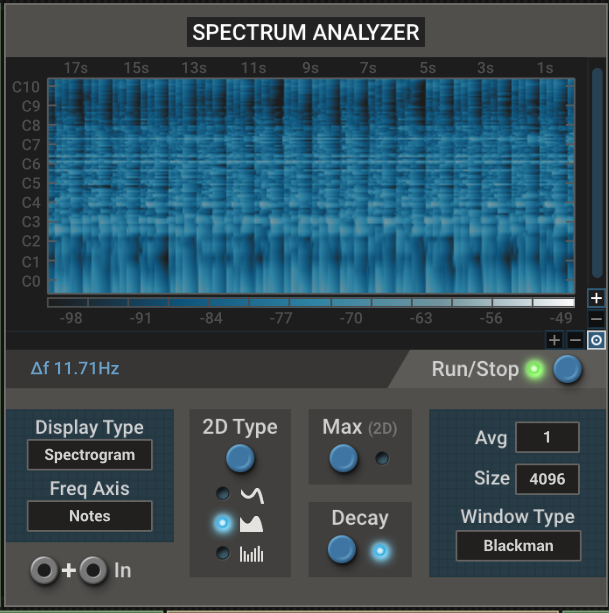
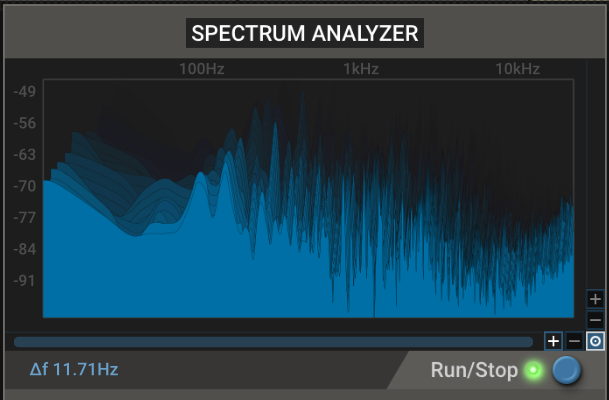
Multiphonics already had a beautiful oscilloscope; now you get a spectrum analyzer with a bunch of views, too. There are bunches of extras — a 3D and spectrograph option in addition to the 2D, the ability to display (western) note names on the frequency axis, and more. I just wish they hadn’t gone so all-in on the blue monochrome color scheme, because you lose some detail (especially in 3D).
Conclusions and more
AAS continues to deliver steady progress on Multiphonics, and it blossoms as you devote time to it. There’s no comparison to the sweeping ecosystems of Reaktor/Reaktor Blocks or VCV Rack, and yes, there’s still competition from Softube and Cherry Audio, among others. But Multiphonics continues to mature as an environment with the unique character AAS brings.
Let’s review all that you get in Multiphonics now. There’s pushbutton polyphonic operation and MPE. The phase modulation and phase distortion oscillators join AAS’ unmistakable Objeq, Stack, and Tube oscillators — and their Objeq and Tube filters, too, plus all the waveshaping and saturation. For added convincing, AAS is always pumping out unique patch content.
There’s also just something beautiful about the level of detail and consistency in the design and documentation.
It’s all a great addition to the ever-richer software modular world.
For new customers, Multiphonics CV-3 is 50% off through March 10; v3.1 is a free upgrade for current CV-3 owners.
Multiphonics CV-3: Latest update
Multiphonics CV-3: 50% off at Plugin Boutique
If you buy something from a CDM link, we may earn a commission.