It all starts with the envelope, so that even a few milliseconds of sound can generate “thousands of sonic trajectories.” Built entirely in the free, open-source Pure Data, Envion is a deep compositional playground. You can think of it like an algorithmic drum machine. Emiliano Pennisi shares his creation with us.
Because of the open nature of Pd and Envion itself, and a lot of effort from Emiliano on documentation, you might use this as-is or as a springboard into learning from the tool and extending it as you desire.
The musique concrete and “classical” aleatoric references are clear, but you could also take this into a lot of other directions. And it even runs on plugdata on iOS — giving you a taste of the snappy, poppy, weird goodness that flows out of this nest of patch cables. (See my recent story on the latest plugdata update, and why it’s so cool, from the titual plug-in to the iPad and beyond.)
This thing can sound a lot like vintage Xenakis or long lost tape compositions, but it can also sound like this:
Or this:
Insane as that UI may look, this is set up for total novices to find their way in — really. (Just be prepared to impress anyone looking over your shoulder.) Basically, you can just load up the master preset, hit “go” (bang), and fetch any sounds you want to feed into the system, including working with network-based presets loaded from the web.
The whole scheme generates this complexity from a simple idea: spawning a whole bunch of micro-timed sound playback:
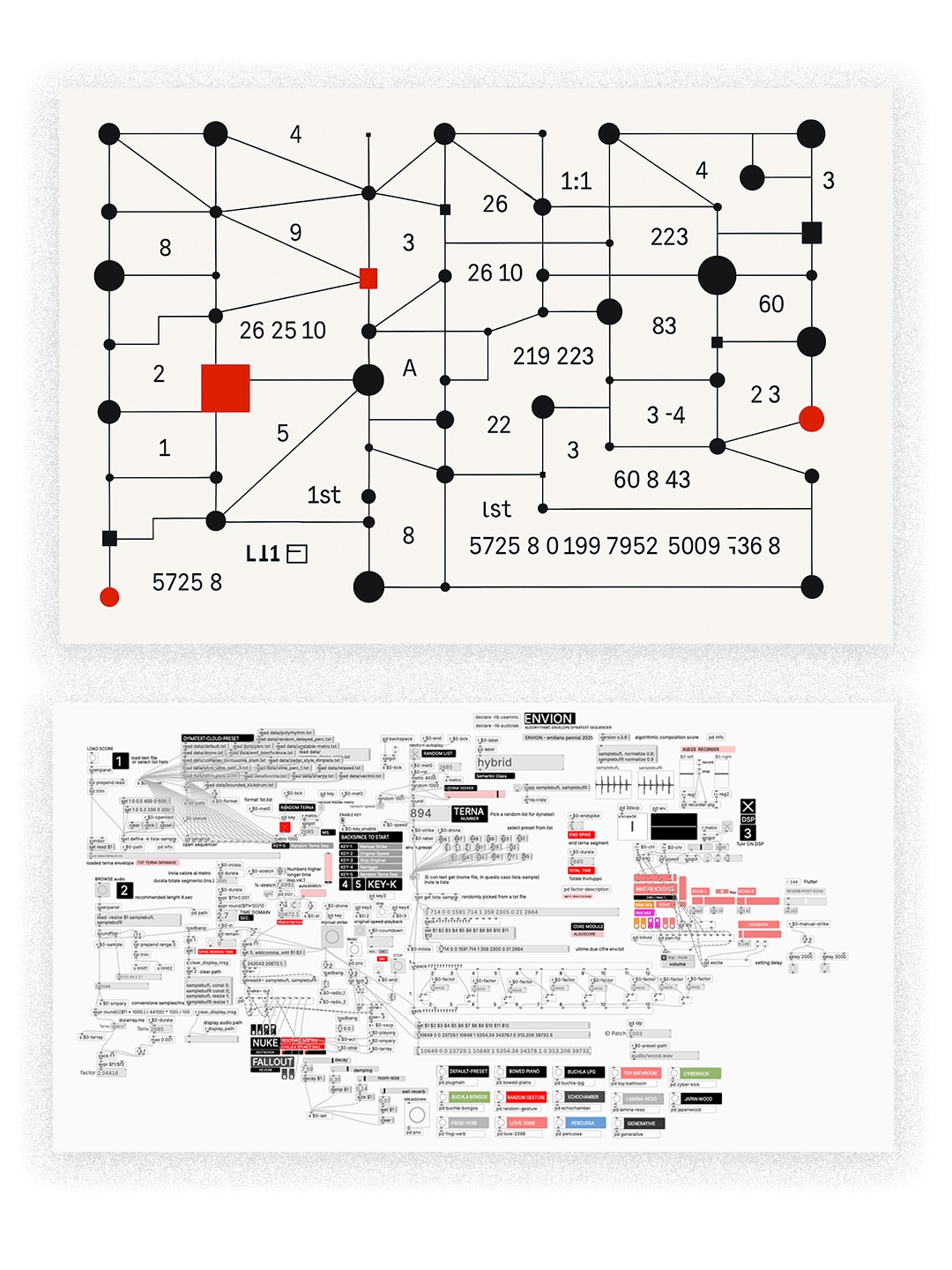
[Envion] drives the read index of stereo buffers through textual sequences of triplets (value, time, delay) sent to
vline~.
Each line of a text file represents a complete envelope; switching line means switching gesture.The core philosophy behind Envion lies in its invitation to slow down — to explore sound through micro fine-tuning and patient listening. Rather than chasing immediacy, the instrument rewards those who take time to sculpt and observe its evolving behaviors. Approaching Envion too quickly or superficially will rarely yield meaningful results, as its depth unfolds only through careful attention and sonic restraint.
What’s inside, in a nutshell:
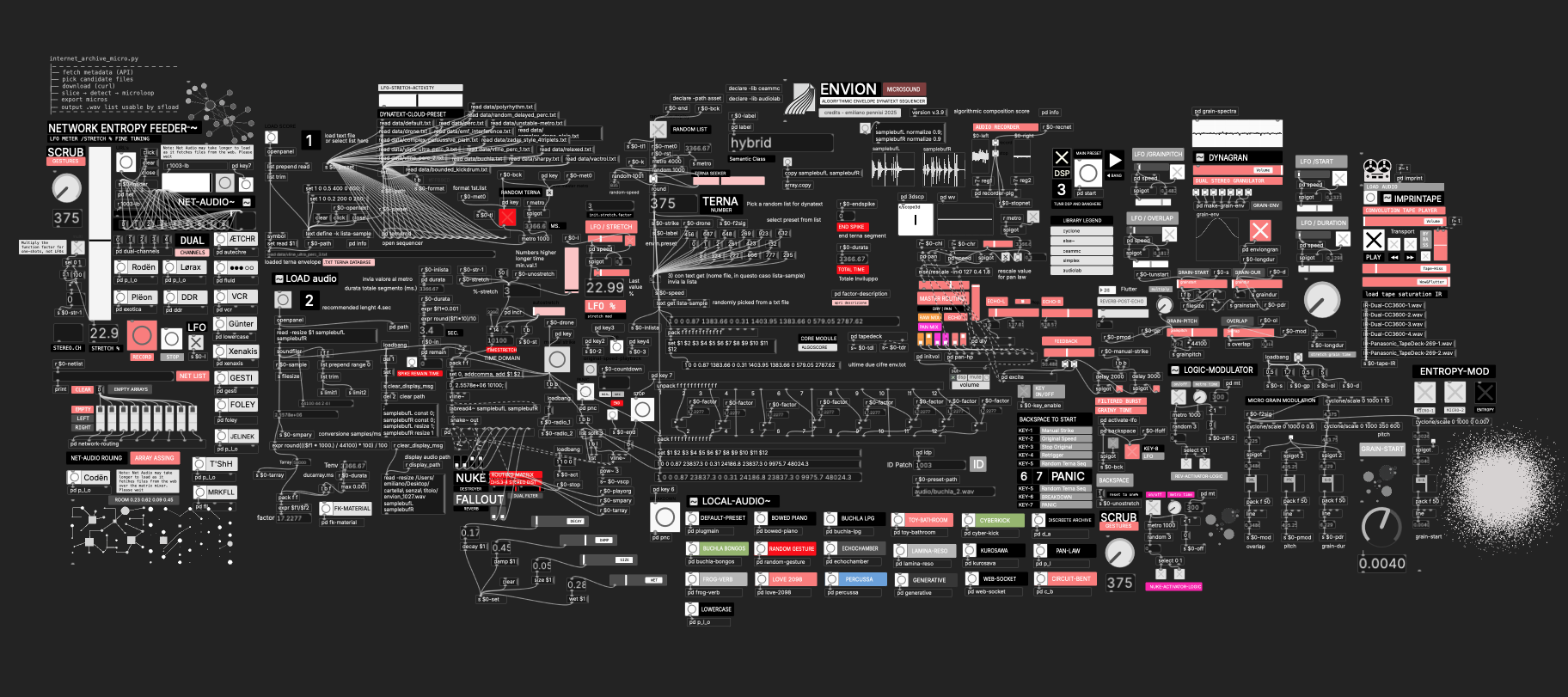
IMPRINTAPE (convolution tape deck)
- real hardware IRs (mechanical + temporal character)
- can run as a continuous tape-bed or inside the routing chain
DYNAGRAN (granular engine)
- behaves like an articulator, not an “effect”
- dual-stereo micro-offset, envelopes per grain, up to 4s
- dedicated LFO per parameter for organic motion
“I’m also refining the sample-fetch layer so acquisition becomes more “ecological”, with Envion actually hunting its own material,” Emiliano tells CDM.
There’s also a new interview with Emiliano up where he talks more about the philosophy behind the tool:
https://xorspace.substack.com/p/perspectives-with-emiliano-pennisi
Envion is all exquisitely documented, step by step, with tons of details and background information. That feeling of slowing down can stop with kicking back with even the documentation and GitHub.
https://www.peamarte.it/env/envion_v3.6.html
So, there you have it.
Actually, that’s it. We can now safely pause CDM for the rest of 2025 and just mess around with this and Data Knot and Max, as that should keep you plenty busy. Maybe even 2026. (I’m joking, but… you know….)
Find more from Emiliano:
https://www.instagram.com/_a__v__e__n__i__r_/
Oh, and he’s even got a musique concrète-themed subreddit.