This has got to be one of the quickest routes to sheer drum happiness inside Ableton Live ever. Meet the pay-what-you-want/donationware Vertex by aorist (aka Tom Duncalf). It’s a bit like a Moog DFAM, but in the Live idiom, with a bunch of extras. You just need this one. Trust us.
It may feel like there’s not enough time to play with something else, but this one — you just drop on a track and you’ll have to pull yourself away from it.
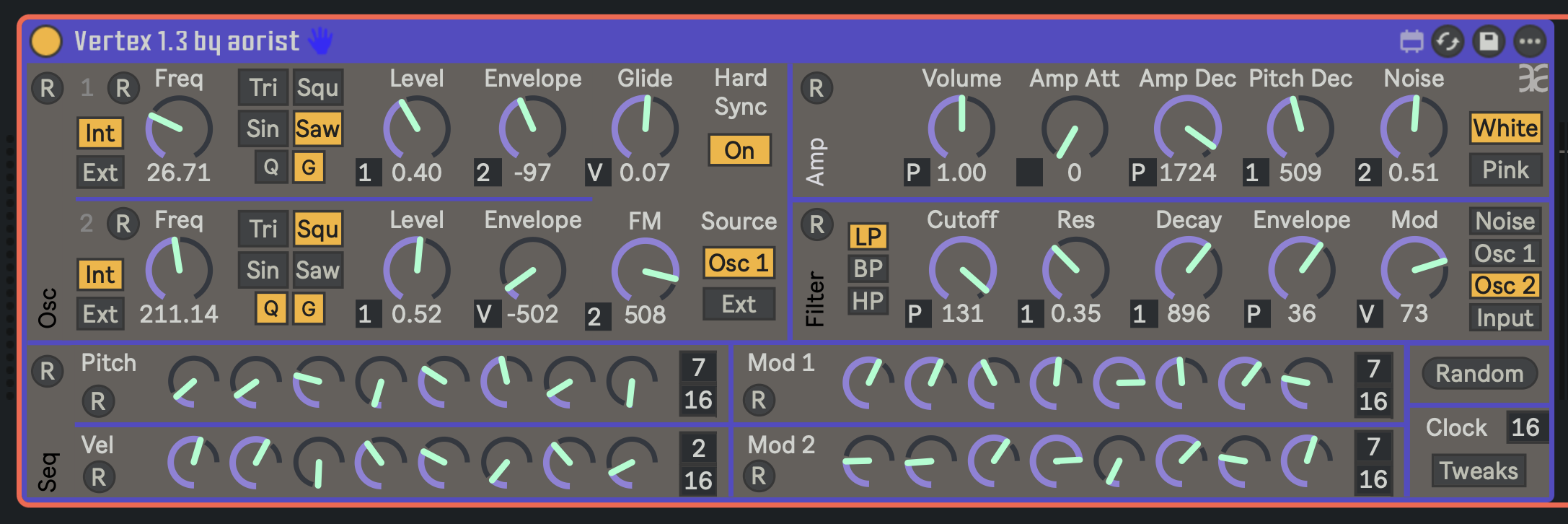
Vertex is loosely based on the Moog DFAM. I should warn you that this is not going to make you want a DFAM any less. That instantly reminds me of the fun of tweaking the hardware. But sticking this inside Ableton Live has its own pleasures. The always-running sequencers can be assigned anywhere, even before you mess with outside modulation. You can easily drop this inside a Device Rack and map controls as you wish for your controller — there are a few ways I could imagine approach macros. And Tom has rounded this out in a way that makes sense in software.
Features:
- 2x triangle/saw oscillators with pitch envelope, glide, quantize, hard sync and FM
- Switchable LP/BP/HP analog modeled filter with FM (thanks to Surreal Machines for the filter)
- 4x 8-step sequencers (pitch, velocity, and 2x mod), with individual length and rate controls
- Sequencers can be assigned to any parameter
- 3 external inputs, for direct external input, oscillator FM and filter FM
- Randomization for sequencer and oscillator parameters
How is that different from Moog’s wonderful hardware box? Actually quite a lot of details that make this feel more like native software:
- 2 extra sequencers
- polyrhythmic sequencers
- separate clock per sequencer
- sin and tri waves – sin is great for techno bloops
- pitch quantize
- per osc glide
- pitch range control
- randomization
And that randomization is really the genius of this thing. It’s an instant inspiration-slash-chaos device.
Here’s Tom’s walkthrough:
Tom tells CDM he wasn’t really pushing this device — but, as often happens with these creations, a producer picked it up and ran with it. The awesome techno producer Mordio streamed with it and demonstrated how useful this is for instant hypnotic techno and other percussive pleasures.
I couldn’t agree more:
You can make it sound like stuff you’ve heard before. You can make it sound unlike anything expected, too.
It sounds wonderful dry, but I just had to route it through some effects. Here’s what that sounds like, with some parameter tweaking so you can see just how useful this is:
Featured in that video:
If you buy something from a CDM link, we may earn a commission.
Arturia MIX DRUMS (which is frankly awesome — you might have missed that in the usual flurry of plug-ins!)
Klevgrand WALLS – just another perfect reverb
Adaptr UTOPIA – way more than a reverb; had a talk with the developer to share soon but spacing out our plug-ins here, stand by!
MDL Indigo v6 Live theme by Deafman; see the story on those – same theme throughout this story
Tom notes he left out external input explanations from the walkthrough demo so here’s a chaotic demo using Sting 2 from Iftah (see previous coverage) as a MIDI input:
And he wrote me with additional thoughts. First, remember that there’s this excellent “tweaks” panel. That includes options for pitch range, decay curve, and filter slope, drive, and pre/post order.
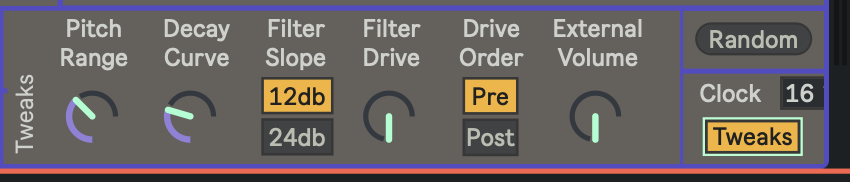
You can set external audio input by selecting External Volume on this panel, routing it in via the standard Live facility.
External MIDI can be set to determine pitch of each of the two oscillators, and of the FM, replacing or supplementing the internal configuration. As I’m (kinda sorta) illustrating in that demo, it will also determine trigger — the sequencer still free-runs according to the session clock, but MIDI notes will trigger the envelope generator (and the active step parameter control runs independently).
Go get this one.
It could have been a secret weapon, but this one is too good for anyone to keep secret. Share the love.
Go check Mordio’s site, too, for a podcast, a blog, a shop, teaching, mastering, a bunch of stuff.
And some really great music! Just out —
This feels really different from using the DFAM — more like a software instrument that takes the best of he hardware. But it does make me want that original Moog hardware, which is in stock and available now at Perfect Circuit (affiliate link). Here in Europe, Thomann has some b-stock. Uh… I’m not sure if I’m pitching this to you or to myself, but there you are.