For over two decades, Rafael Anton Irisarri has been carving out a space that exists somewhere between the tectonic weight of modern classical and the vaporous drift of ambient music. Whether recording under his own name or as The Sight Below, Irisarri’s work is characterized by a physical sense of scale – soundscapes that feel like they have weather systems and geological history.
For an artist with such a deep dive of a discography, his latest solo album, Points of Inaccessibility, is ironically a rather digestible set of music that reveals a journey I often find myself ready to repeat as soon as it’s done. Born from a residency at the Uncloud studio in Utrecht, the album grapples with a very modern paradox: we are the most technologically connected humans in history, yet we are arguably the most isolated. The recordings themselves carry the literal weight of their environment – the studio was housed in a former psychiatric prison, the Pieter Baan Centrum.
In addition to Points of Inaccessibility, Irisarri’s collaborations with Italian artist Abul Mogard yielded Where Light Pauses in the Silence of Sun, out in June. Mogard also features on Points.
With a tandem career as a mixer/mastering engineer and label owner, Rafael is a “musician’s musician” – someone who spends his days in the surgical precision of the mastering suite (running Black Knoll Studio) and his nights coaxing emotive, bowed-guitar ghosts out of stacks of amplifiers.
We sat down recently to talk about stacking the right effects, the physics of bowing a Les Paul, and the existential dread of the “AI girlfriend” era.
You’ve mentioned digital connection (or lack thereof) inspiring the new album and its title. This idea of places that are physically inaccessible vs. the omnipresence of digital connection. How did that translate into the actual sounds?
These are things that interest me and I think about but I necessarily don’t put them onto a record, per se. I observe a lot, you know, I’ll be on tour or something, or playing somewhere. It’s quite literally happening everywhere.
You’ll see a group of friends at a table having dinner. In certain cultures – let’s take Mexico City, for example – people eat as a group, and they’re all chatting and whatnot. But then you see them now, and they’ll all be on their phone as well. They’re not really in that moment. Or, they’re taking pictures for content, whether it be taking a selfie or taking a group shot or taking a picture of their food. They’re not in the moment anymore, you know.
I’ve been kind of obsessed by this concept of the “poles of inaccessibility,” which are locations on earth that are the furthest away from any other point. There’s a few locations that you barely get to, which are extremely isolated. I was kind of really obsessed with this concept, and I start to correlate it: “man, it feels like modern life, it’s like we’re all in these, like, isolated islands in the middle of nowhere.” We’re all connected now, but also very isolated.
Rafael Anton Irisarri – “Breaking the Unison”
It reminds me of that Spike Jonze film Her. I see people – especially younger ones – now who spend more time with AI than actual humans.
[Her] basically became a fucking documentary. Loneliness and isolation is something that all humans experience at one point or another. This is not a new problem or anything, but it’s become massively exacerbated by technology as well, because the same technologies are promising to fix the problem of loneliness and isolation, they’re actually causing it at the same time. It’s a bit of an ouroboros.
You recorded Points of Inaccessibility in Utrecht, in the Pieter Baan Centrum – a space with a very heavy history.
I didn’t really have a concept for the album beforehand. And as I entered this facility, this building where the UnCloud studio was located… essentially, it was inside of a former psychiatric prison. The minute that you enter the place, you think, “wait, this place looks kind of weird. What’s going on here? Like, this looks like it was a prison? What the hell?”
It has all these barriers, corridors that lock, and you have to get buzzed in to different areas. All these heavy doors and whatnot. It’s no longer used as a prison – the cells were all empty. They kept the same heavy doors for every studio, with a very little window.
That sounds incredibly heavy, especially for ambient music, which is so often about space and air.
I asked my friend where we were, and he said: This used to be where they housed violent criminals for psychiatric observation. That put me in a heavier mindset, thinking man, if the walls could talk here… Holy fuck, you know?
It’s no longer used as a prison – the cells were all empty. They kept the same heavy doors for every studio, with a very little window.
How did you actually capture the sound in that environment? Was it a traditional studio setup or something more fluid?
I was working with Jaco Schilp, and we were preparing an AV set. I kind of need to generate sound for him constantly so that he can be working on his point cloud patch, because it fed directly from my rig. In my live rig, I’m usually playing everything live in the moment.
I play with a lot of loopers, so I had them set up, and then I’d constantly improvise and build on things. I did that for an entire week straight, like 8-10 hours a day, just recording material, because I’m improvising and creating all these things. I ended up with probably a good three, four hours of material. When I came to New York, I turned that into like a good 15 or so pieces.
Let’s talk about the rig. You mentioned being “looper heavy.” Are you using the stock Ableton Looper, or are you in the Max for Live world?
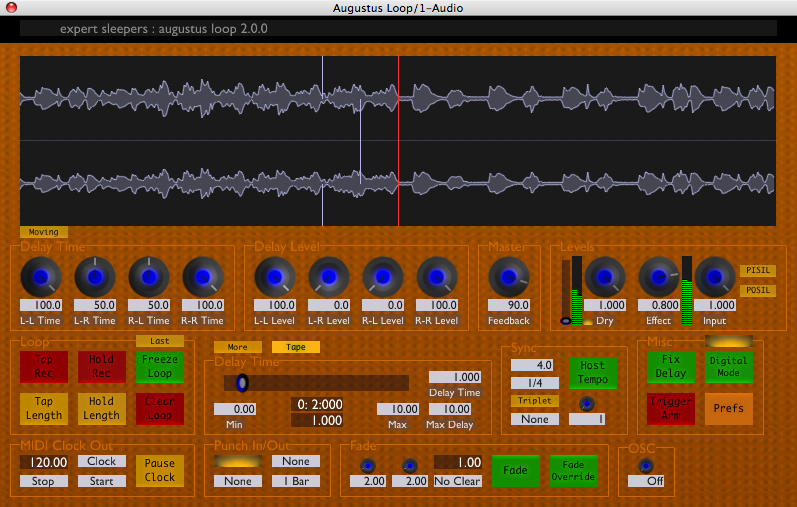
No, I use Augustus Loop from Expert Sleepers. I absolutely love this plugin. It’s crazy because it’s super basic, but very powerful. You can do a lot with Varispeed; you can do sound-on-sound with it, you can saturate, you can filter, you can do all these things with it.
Expert Sleepers is legendary for their Silent Way and modular integration – I don’t often see their software getting as much love. Why Augustus Loop specifically for your workflow?
The GUI looks… no offense to Andrew, but it’s very rudimentary. Looking at it now, it’s not like a “cool” looking plugin, you know, with a virtual tape machine and all the little things. But I first got my copy of it in 2009 and I’ve never stopped working with it, because it’s great. I really hate it when they take something that you know how to use really well, and you know the functionality… and then suddenly the entire thing is redesigned to look “nicer”. Augustus Loop is super stable, and I trust it well.
When you’re looping live guitar with that many layers, latency usually becomes the final boss. How are you handling it on current machines?
It’s pretty good, actually. I’m using a [MacBook Pro] M3 laptop right now. I’ve been using guitar modeling stuff from Overloud, an Italian company. I love their amps – it really feels like you’re playing through a [hardware] amp. The latency, it’s, it’s really good. When it started making music, you’d hit a note, and it was painful to try to keep a rhythm without going out of time, compensating for the latency. But nowadays it feels really, really good.
Most people associate your sound with massive, washed-out reverbs, but I’ve always felt there was a grit to it that comes from somewhere else. What’s the “engine” behind that texture?
My biggest “weapon” for music is actually saturation. It’s not like I’m putting everything wet or layering a bunch of delays or reverbs or whatever. It’s more about the little things that you’re doing with it to create the tones.
I also use certain picks, which I call the “secret weapon” of my guitar. These are 0.38 millimeter picks – it’s like paper, and it feels like the string is barely being touched. You don’t have a lot of heavy transients that way.
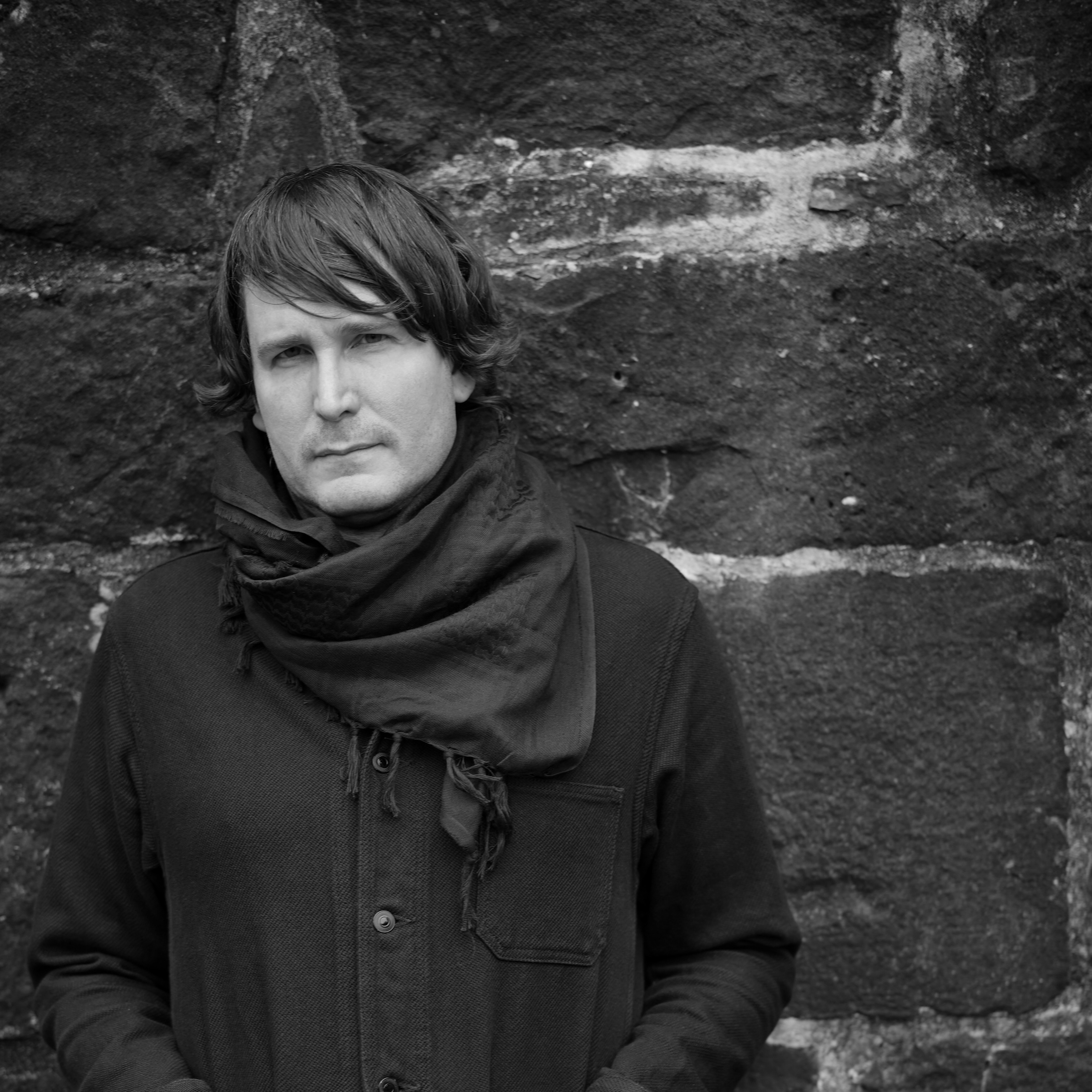
Rafael Anton Irisarri. Photos, above; top: Iulia Alexandra Magheru.
The guitar on the new albums doesn’t sound like a guitar – it sounds more like a string section. Is that all bowed?
Pretty much, yeah, yeah. I like to use viola bows for the guitar – though sometimes I’ll use a violin bow. I’m generating [non-guitar-like sounds] mostly from my own playing. I’ll improvise something, make my loops with whatever I’m playing with the bow.
Bowing a guitar is notoriously finicky. How do you get individual notes without it just being a wall of noise?
I have to work with how I’m holding the guitar, which is different for each guitar. One guitar might be too flat and won’t work to bow. I often use the [Gibson] Les Paul, which I can arch a little bit.
If I’m trying to play melodically and do a motif more than a drone, I often only play the high and low strings. The minute you try to play the center strings with the bow, you get the other strings in the way – it’s not an arched fret like a cello or a violin.
How are you getting those deep, growling cello registers from a standard electric guitar?
Something I figured out: if I bow a guitar and use a pitch-shifting pedal detuned to an octave, I get a cello-like sound. With a little bit of distortion, I get the cello “growl” that you’re talking about.
Right now I’m using the Electro-Harmonix pitch pedal, the Pitch Fork. If I take that and turn it to a lower octave, then I’m in the pitch register of a viola. And if I turn it off, then my highest string is in the register of a violin. If I want to play in the cello register, then I just pitch down and play on the low E string – and then pitch down further for an upright bass kind of tone.
Do you work much with transcribing your acoustic playing to MIDI for use with other instruments?
I really love the Ableton audio-to-MIDI function. I love the concept of it – it never fucking works, right? [laughs] But sometimes I love that it doesn’t work right, and sometimes you get crazy things happening. It’s completely wrong, but it’s actually really cool.
Sometimes technology causes things to malfunction, and then I like the malfunction, and then the malfunction gives me an idea to do something with it. You play it wrong once and it’s an error. You play it wrong twice, it’s jazz.[laughs]
Rafael Anton Irisarri – “Signals from a Distant Afterglow”, with Karen Vogt’s vocals.
Speaking of the human element, there’s a stunning vocal on “Signals from a Different Distant Afterglow.” It sounds like a transmission from a distant radio station. Who is that?
Karen Vogt [from the band Heligoland] sings on this record. She’s an amazing singer. She works a lot with Robin Guthrie from the Cocteau Twins. I sent her the track and she asked, “is there a voice in here?” I’m like, “No, why?” She said, “I keep hearing this voice melody in the recording”.
I said, why don’t you just record what you’re hearing? Just track it and send it to me. She does a lot of vocal looping. She’ll have, like, a [Shure SM-]58 and a looper, and she’s just doing a whole set of just vocal loops. She recorded something, and I was like, “Oh, this is fantastic.” I just dropped them into the session and did very little to it, really.
It has a very specific “room” feel to it. Was that a choice in the mix?
I actually left the exact effect that she had on, since it worked well already. It was a combination of her apartment reverb in Paris bleeding through, and then some delay and reverb that she used in recording. It separates super nicely from everything else that’s around it. It almost sounded like a transmission that arrived late, or a signal that arrives late.
You wear two hats – the artist and the mixing/mastering engineer. Does that make you more clinical when you’re producing your own stuff?
I work in Pro Tools when I’m mixing. I work in Ableton when I’m producing or playing live. If I were to mix something in Ableton – yeah, I can totally do it, but it’s going to sound different, because my workflow is going to be completely different.
Sometimes technology causes things to malfunction, and then I like the malfunction, and then the malfunction gives me an idea to do something with it. You play it wrong once and it’s an error. You play it wrong twice, it’s jazz.
When I’m mastering, I use Steinberg’s WaveLab for a lot of it. One thing I don’t use it for is as my “tape machine”, for tracking – I do that with Pro Tools. Now I don’t do much in terms of effects in Pro Tools, other than maybe putting in something like FabFilter Pro-Q at the start of the chain to do some surgical shit with it. But basically, it’s hitting play, running it out, and coming back into Pro Tools.
Do you feel that digital mastering tools have finally caught up to the hardware?
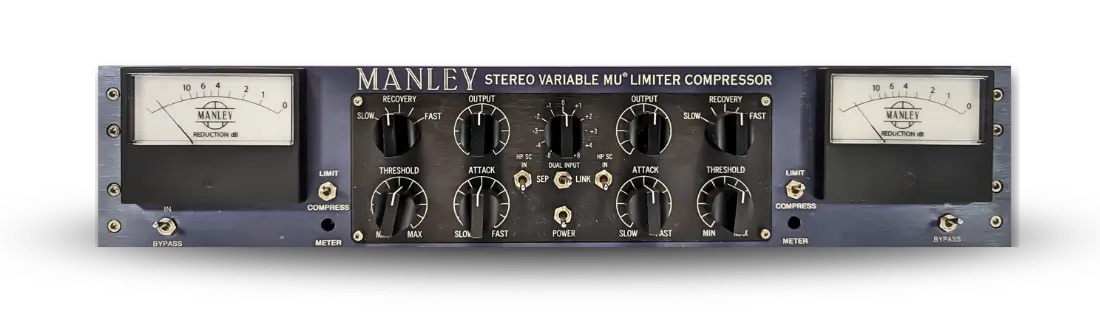
I can’t be saying things like, “Well, analog is infinitely better than digital,” because that is not accurate at all. If I’m working on a hip hop record, say, a reggaeton record, and I try to run the kick drum through my [Manley] Vari-Mu right here, it’s not gonna work, because the sound that you’re used to hearing on reggaeton records is not of an 808 kick going through a Vari-Mu. You’re used to hearing records that are made digitally, and if you want to be able to sound like those records… I can work on it entirely in the analog domain, but I’m going to have to make some choices.
What about the current vinyl and cassette revival? As someone who has to deliver the masters, is it a headache or a joy?
I love CDs. I wish that I could make CDs more. Whenever you make a DDP [Disc Description Protocol] to send to the plant, what comes back sounds exactly as you sent it. When you do vinyl, then it’s like, “roll the dice and flip a coin and see what happens.” Sometimes they’ll come back, and it’s like, “All right, this sounds really nice,” and it sounds unexpectedly in a different direction, but nice as well. Other times, you go “shit, this record doesn’t sound good at all on vinyl.”
I just did recently a reissue of A Fragile Geography album, and we did a cassette companion with reworks by different artists. I went to several places to try to get the tape manufacturing done that sounded good. Early passes often had a massive amount of hiss, so they sounded like a cheap transfer. I quickly realized there were issues with some of the duplicators.
Rafael Anton Irisarri – A Fragile Geography
Going back to digital connectedness (and distractions), how do you find that affects the ability to listen intently to music?
No one sits through a record from start to finish anymore. I’m 48. When I was younger, I would sit with a record. “This is my entertainment.” Maybe I learned to play guitar to this record. It would be unthinkable for me then to even listen to music when I had 10 other things happening.
The way that you engage with music on streaming is so different. On the same device that you’re using to listen to music, you’re getting 10 other different pop-up notifications for different things. Sometimes it’s, like, “oh, you know, I guess we bombed another country!” And at the same time, you’re listening to a really nice record.
And now we have the added layer of AI-generated filler and literal fraud on the platforms.
It happened recently actually several times to William Basinski. There was a record that came out, I think, in July of last year, that was listed as William Basinski and Claire Deak from Australia. And I was like, “Oh, Billy put out something new,” and it’s completely fake. They actually never even worked together. Someone just did that and released it.
There is now a really massive epidemic of AI music on streaming services. It’s pretty huge, especially in the field I’m in, with experimental ambient music. There’s so many playlists with automated artists so that [streaming platforms] don’t have to pay out. As a musician, as an artist, this is very depressing.
What’s the “north star” when the industry feels this fractured?
If you’re doing this and you decide to make it your way of life, you must do it because you really love it, not because you’re getting any kind of money from it. You’re not seeking validation from people. You just love doing it, and that’s it.
What’s next for you?
Aside from Points of Inaccessibility, I have my second album with Abul Mogard, an Italian musician that I’ve been working with for the last several years now. We completed the new album from a residency that we did in Berlin last year.
We’re planning another residency in Berlin again to record as well. We’ll be playing live with a small ensemble, with Martina Bertoni on cello and Andrea Burelli on violin. It’s different conceptually in terms of what we do.
After Abul and I started working together, we found out that we actually work really similarly and have similar tastes.
Stephan Mathieu [German mastering engineer at Schwebung] connected me to a Belgian band called Aksak Maboul, originally from the 1970s, who are recording again, and I’m working with them.
Rafael Anton Irisarri’s album Points of Inaccessibility is out now – listen on Bandcamp
Rafael Anton Irisarri & Abul Mogard’s album, Where Light Pauses in the Silence of Sun, is out in June – preview on Bandcamp
Find Rafael’s mastering work at Black Knoll Studio