What if an integrated plug-in instrument could rival even full-blown modulars? That’s the question posed by u-he’s Zebra 3, out now at long last for macOS, Windows, and Linux. It’s unlikely any other soft synth takes on just this much synthesis territory, or with this much depth. From spline-based morphing oscillators to physical modeling and through-zero FM synthesis, this is a horse of a different stripe.
Urs Heckmann’s Zebra made history back in 2003, with the major v2 update in 2007. In that era, you’d typically have to dive into a modular environment like Reaktor or Tassman to come anywhere close to what Zebra put in a single window. (Remember that even NI’s Massive didn’t arrive on the scene until the fall of 2006.)
Now, we’re spoiled for choice — Arturia Pigments, Xfer Records Serum 2, the open source Surge XT, and others all vie for your semi-modular synth experience. But there’s nothing quite like Zebra or u-he’s unique perspective on sound and sound design. In many ways, Zebra 3 delivers on a lot of what Massive X had promised. It might even take on your modular environment, thanks to the sheer depth of tools on offer and the ability to freely instantiate modules with drag-and-drop as you need. That is, if you love modules and matrices and layering synth methods and using rich morphing envelopes, Zebra 3 is there for you. All it removes is patch cables.
Oh, and one other note — this is the one tool I’ve mentioned so far that also runs on Linux, so the Linux workstation with Zebra, Surge, VCV Rack, and plugdata seems a no-brainer now.
The V3 feature list is just stunning. It’s physical modeling, modal synthesis, virtual analog, and digital wavetable and FM synthesis, all in one:
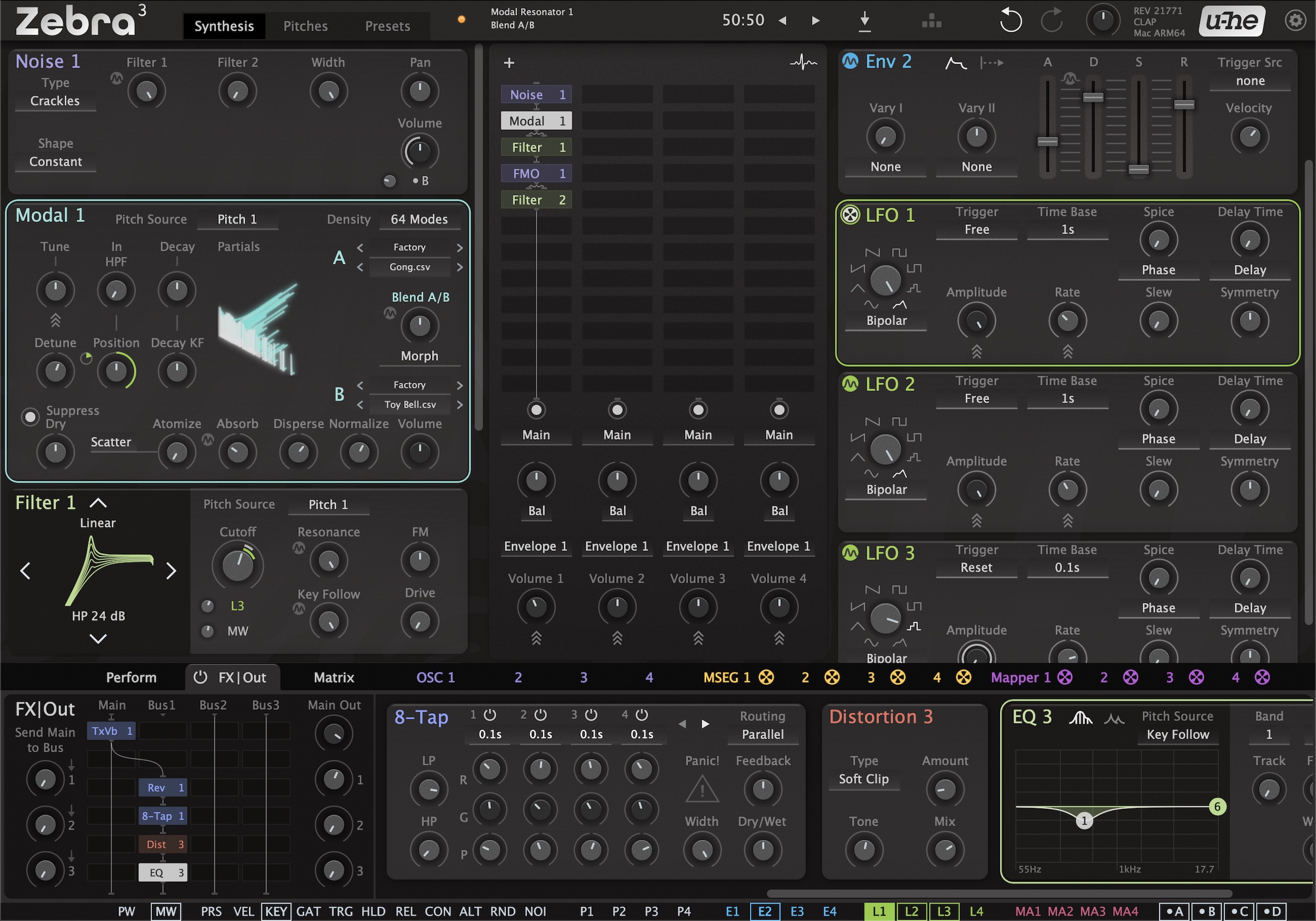
- Two oscillator engines: wavetable (16x unison) and additive oscillator (1024 partials)
- Spline editor for oscillator waveforms and MSEG curves with geometric morphing
- 20 oscillator effects: spectral decay, sync, phase remapping, etc.
- Filters with 13 models
- FM oscillators with 2 operators, plus third audio input operator
- Modal resonators and comb filters
- Noise and Exciter modules
- Vector and Scan mixers
- Mod Math
- Mappers with step sequencers, freely drawable transfer curves
- Ring modulators, distortions, wavefolders, equalizers
- Delays, multitap delays, reverbs, compressors
CLAP, VST3, AU, AAX, macOS, Windows, Linux, MPE, microtuning, MTS-ESP.
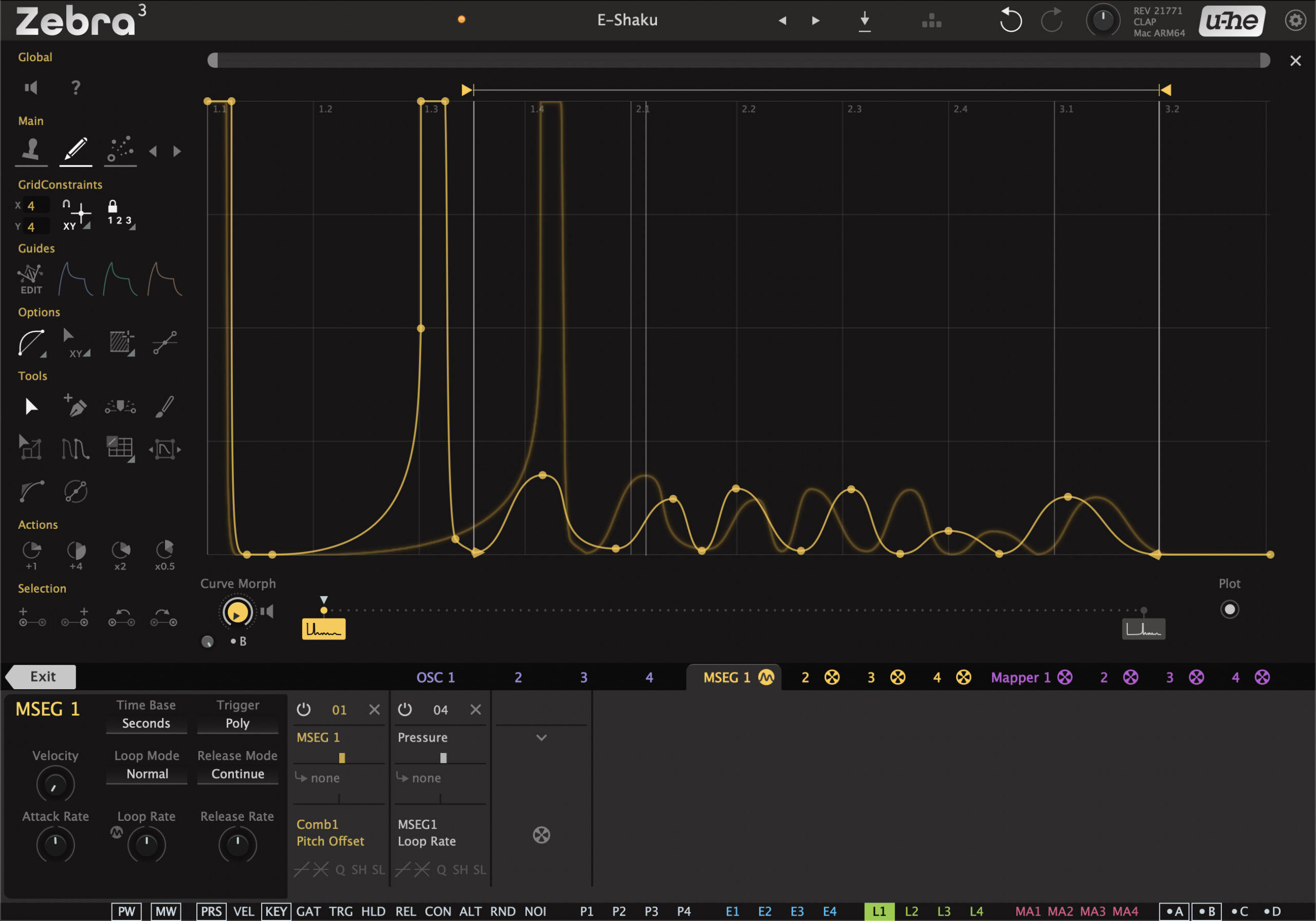
For deep spline-based envelopes and modulation, I can’t think of another tool with quite this set of editing tools. A drawing-style, deep spline editing interface, plus a rich mod matrix good enough to make you forget about patch cords, adds up to one deeply intriguing instrument.
Plus, don’t forget you can try a lot of this for free in the monophonic Zebralette 3, which is built on the same engine. That includes the modulation matrix, wavetable and additive synthesis, the sophisticated envelopes, and effects. (audiopluginguy has even written a well-considered review of the free version — worth reading for how you spend your time, if not your money!)
And just because you don’t see patch cords onscreen doesn’t mean you can’t do the routing as you can on a modular — u-he emphasizes that pitch, gate, and triggers signals are all “first-class modulation” you can route into anything.
u-he is even so bold as to call this “wireless modular” — and maybe that’s fair. While technically I think it qualifies as semi-modular, in that there are normaled routings, you get the kind of open-ended patching and module creation you normally associate with modulars.
And there’s really quite a lot you can do in the physical modeling realm, too, with noise generators, Exciters, Modal Resonators, and modeled filters. You get glimpses of that in other tools, but Zebra offers a fairly complete set — and alongside wavetable and West Coast sorts of tools.
It’s really beautiful. I always admired the Zebra architecture, but this is the first time it’s come in a modern package and UI. And for fans of doing more than just VA, getting this alongside Absynth and Plasmonic and AAS’ stuff means you can really devote your life to strange physical modeling and resonant sounds and never a dull vanilla 2-osc bass again. (Live a little!)
I mean, if I had any question about this, it might be — does this do too much? But for Zebra fans, that’s not even a question.
There are already too many videos about Zebra 3, so let’s be choosy:
Autodafe is always an easy favorite.
Here’s PLUGMON with some rather nice presets they’ve created:
Plus if you ever wanted to have Urs teach you about LFOs, here you go:
https://u-he.com/products/synths/zebra3
If you buy something from a CDM link, we may earn a commission.