Khyam Allami presented his long-term research project in Beirut yesterday, and it’s an exciting one. Hundreds of tuning systems, ajnās, and maqāmāt are now in a free, open archive, and there’s a free MIDI plug-in that lets you apply tunings (and tweak them by ear) across all major software tuning formats.
I haven’t gotten to talk to Khyam yet, so this is a preview — I wanted to make sure it’s in front of everyone’s eyeballs who didn’t catch this in Beirut or online, to see what you think. (Greetings, Arabic electronic music producers.) There are two components to check out:
- Digital Arabic Maqām Archive: a “multilingual, open-source platform, corpus and API for Arabic maqām theory.” https://diarmaqar.net/en (also in Arabic and French). The archive is also on GitHub.
- Tanghīm MIDI plug-in for macOS, Windows, and Linux, a free and open-source tool for applying tunings and tuning yourself — almost like having tuning pegs inside your software. Check the full project and download.
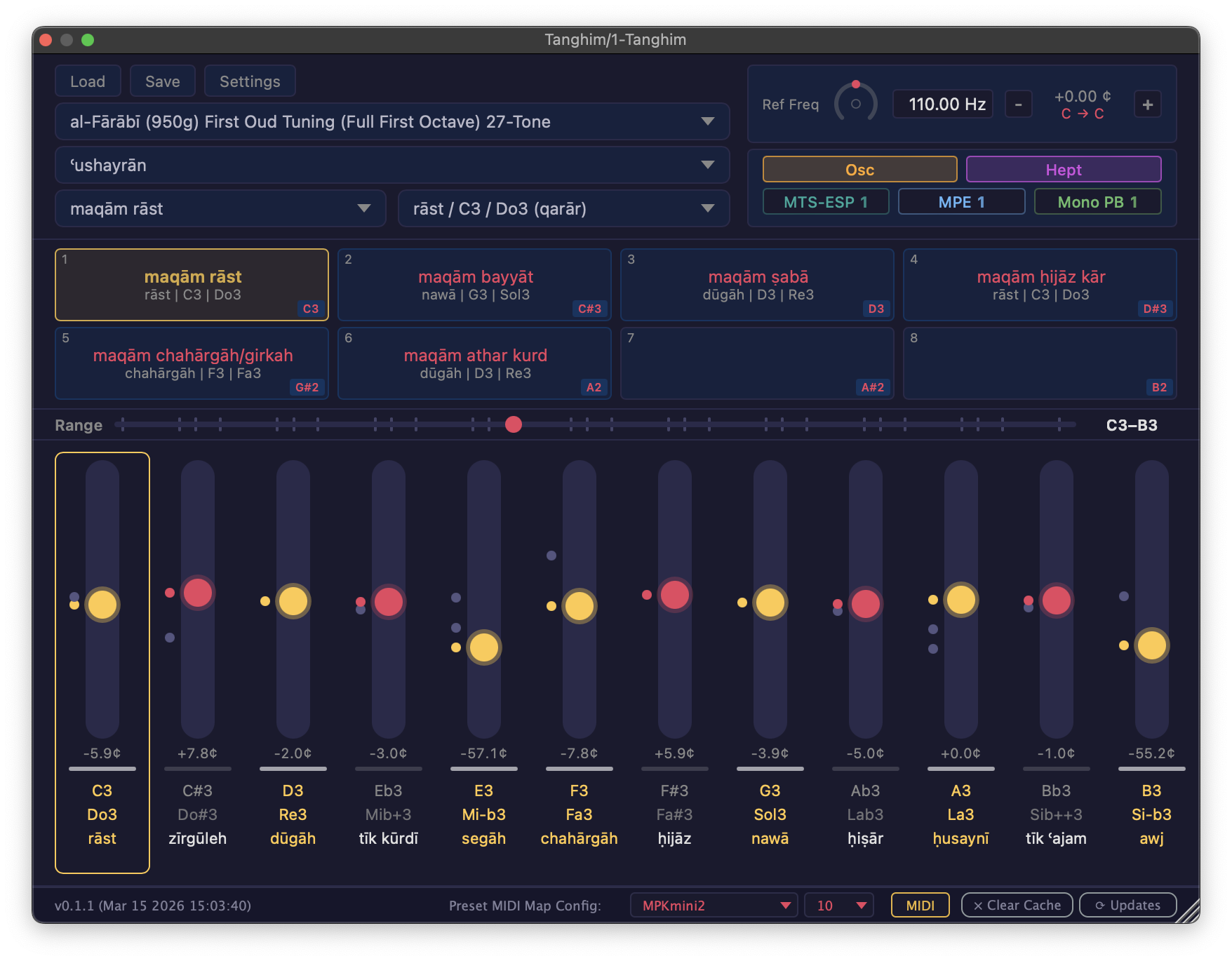
The software works across Oddsound MTS-ESP, MIDI Polyphonic Expression (MPE, for polyphonic pitch, supported by MPE hardware, Ableton, and a lot of software), and even monophonic pitch bend, for maximum compatibility. (With mono pitch bend, you can use literally any MIDI hardware or software back to the birth of the spec.) It’s a MIDI effect plug-in, but for Ableton Live which still lacks support for that, there’s also a bundled PE Receiver and a Mono Pitch Bend Receiver as Max for Live devices.
Tanghīm addresses a huge, huge limitation of existing tuning interfaces for MTS-ESP, MPE (including Ableton’s Tuning Systems), and Scala. These tend to lack any live interface for tuning. That’s unlike acoustic instruments (or singing), where you’d naturally adjust to different contexts either by tuning the instrument directly or working with intonation. It’s especially true in maqāmāt, for instance, where thinking of a fixed tuning misses all the nuance of performance. (Maybe you could argue it’s less so in something like a gamelan ensemble, as generall you don’t start hammering metal percussion right before you play, but even then — nuance and spirit is everything.)
Sure enough, even the name is related to the idea of intonation — restoring this as live musical practice, and not just the colonialist, 20th-century idea of standardization. From the description:
Tanghīm is an Arabic maṣdar, or verbal noun, denoting the act of intoning or setting pitch. In linguistics it is the standard equivalent of intonation, the melodic contour of speech.
Here it names intonational tuning (the pitch relationships that make up a system) as distinct from the Arabic usage of دوزان (dūzān) for the mechanical tuning of an instrument’s strings. Dūzān is a borrowing from Ottoman Turkish düzen (“order, arrangement, tuning”), from the verb düzmek (“to arrange, put in order”).
The archive is something people have only dreamt of before. It’s not that it’s comprehensive — this is a bottomless field. It’s that you have so many different ways of visualizing and hearing what you’re studying, across a variety of different Western and Arabic models, modern and historical. String length? Fret length? Pitch class? Staff notation? Cents? Different languages? There’s something beautiful about just lining up the different models, side by side. It underlines the realization that you ultimately have to internalize tune, to be able to sing and play it, but also makes it clear what the model can do as a guide.
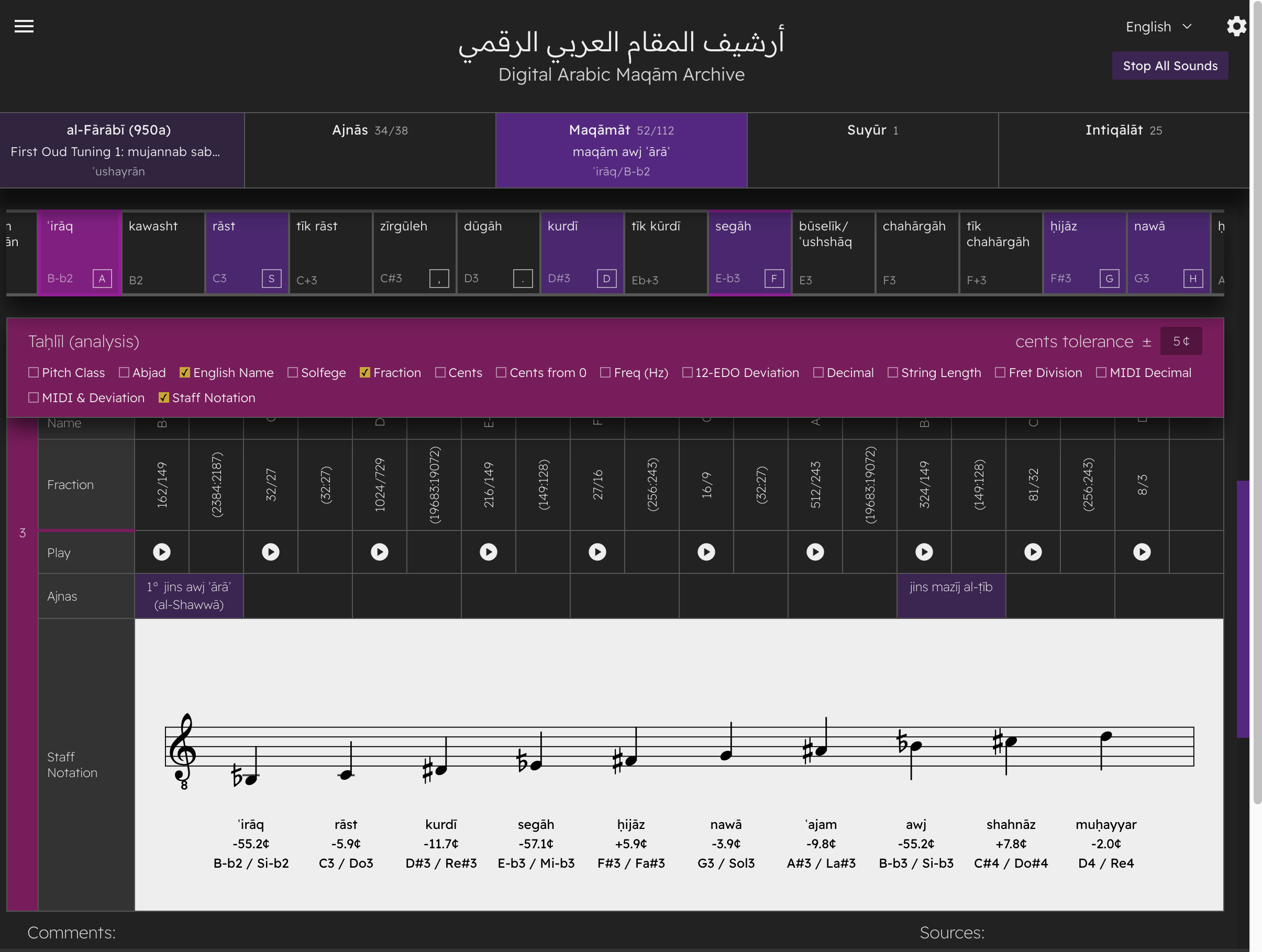
It’s also genuinely thrilling to see this project come to light. The archive is the work of Dr. Khyam Allami and Ibrahim El Khansa in the Music Intelligence Lab at the American University of Beirut. (Look up AUB’s history if you don’t know it; the “American” part is largely a name at this point — it’s been a vital project of the Lebanese and Arabic academic scenes.)
And the software brings to life what’s possible — addressing some of the restrictive principles of software so far that Khyam, and folks like Palestinian-American scholar/musician Sami Shumays, have raised. The software just couldn’t model what musicians do — modulations, exploration, properly naming the notes (with words, not just numbers), and so on.
For all the musical intelligence and corpus and API talk, this surely matters to those of us trying to decolonize our hearing and learn the music more deeply. That’s true in Beirut just as it is in Dearborn, Michigan — because most of us have devoted so much time to adapting to the standardized, reductive systems of 20th century theory and technology. The computer can do better; we can do better. It’s great to see someone doing that. It is a lot of work — so more on this soon, I promise. But I do also hope this opens the floodgates of people trying similar ideas across musical traditions.
Via:
https://musicintelligencelab.com
Updated: there’s another presentation coming up online, so anyone can attend: (note the Beirut time zone)
It’s worth re-reading this conversation, because now you can see where it’s led some years later, through an incredible amount of work: