It’s not lost on me that the same week InMusic announced its acquisition of Native Instruments, NI’s original founder, Stephan Schmitt, was busy with his team showing off new ideas about what a digital instrument can be.
The Nonlinear Labs C25, like the C15, is an exercise in building a synth around the player. It’s a decidedly premium instrument, but it’s also a statement, from its deep engines to its focus on physical interaction.
I’d expect nothing less from Stephan Schmitt. Even his own Reaktor patches most often focused on this question of performance interaction. Nonlinear Labs’ C15 almost seemed like it came out of some parallel dimension, a bespoke craftspiece in wood with an enormous ribbon controller and, you know, no MIDI in or out. At launch, it felt a little like one of those kit sports cars an eccentric recluse builds in their garage. Over time, it’s become an excellent keyboard, and yes, you can add MIDI I/O if that was really bothering you.
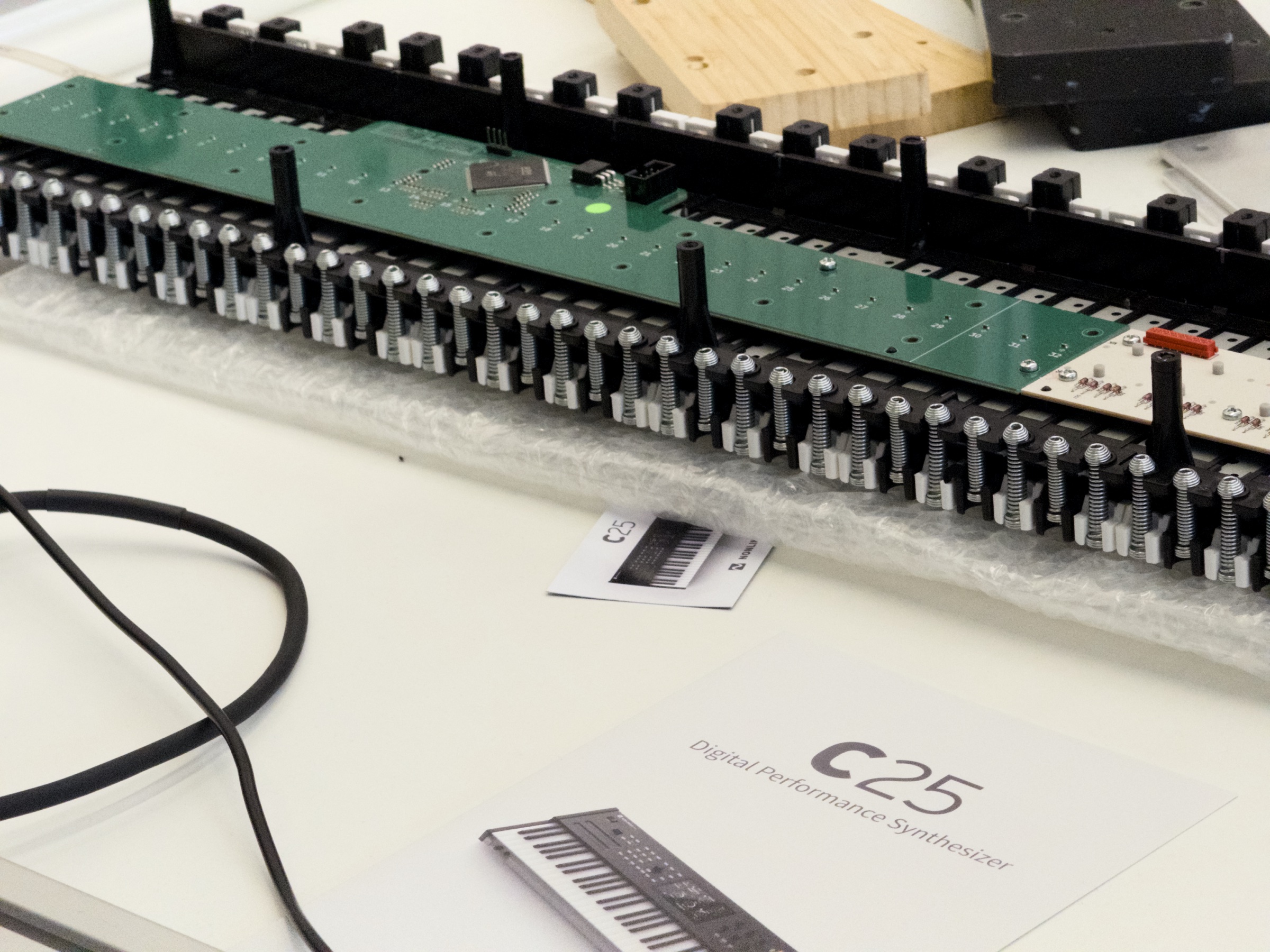
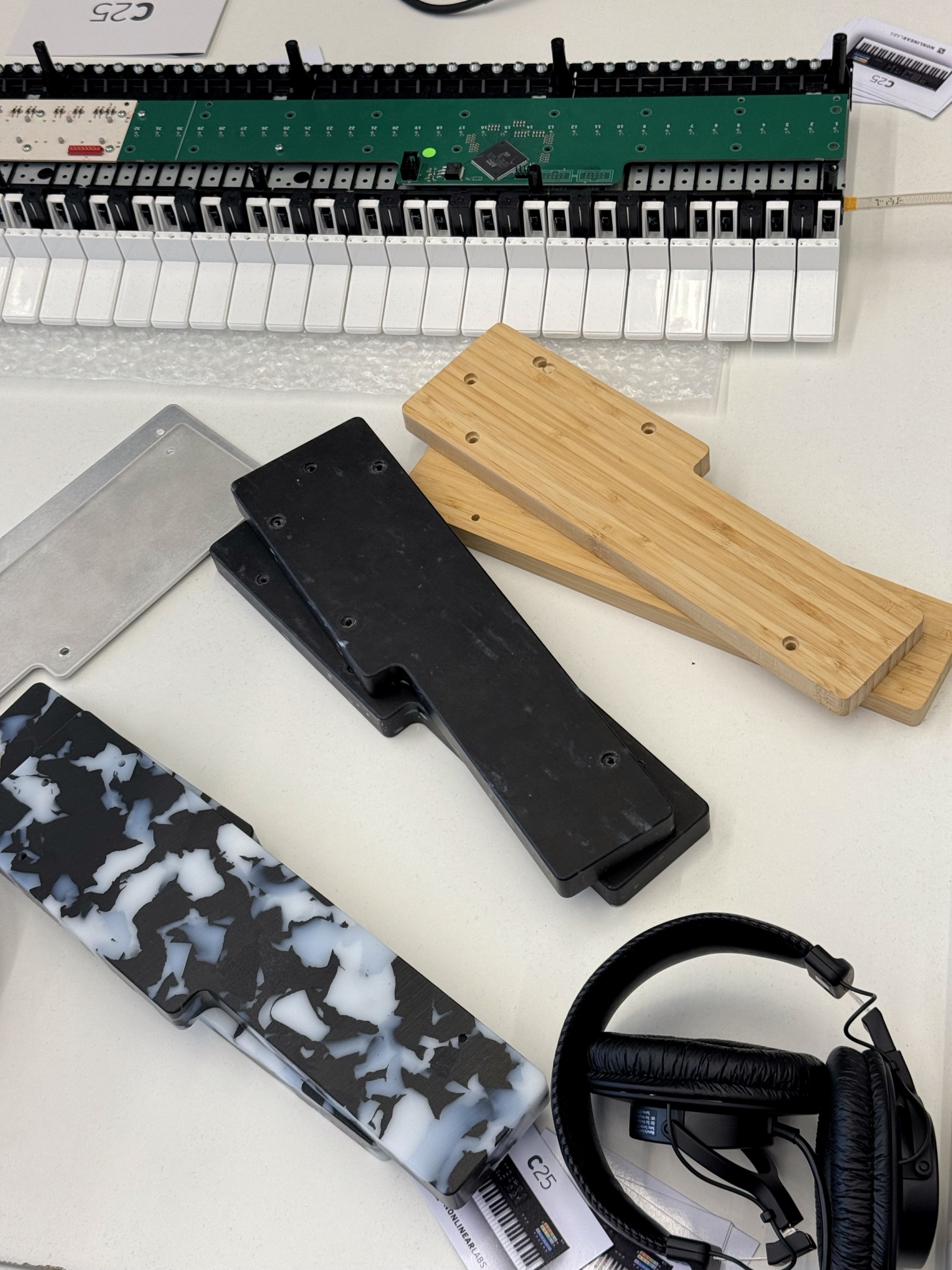
Don’t let the more conventional look fool you, either. While the C25 is now dressed up in black and a more conventional rectangular shape — a keyboard you can more easily take home to mum and dad, perhaps — it’s every bit as packed with engineering innovations. And it’s still manufactured in Europe, down to even “most” of its components (which is no mean feat). You get the same original continuous sensors developed by Nonlinear Labs, combined with the same TP/8S keybed from Fatar, and you can access the full C15 preset library. But almost everything else is reimagined.
The C25 has MIDI. And it has a big display. But it’s actually more hands-on, not less, even though the ribbon controller is relegated to a corner of the main panel. (Betcha someone decides they prefer the C15. I think whether they intended it or not, Nonlinear has cleared the path for a Special Edition C25 that brings back the wood and angled shape and full-size ribbon. “Signature Edition.” Whatever.)
This new edition is lighter, more compact, “more robust,” and has expanded expression, sound, and performance features.
New in the C25 — including some features that we saw over at NI HQ back in the day (ribbons and haptic controls):
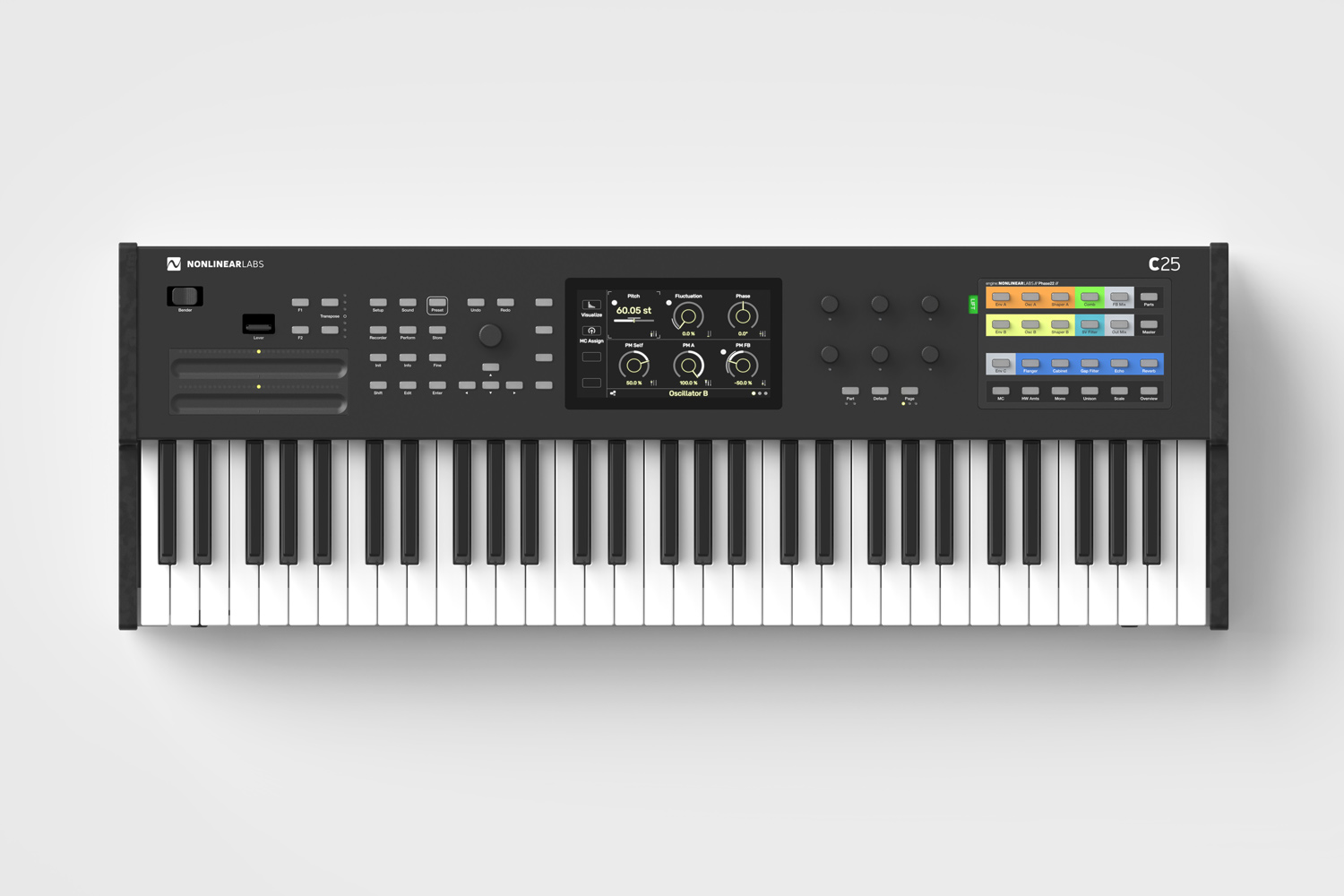
Phase 22 Synthesis Engine. Full C15 preset compatibility; like the C15, this is a combination of phase-modulation/FM, waveshaping, physical modeling, and subtractive synthesis. I don’t think it’s an exaggeration to say this starts to feel like the original vision of Generator/Reaktor in an integrated keyboard. Clarification: This is an identical engine to what’s on the C15, but it is regularly updated (see below).
Polyphonic expression. New custom continuous sensors now facilitate greater resolution, poly aftertouch, and even poly modulation based on travel of the keys with assignable parameters. (This deserves more detail, so stay tuned.)
New Lever and updated ribbons. Joining the C15’s Bender, you now get a Lever, a compact paddle with with magnetic return force. The touch ribbons may be smaller, but they each have a bar of 33 LEDs for additional visual feedback and new interaction possibilities. The new ribbons are also capacitive sensors now.
Pots you can feel. Six high-res potentiometers now have touch and haptic feedback (plus a step encoder). That opens up a ton of behaviors — detents the software can create, push and pull, simulated physics, and bi-directional interactions with the internal engine, depending how they develop this. Smart instrument builders are going to start to put more of this into standalone gear. For now, this already gives you end points for the encoders, so you don’t have to stare at the screen.
Complete tuning support. Of course.
7″ TFT display with touch. This just looks and feels terrific, and those engines deserve visual feedback and touch. From everyone glued to the keyboards at the stand, too, I’m convinced that this still feels every bit a performance keyboard, not another computer thingy.
The visual reveals the signal path of the engine, etc., as well.
Nonlinear Labs still loves your feet. 4 inputs for pedals and 4 inputs for control voltages. (The CV ins are a nice new addition.)
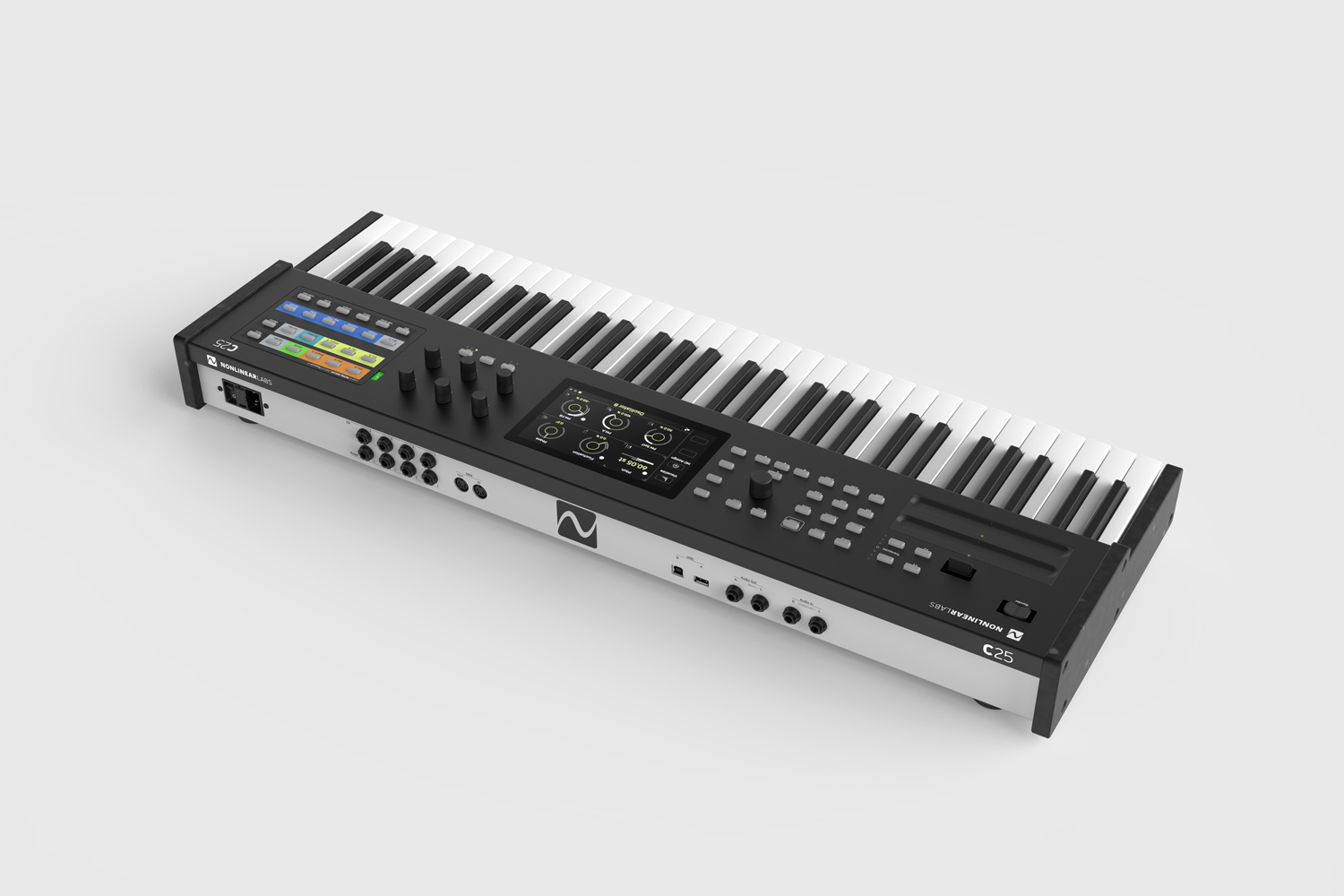
Studio audio. High-quality effects, 24 voices at 96 kHz if you so choose, tons of effects slots, and hours of lossless audio recording onboard. The keyboard is the studio as well as the instrument, which is not an attitude we see so much these days. But don’t worry, it’s now not quite as weird — USB host and device and MIDI in and out are there now, too.
(There was laughter at Superbooth about the MIDI DIN. Yeah, it’s available now!)
The whole team at Nonlinear Labs is made up of really lovely people, and talking to Stephan is always inspiring, so I promise to go visit them and go deeper into the C25. It’s one of those things where it’s like having a chat with instrument builders; it’s more than just some new piece of gear. Even if you aren’t in the market to buy the thing, you want to know more about it.
Don’t miss the talk:
For 2025, Nonlinear had introduced some significant architectural updates to the Phase 22 engine(s), which are also reflected here:
One of the major changes is that the polyphony will be increased from 24 to 48 voices at the previous sample rate of 48 kHz. Alternatively, a higher sample rate of 96 kHz with 24 voices is offered.
The C15 audio engine has been expanded to support polyphonic modulation sources. In the first step, polyphonic aftertouch can now be received via MIDI.
Pitch bend and sustain functions can now also be used independently of macro controls, freeing them up for other modulations.
A sostenuto pedal function and the ability to switch presets and banks via footswitch have also been added.
There are also a number of improvements to user-friendliness and optimizations to the operating system.