Enter an organic sound machine that will take you to an imagined sound world somewhere between a temple garden and a half-awake dream. ENDOGEN is a dazzling tool for microsound, drones, and atmospheres, built in Max and SuperCollider, exploring notions of lowercase synthesis. There’s a lot to cover as far as what it can do — but you should also feel empowered to get delightfully lost, too. Here’s a first look.
I’ve been working with builds of Endogen for some days now. It’s another creation from Emiliano Pennisi, aka a__v__e__n__i__r; I wrote about his exceptional free transient-focused algorithmic drum environment, Envion for Pure Data. Endogen is deep, mysterious, and perhaps just the kind of delicate sonic retreat your soul needs right now for a moment, a refuge from this insane world.
Before we get into that, though, a note on “lowercase” music or the unenlightened. (I certainly was no expert!) It is a genre, and I like that even before you know any context or history, you kind of intuitively sense what it might be about — a radical music of soft sounds. Composer Steve Roden evidently coined the term, creating music from ultra-quiet sounds. It’s exemplified by compositions like Forms of Paper — which gets its own dedicated module in the vast ENDOGEN environment, by the way. As the name implies, this is a music made from paper as a sound source; it was originally commissioned by the LA public library’s Hollywood branch. Back when VICE had more actual staff, even they were into it:
Lowercase: The Music Genre That Should Be a Typeface But is Made Out of Paper
ENDOGEN is a sound studio for producing lowercase sounds entirely in-the-box on your computer. SuperCollider, the free and open source synthesis tool, provides the sound engine; Cycling ’74’s Max weaves it all together via an interface, directing traffic via an OSC (OpenSoundControl) connection.
You don’t need a Max license; the free Max Runtime will also work for standalone more. Or even easier, just run the patcher via Max directly — even without a license, it’ll operate properly in demo mode (and you can still browse around its innards). If you’re an Ableton Live Suite user, you’ll even find a copy of Max is already installed via Max for Live. Of course, a full Max license will give you editing and modification powers.)
It’s a sound studio, in a way, but the sprawling interface feels more like a map to a lost kingdom of sound toys. And you get a forest’s worth of generative materials:
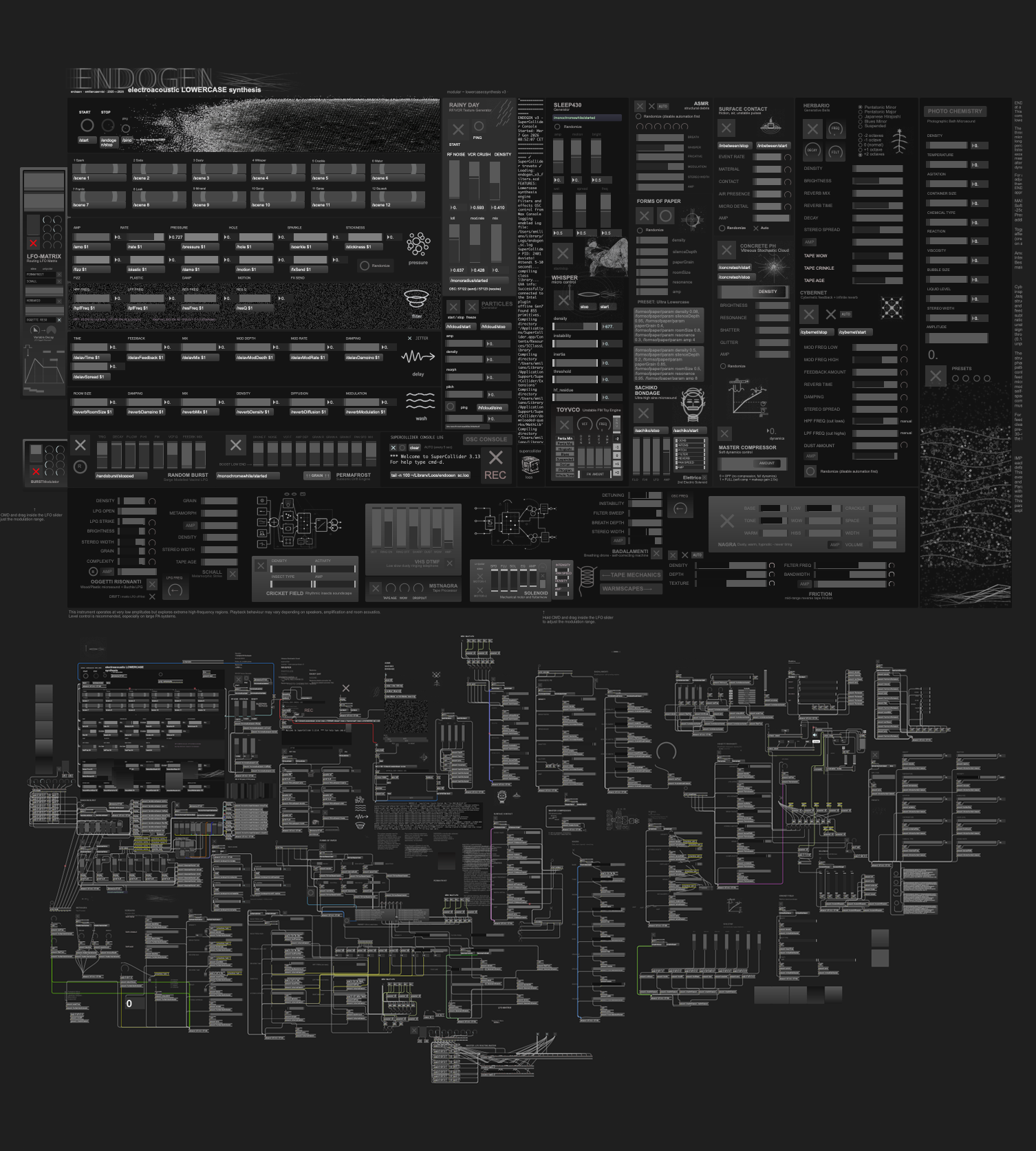
- 14 modal synthesis methods, loosely interpreted, “modeled after vactrol-like dynamics and the frequency responses of tapes, cabinets, and amplifiers.”
- 30+ specialized synthesis modules (generative oscillators, modal synthesis, cybernetic systems, tape mechanics, noise generators).
- Two generative oscillators and ten bonus oscillators with direct frequency control — you can tune these however you like.
- Sleep Pad 432, Whisper, Forms of Paper, Concrete PH, Surface Contact — all for more inspiration.
- 150 parameters with gradual evolution spanning minutes rather than subdivisions of seconds or beats.
- Different modulation types — unipolar, bipolar, additive, absolute
- Sine, ramps, triangle, square, sample & hold waveforms.
- Direct recording (saved to disk, just hit record).
- Companding system for balancing dynamic range.
For the most part, there are no presets; you just gradually explore. And there isn’t really even a manual for each parameter — not as an omission, but by design. For anyone who ever wanted to be free to just turn knobs and find out what happens, this is for you.
Just be prepared to be patient with that process. There’s no random LFO, and while there are internal timing sources, they don’t follow divisions of beats or even any shorter division of time. Instead, everything is organized into longer spans of gradual evolution, modeled, the developer says, on natural phenomena. You’ll be given a density control for most sections, for instance. You have to wait and listen, letting environments emerge.
Instead of turning a knob and hearing an immediate result, you set something in motion and wait for it to melt or catch a breeze. It’s a sailboat, not a powerboat.
If the project approaches near silence, that’s also intentional. (Ever wanted to quiet a crowd? Play so softly they have to abandon even whispering!)
Emiliano has been packing more and more functionality into this in the past few days. Low Pass Gate fans, they’re here in abundance. And now you get tools like a new matrix for exploring deeper modulation. From Emiliano:
At the core of the system are Low Pass Gate inspired dynamics: slow envelopes, asymmetric decays, non-linear energy transfer, and organic responses reminiscent of vactrol circuits, contact interactions, and small resonant objects.
The Tape & Mechanics section goes beyond emulation. Capstan modeling, wow & flutter, phase inversion, and speed-dependent frequency response transform sound into an unstable mechanical system capable of moving from fragile micro-events to dense, physical sonic masses without breaking coherence.
The new multi-channel phase-shifted LFO matrix introduces deep generative modulation.
Five independent LFOs distributed across 36 destinations create slow interference patterns, non-periodic drift, and emergent sonic states that are impossible to achieve with traditional single-LFO modulation.
Here I am just playing around in the environment — and floating from section to section so you can get a view:
The more you explore, the more you realize this really can be an instrument you can make your own, as you learn to coax unexpected sounds beyond the ones that appear first along the surface. More is coming, too — Emiliano shares this delightful integration with live coding:
[This] includes an advanced sampling player based on FluCoMa descriptors and 2D corpus exploration in SuperCollider. In that clip, I’m exploring the possibility of integrating a 2D plotter, which is a very advanced feature roughly comparable to Absynth’s newer Explore concept.
You set something in motion and wait for it to melt or catch a breeze. It’s a sailboat, not a powerboat.
See more on FluCoMa:
2D Corpus Exploring by James Bradbury
I think just playing around with this may forever change how I approach Max patching!
Really, this is what we all need. If music is a practice in transforming time, this approach forces you back into longer-form rhythms, into letting go of this clock-time, second-by-second control. It feels like a release, like a long steam bath for your perception. It feels like freedom.
39EUR; macOS and (updated) now Windows! (Full files and projects are available.)
ENDOGEN complete documentation
More examples and feature demos:
PS, if you’re curious about Max and want a place to start, we’ve got a CDM page for that:
Previously: