It’s the absolute opposite of “AI” as you’ve seen it. There’s no online connection, no giant data set. And here, neural nets help you to resist presets and defaults — not lead you into them. The new PhenoType for Sonic Charge Synplant will help you precisely define the ear-bending alien sounds you want to create in words. CDM got an early look.
Here’s the idea. First, Sonic Charge started developing an algorithm to describe Synplant patches using words as tags. But then, they hit a brainstorm. Turn the same algorithm on its head, and you could type in tags to generate patches.
Here’s me using it for the first time. Unlike a large language model, you do need to be specific and use keywords that the engine will understand. So you actually need to stop and think about what you want. This being Synplant, you can morph that starting point into wildly evolving new sounds. It’s like having a randomizer with intention.
In a way, lumping everything under the “AI” rubric is incredibly misleading. Artificial neural networks have a history dating back to the 1940s or so (earlier, depending on when you start counting). So it’s like we’re comparing a bicycle to a gas-guzzling monster truck. Or maybe it’s comparing someone squeezing you a soda spritzer with a bit of fruit versus the Coca-Cola corporation. Locally trained models running inference locally are a completely different animal from the large generative text models that are currently eating our lives and communities. For one thing, you should drink some water, but your computer won’t need to.
I spoke to developer Magnus Lindström about his approach in Synplant 2 back when it was released; you can read that in-depth interview, including how he developed Genopatch, the neural-net-powered engine for navigating complex sets of synthesis parameters.
The road to Synplant 2: the story behind this mind-bending plug-in sequel
This is just a first version. Magnus explains: “We have over 200 tags in there (with around 1000 synonyms) and it has been trained on almost 60000 patches (yep, all by myself hehe), but there are some obvious holes, e.g., knows very little about music genres and exotic instruments. But we will get there in time.”
For now, add more words, and you get more precise results. (You can even see the engine ticking along after you hit enter.) I was impressed, though; I wound up hitting save on everything as this gave me better starting points than trying to browse through presets or just randomizing. I like that, though: here you’re doing some learning, not just assuming a large language model will do it for you.
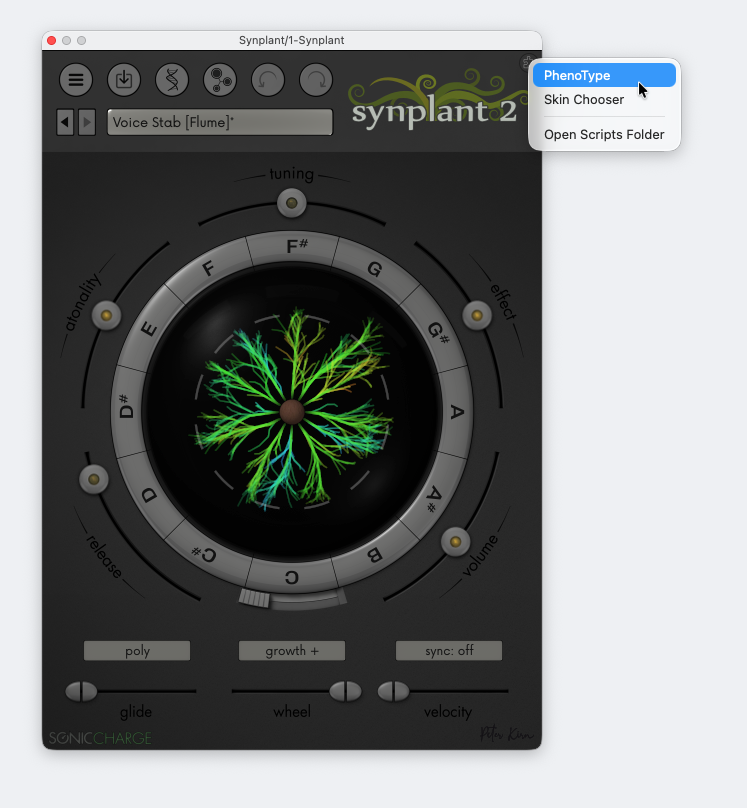
And that’s the joy here. This is really the Sonic Charge team’s craft and personality oozing out of this plug-in. Whereas generative code threatens to normalize music software, here you retain that relationship with an instrument builder — a builder of alien instruments that are only impossible in the digital realm.
I know there are developers (and users) who will be bolting LLMs onto software. But this is so much more particular and interesting. It’s a lot more work. But it’s also a lot more rewarding.
Keep music software weird. If we could ever count on a soft synth to embody that, it’s Synplant.
Now open to anyone with a Synplant 2 license, which, honestly, life is short — go get one.
https://soniccharge.com/phenotype
Previously:
For more on this kind of machine learning technique (in contrast to the hyped-up Big Data Big Tech stuff), see also the way Hannah Lockwood at Native Instruments approached Absynth 6: