You wake up. It’s the year 2003. Some upstart software developer called Audio Damage wants to let you patch a combo filter-delay however you like, including ways that will break your ears. Ronin is reborn as ShinRonin, from a time when software developers let you run with scissors and do strange things.
This is one of Audio Damage’s very first plug-ins. Ever watched really early Jim Henson animations, where instead of the polished puppetry we now know, strange furry creatures were just blowing s*** up constantly in the most destructive way possible? Yeah, ShinRonin is the Wilkin’s Coffee of plug-ins, in that there are many, many ways to create feedback loops and self-oscillating sounds.
Many outcomes are beautiful. Some are destructive. Life is good.
And… that’s the point. ShinRonin is wide open for you to use as you like. The filters and delay lines are just straight-up digital implementations — no gauzy analog models to cover your tracks, no fine-tuned controls that keep you in a safe, on-rails world.
You can produce really quite nuanced, subtle, clean delay and filter effects. And these can morph into rich, modulated, and spatial effects. And you can get all kinds of unique timbres if you push the envelope.
All of this is made terrifically accessible, thanks to two delay lines, two filters (with multiple modes), envelope controls, and dual LFOs. There are two saturation amounts for some stomp-pedal-like effects you can dial in. And then there’s the stroke of genius: a control matrix (with positive and negative modulation amounts for each parameter), and a separate audio routing — one that has inputs for the filter circuit.
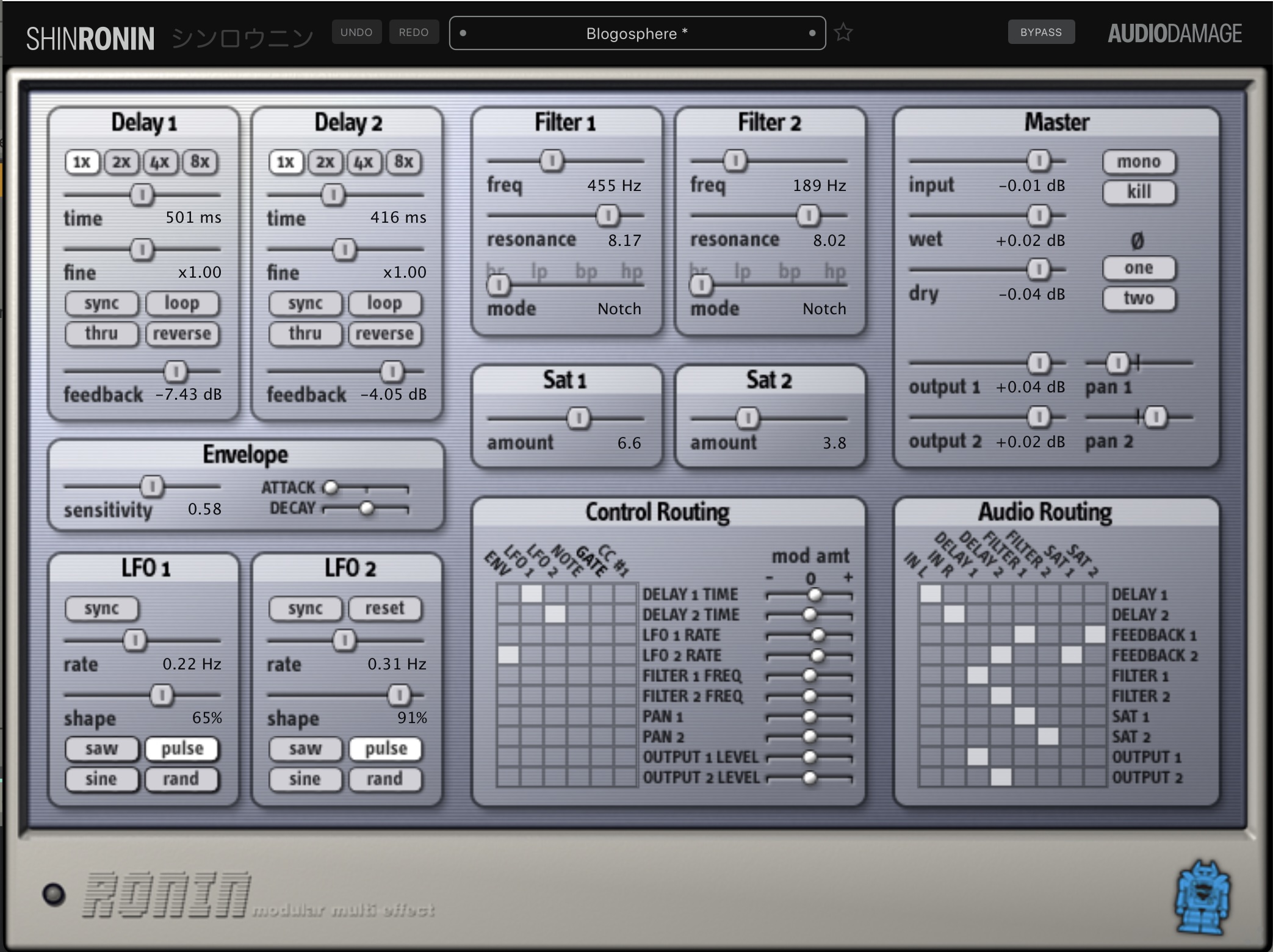
Why don’t more effects plug-ins have this? Well, to my Wilkin’s Coffee point, I suspect a lot of plug-in devs would (wisely) worry that you could create feedback loops or other unwanted effects too quickly.
Audio Damage makes fantastic stuff today — I admit that in a blur of plug-ins, I’ve fallen behind in writing up their latest tools. There are plenty of reasons to enjoy their 2026 selves.
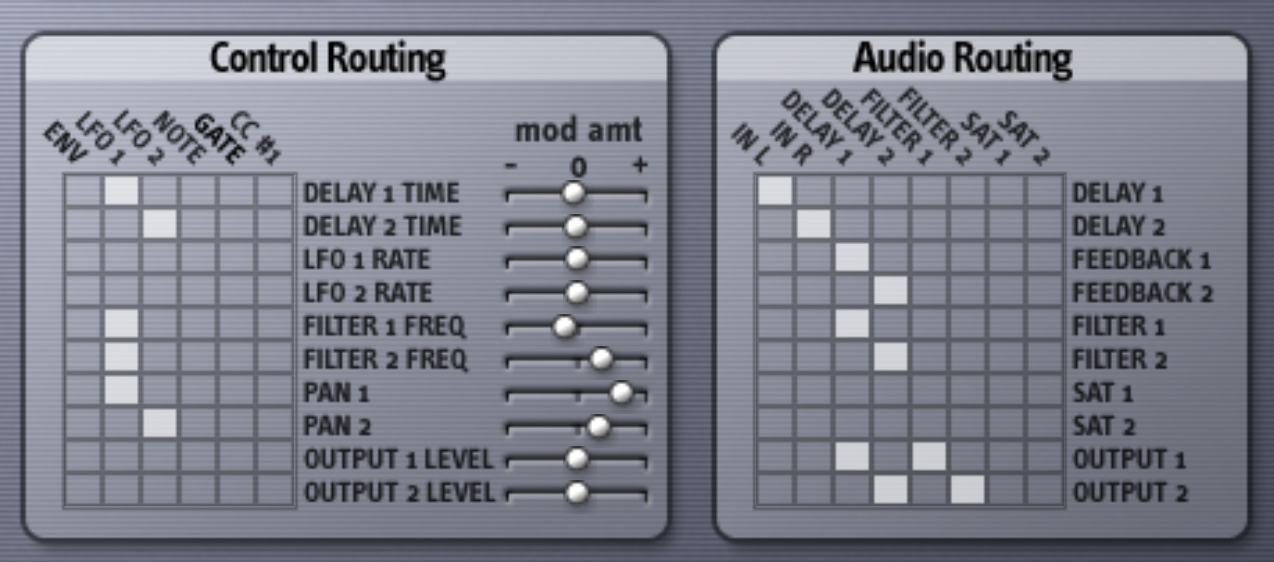
But it’s wonderful to see Ronin reborn as ShinRonin — the same DSP, the same UI, but thoroughly modernized for modern systems, including Windows, MacOS, and Linux — CLAP, VST3, AAX, AU, LV2, the lot.
And honestly, I wouldn’t mind a new SuperRonin effect that ran with this idea. (Comb filtering and not just band-reject, maybe?) But in the meantime, it turns out a little 2003 fits in just fine with our 2026 software suite.
Free even feels like a steal.
Audio Damage ShinRonin – free modular filter/delay
To give you an idea of some spontaneous worlds you might explore, here’s me messing around with ShinRonin and Chromaphone and Multiphonics CV-3 from AAS:
Hey, while it’s 2003, this new computer looks sick.