Quick: when was the last time when you just messed with a synthesizer knobs and played with waveforms for the sheer joy of it? The new soft synth from GForce dumps all the algorithms and black-box elements of FM in favor of the visceral pleasure of messing around with sound. It’s not another historical emulation. It’s an FM playground.
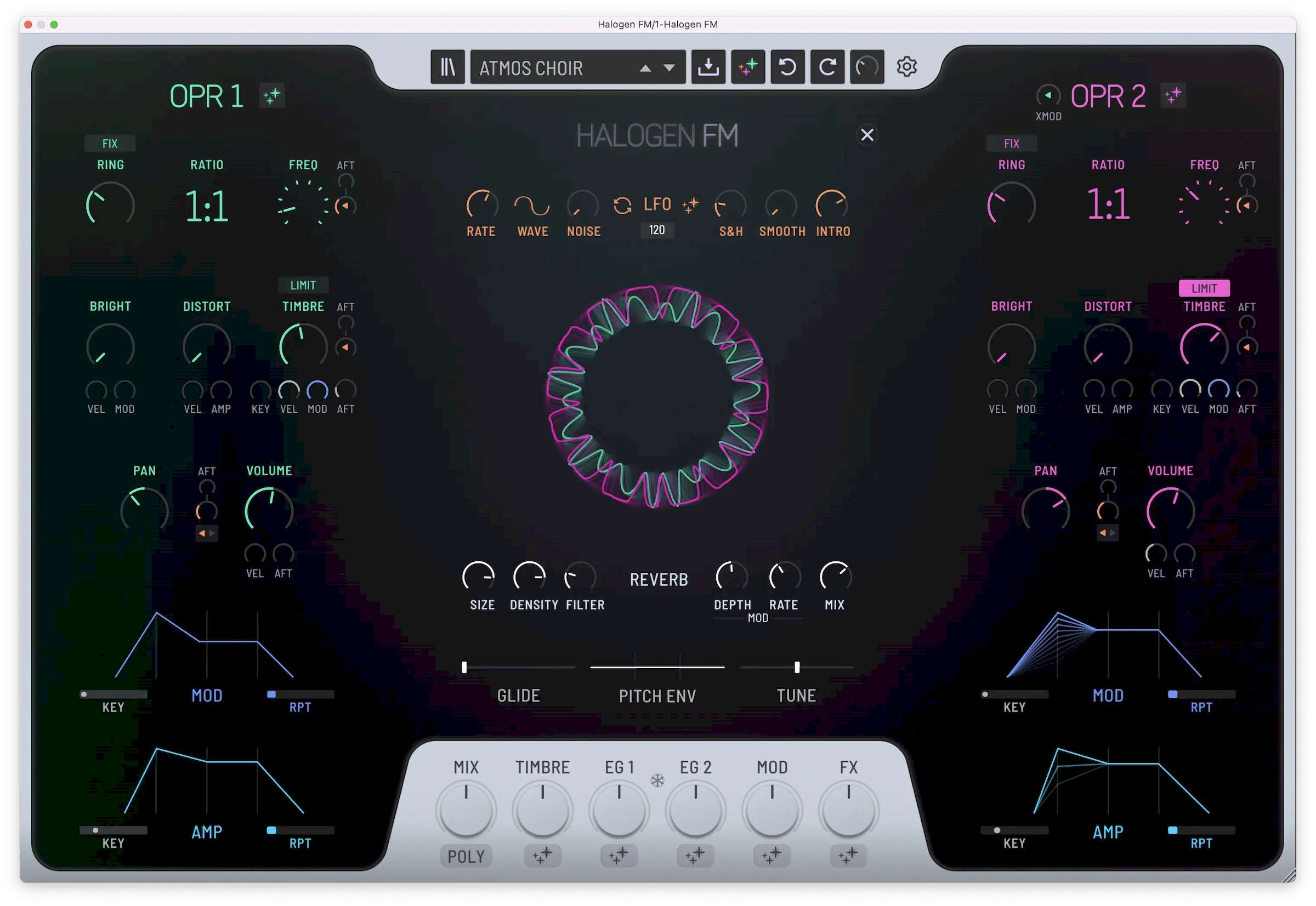
Now, to be fair, Halogen FM has not come entirely out of left field. GForce Software says the project was inspired by a “hidden gem in Japanese FM synthesis.” They would not comment on which FM synth they mean. While it’s a little too obvious, my money is on something in a direction like a lesser-known Casio, as those had similar dual-operator (“line”) architectures and ring mod. (And you could get that in something like a CS-230S.) Smarter readers, I’m sure you’ll nail identifying it.
But you don’t really need to know what hardware sparked the concept, because the minimal interface, unique sound, and plenty of twists GForce has added all add up to make this feel like something new. This isn’t a copy of any one piece of equipment; at last, we get those beloved instruments of the past inspiring creative ideas we haven’t seen or heard before.
And this is really unlike anything I’ve seen from GForce. It’s even a departure from a lot of competing soft synths at the moment. The company’s terrific modeling acumen shines through here; this has all the character and detail that you’d expect from a hardware classic, but it’s combined with a fresh, radically simplified UI.
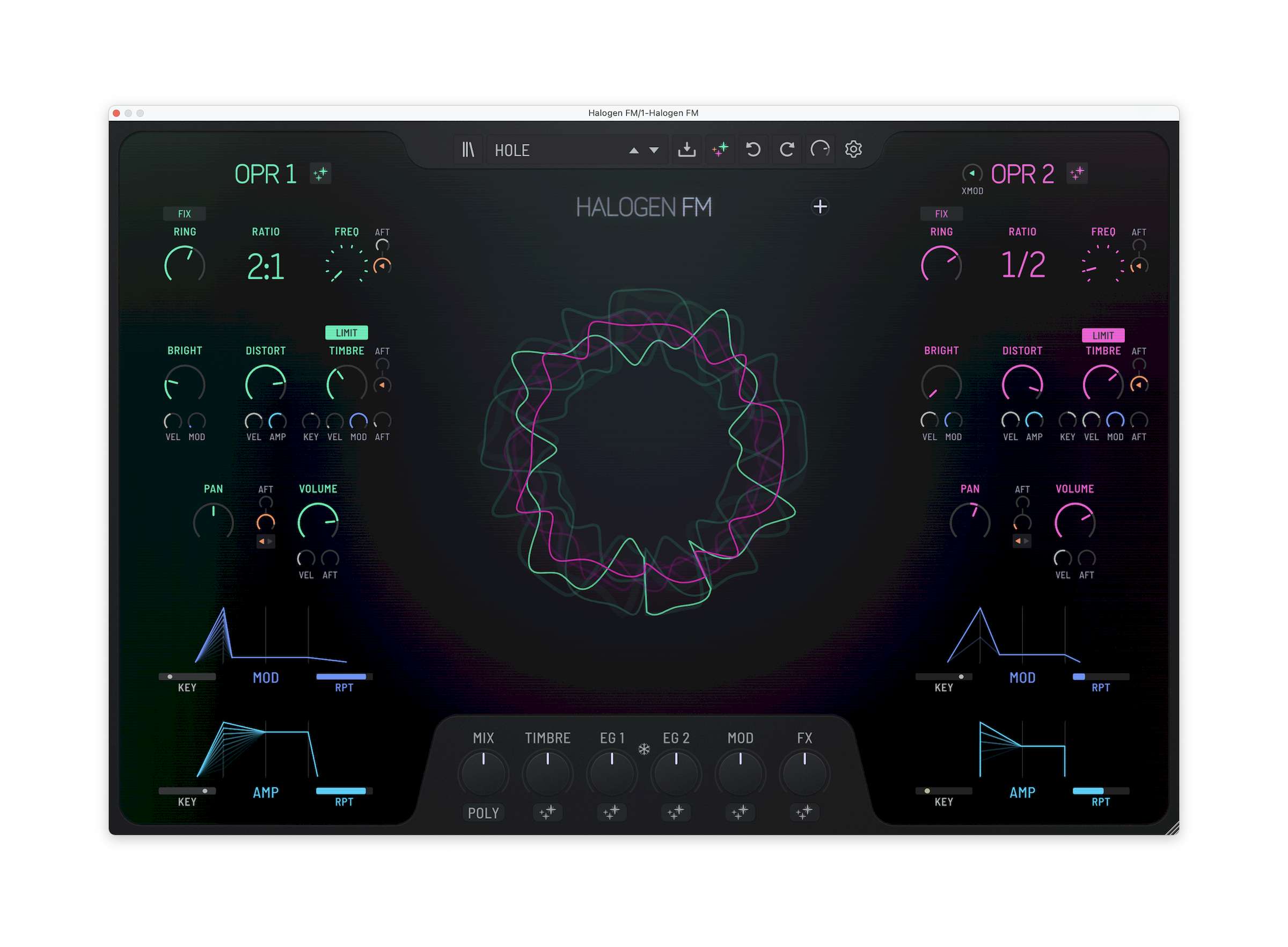
The architecture is clever: fewer elements, but with a wide range of possibilities. There are two operators with independent controls and sounds:
- Two operators, each with ring mod, distortion, timbre, and brightness controls
- Two independent modulation and amplitude envelopes for each operator, with looping and key tracking
- Mapping of key tracking, amplitude and modulation envelopes, velocity, and aftertouch per parameter (just drag the bits underneath the controls)
- Poly aftertouch and poly pitchbend support
- Cross-modulation on operator 2
It’s a layout where at first it seems too simple, and then you realize how much you can get out of it – just my kind of design.
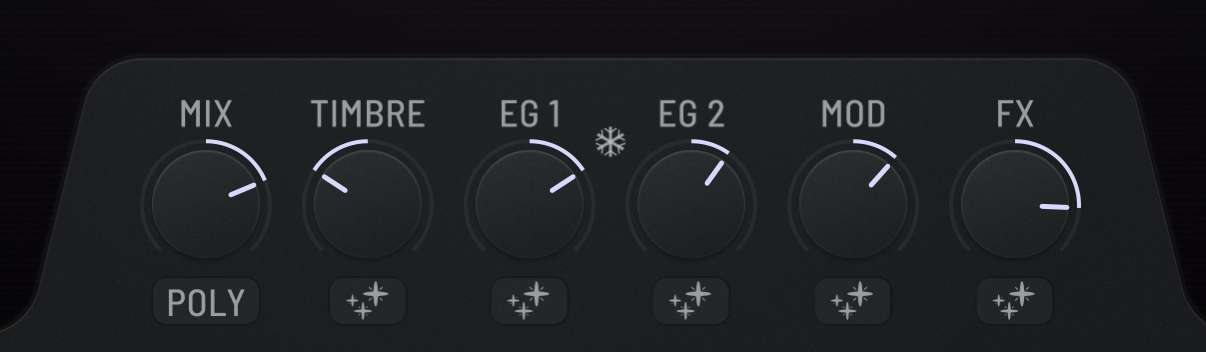
If you ever wanted to grab knobs first and ask questions later, this one’s for you. At each level, you get layers of macros. You can adjust the knobs at the bottom of the screen, for quick access to envelopes, effects amount, op 1/op 2 mix, and timbre. And you can use brightness and timbre knobs on each operator for quick results in character.
Ring modulation is also set up intuitively. You can choose a fixed ring modulation with the FIX button, setting a frequency with the frequency knob, so just the carrier follows your keyboard/MIDI input.
In case you hadn’t guessed, those little “sparkle” buttons randomize the whole patch, each operator, or individual macros. That’s a cute touch that lets you instantly shuffle what you’re doing if you need a boost of inspiration. They call it “Spark Core.”
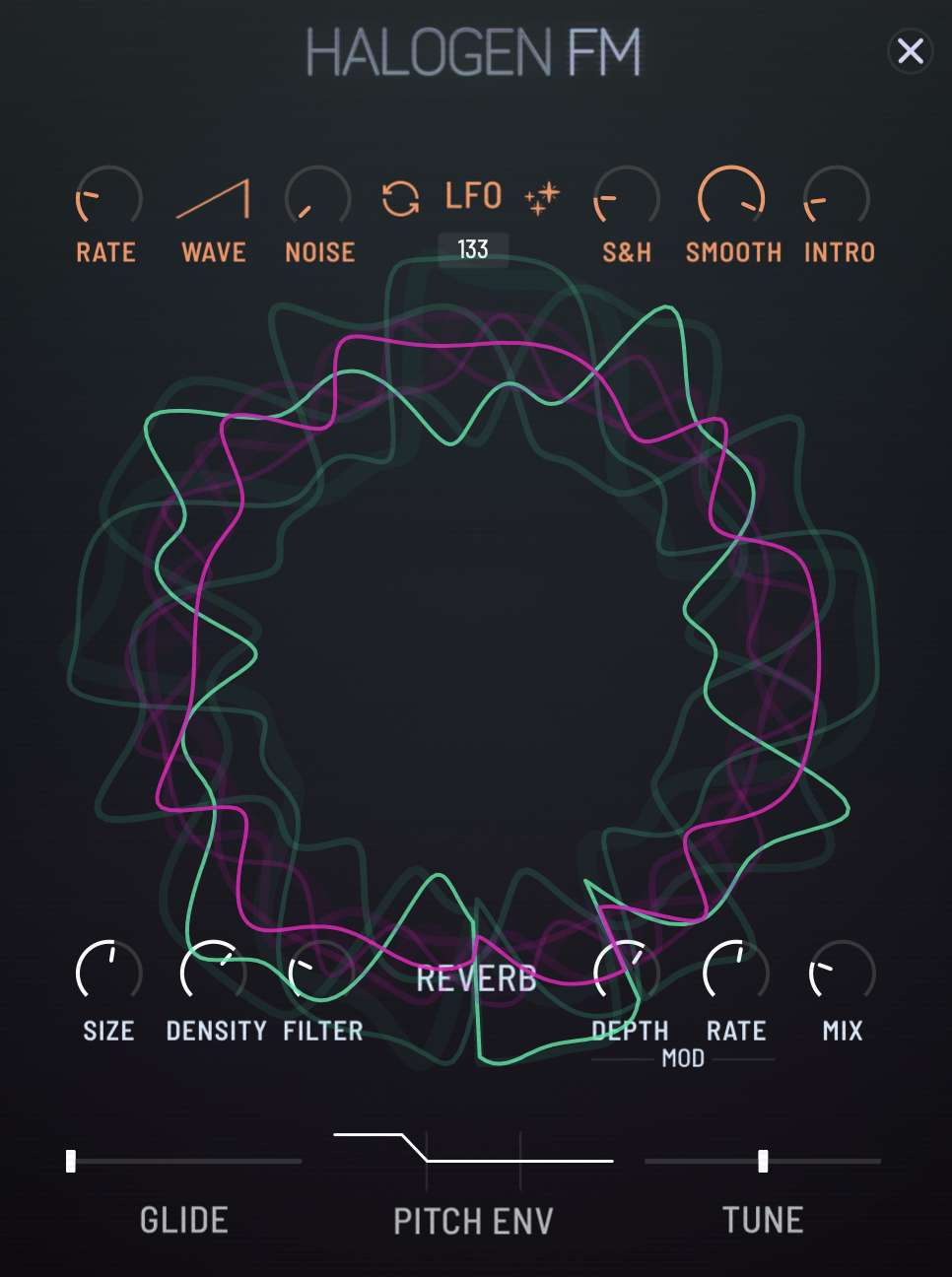
Go deeper – tucked beneath that ‘+’ symbol on the oscilloscope – and you get some additional LFO, pitch envelope, and effects controls:
The addition of poly aftertouch can make this really expressive. With effects turned down and minimal modulation or extreme settings, you can go completely raw – see my demos. But with effects up and some sound design, you can get some truly gorgeous sounds, as they demonstrate nicely here with a variety of controllers:
Now, there are 320 presets in here, and they sound great. But it’s also a lot of fun screwing around in the UI. In particular, that crisp, high-refresh radial oscilloscope in the center makes using this completely mesmerizing. There’s something about the macro knobs combined with the visualization that just put you in the zone.
And then you start going here, just messing around with sounds. The first is a modulating a preset; everything else is just screwing around, which is irresistible.
This is not one of the many soft synths where we fall back on the boilerplate and say it’s “capable of fat basses, thick leads, juicy stabs, lush pads, the sounds of commercially acceptable piccolo licks, and it’s perfect for your ska band.” It’s more like “everything this thing does makes it sound like you’re deep in the synth lab, in a delicious way.” It makes wreeorw wreeorw sounds of all flavors. Synthesizer Patel would buy this in a heartbeat. “It’s ideal for anyone who loves synthesizers and maths.”
Hell, yeah.
But yes, while everything is wonderfully synthy, you do have a ton of control over how metallic or harsh or mellow or smooth everything is. You can animate at different speeds, for extreme modulation or subtle shifts. And when you’re ready to go there, GForce have done a great walkthrough:
GForce has done a beautiful job of making some classic Oberheim synths available to us with perfect precision at prices we can afford. (I wrapped up a conversation with Tom Oberheim himself last month and will have that wide-ranging discussion for you shortly. I’d say if Tom’s happy, they did a good job.) But Halogen FM is something unlike other stuff on the market. You can definitely patch something like this on a software modular, of course, but they’ve done a bang-up job of making a coherent instrument that’s quick to play with.
And the intro price makes it easy to recommend as an impulse buy. It’ll be £66+VAT eventually, but through the end of July, it’s £33+VAT. A 7-day trial is available. macOS, Windows, AU, AAX, VST2, VST3, and (oft-neglected!) standalone:
Available now on sale at Plugin Boutique:
If you buy something from a CDM link, we may earn a commission.