Back in green: three years after Native Instruments announced its demise, Absynth 6 makes an unexpected return from the dead. What we get is not just a rerelease, but the biggest update for the polysynth in its history, with everything from new filters and engine enhancements to a new UI and MPE. Early review: this is a polysynth you need to explore all over again — or discover for the first time.
Preview: I’ve been working with prerelease software for the past few weeks, including a late build, as provided by NI. V5 still runs on my modern M1 Max MacBook Pro, so I used that for comparison.
Absynth 6 is out now — roughly 199EUR/USD for a new version, or $99 for the update. If you buy something from a CDM link, we may earn a commission.
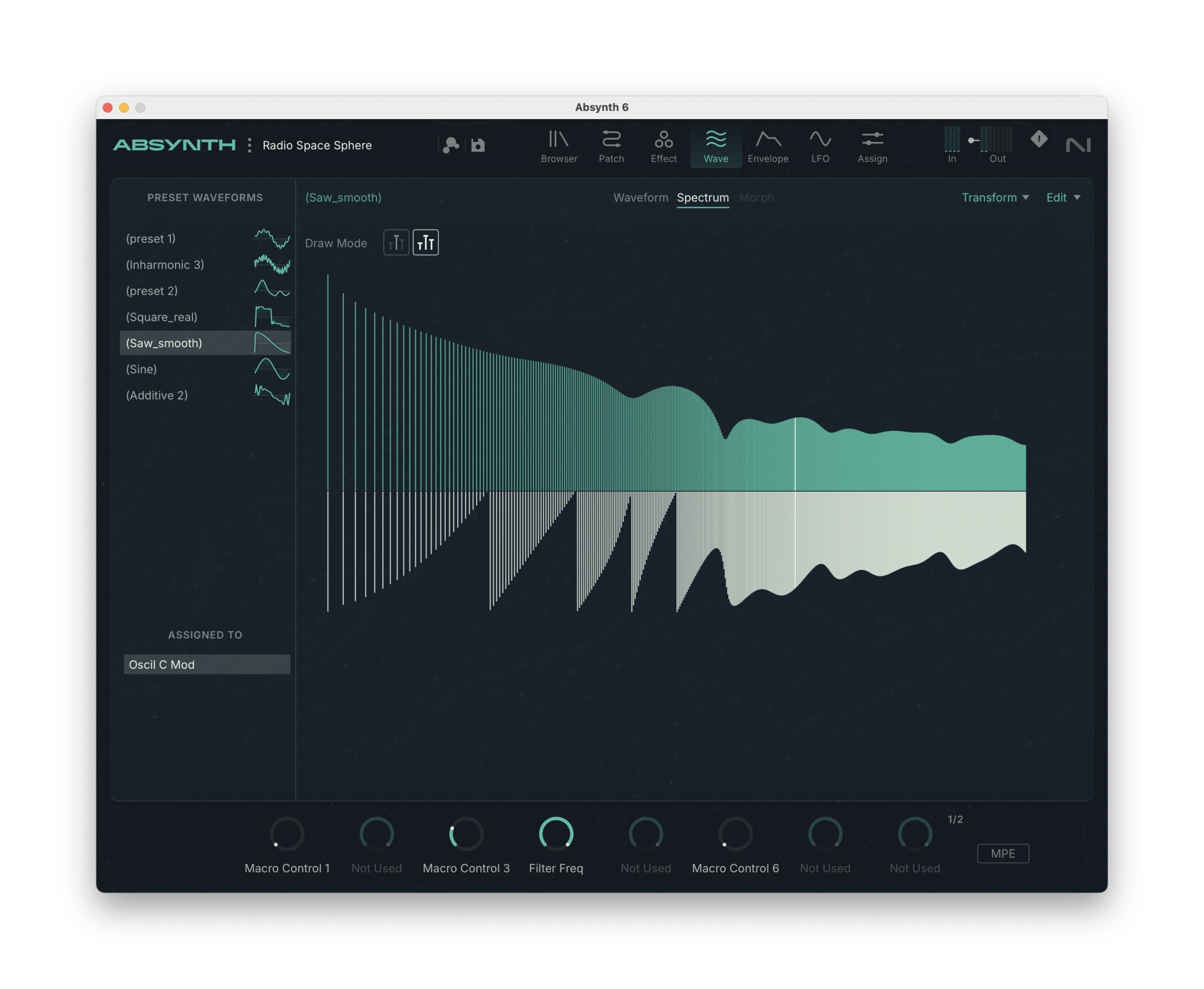
Sixth sense
Here’s the challenge for Absynth 6: make existing users happy and pitch Absynth to a new generation of users who’ve never touched, or possibly even heard of, the instrument. And it comes as a surprise because NI told us they’d given up on the project. It was too big, they announced in 2022.
Instead, NI has done a complete 180 and given this release a huge launch, complete with presets by Kaitlyn Aurelia Smith, Richard Devine, and the one and only Brian Eno, plus a green-colored visual spectacular by Aphex Twin collaborating visualist Weirdcore. And partly thanks to Absynth’s impassioned user base, it sounds like there are more artists on the way.
Speaking of, here’s my own flythrough of the UI and some new patching — all original sounds, minus of course the Preset Explorer:
But hype aside, can a relaunched Absynth compete in 2025? Thanks to rebooting those features and not just doing a pixel-upscaled release (in sound or UI), the answer is a resounding yes — even with the likes of Serum, Pigments, or NI’s own Massive X arguably in competition. (I think it’s also not a stretch to say Absynth is one of the reasons those synths combine wavetable with granular and other “experimental” features.) For synth lovers, this is like going back to Final Fantasy VII feels for gamers. This is just one of the great semi-modulars ever.
I can’t recall any major “legacy” synth getting a one-shot overhaul this extensive all at once, with a new framework and UI. Absynth 5, the last major update, was big on paper, but version 6 even takes those banner v5 features further:
Something new, something minty

New UI. Absynth’s interface is both redesigned and rewritten. (See the version 5 screenshot below for reference.) Gone are the pixel-based, game-like graphics in favor of a more subdued approach. The alien charm still comes through, though — and this interface is an order of magnitude easier to read and use. You can scale to HiDPI Mac and Windows displays. And somehow a lot of the cleverness of the earlier Absynth design is even more apparent here, like the ease with which you can click on and off slots in the semi-modular design, or the powerful paned displays for editing waveforms and envelopes. What’s gone you don’t miss, by contrast, like the spreadsheet-style patch editing, wasted UI space, or weird geometric shapes and number read-outs you can’t edit.
Accessibility support is so far incomplete (for full screenreader compatibility, etc.), but now that the work is done migrating to this new foundation, that’s a likely next step. (See also recent Kontakt updates.)
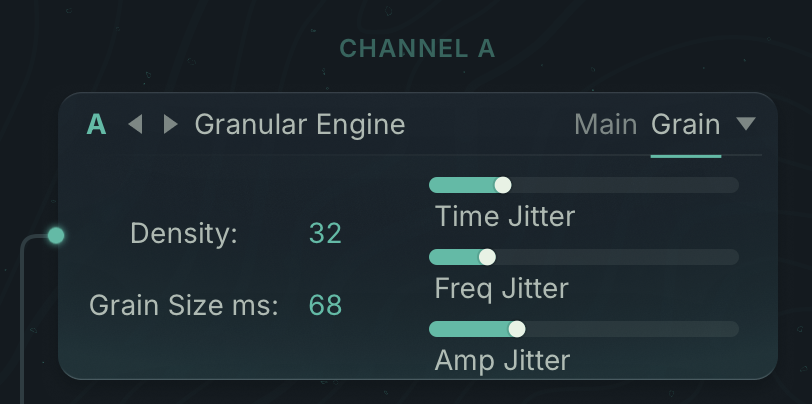
New granular engine. This has implications throughout the architecture, and it starts with the oscillators. When you select the Granular Engine, you can now scale Density all the way from 1 to 32 — the previous version capped out at a measly four. Turning it down again now is actually fun, as you can create unique lo-fi pitched effects, especially as you add feedback. And you retain compatibility with old Absynth granular patches. But Absynth is now finally a serious granular synth, with thick textures and ringing tones. Your modern CPU won’t care, either; it’s not the 2000s anymore.
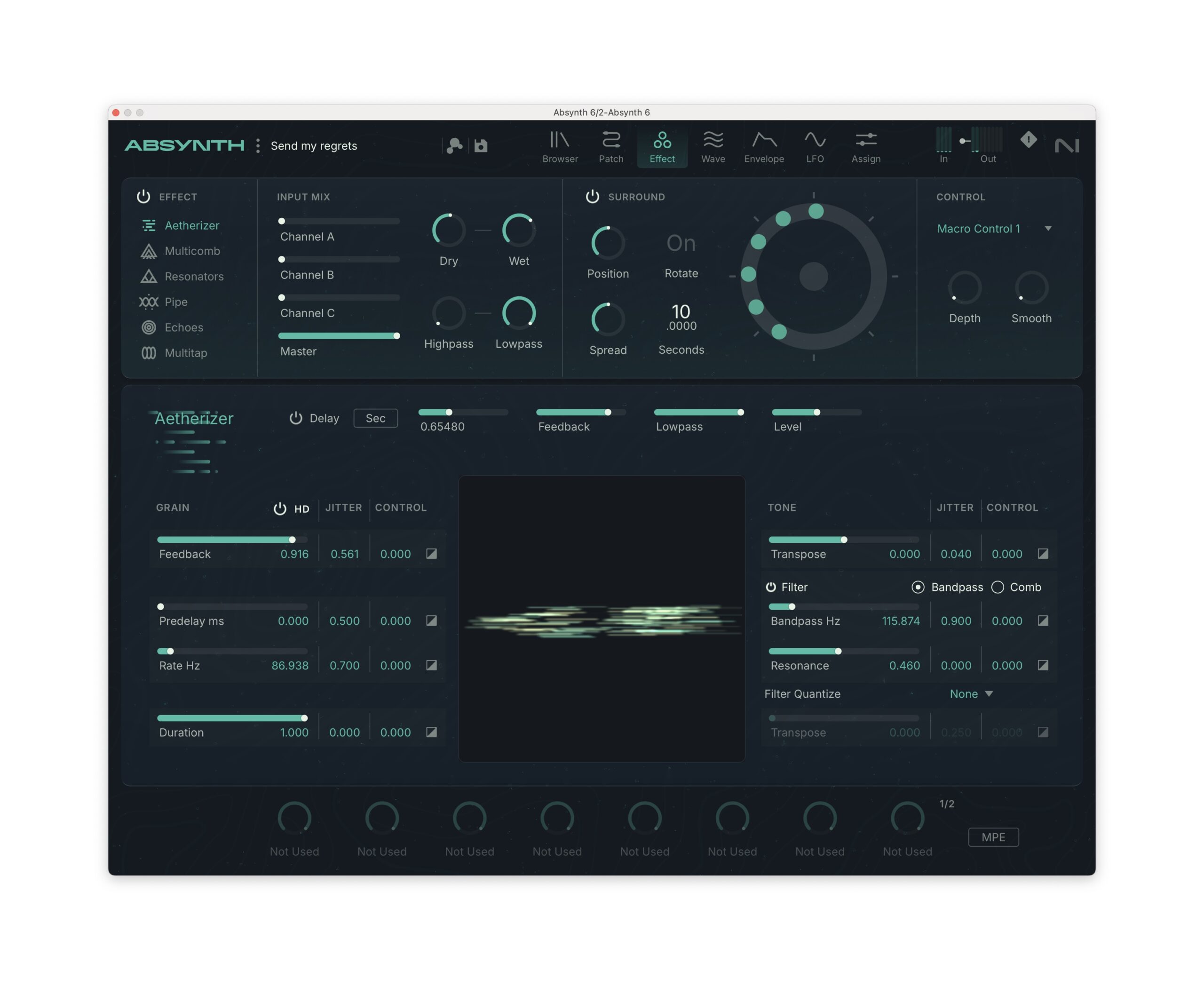
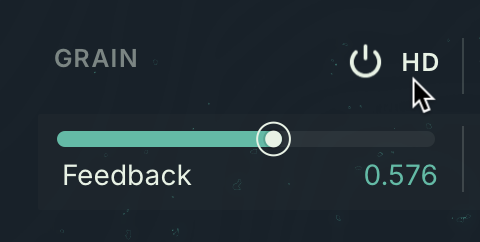
Cloud Filter, Aetherizer with high density mode. These are “just” HD switches, but wow, do they open up another character. Introduced in Absynth 5, these were already unique effects. Aetherizer is a granular delay with comb or bandpass filters that you can introduce in the feedback loop, and Cloud Filter is the filter version for use inside the synth structure. In V5, these produced some interesting pitched feedback effects. But with the high density modes, they transform into dense, rich fogs of sound that shift in complex ways. More than just an effect, they become an integral component of the sound patches. That has been my experience with Brian’s Rhizomatic software, too; the effect isn’t a bit of icing at the end, but part of how you imagine the entire patch as a resonating instrument. And the fact that you can go back to the lo-fi version of course means you appreciate the “vintage” sounds as an intentional technique, not a limitation.
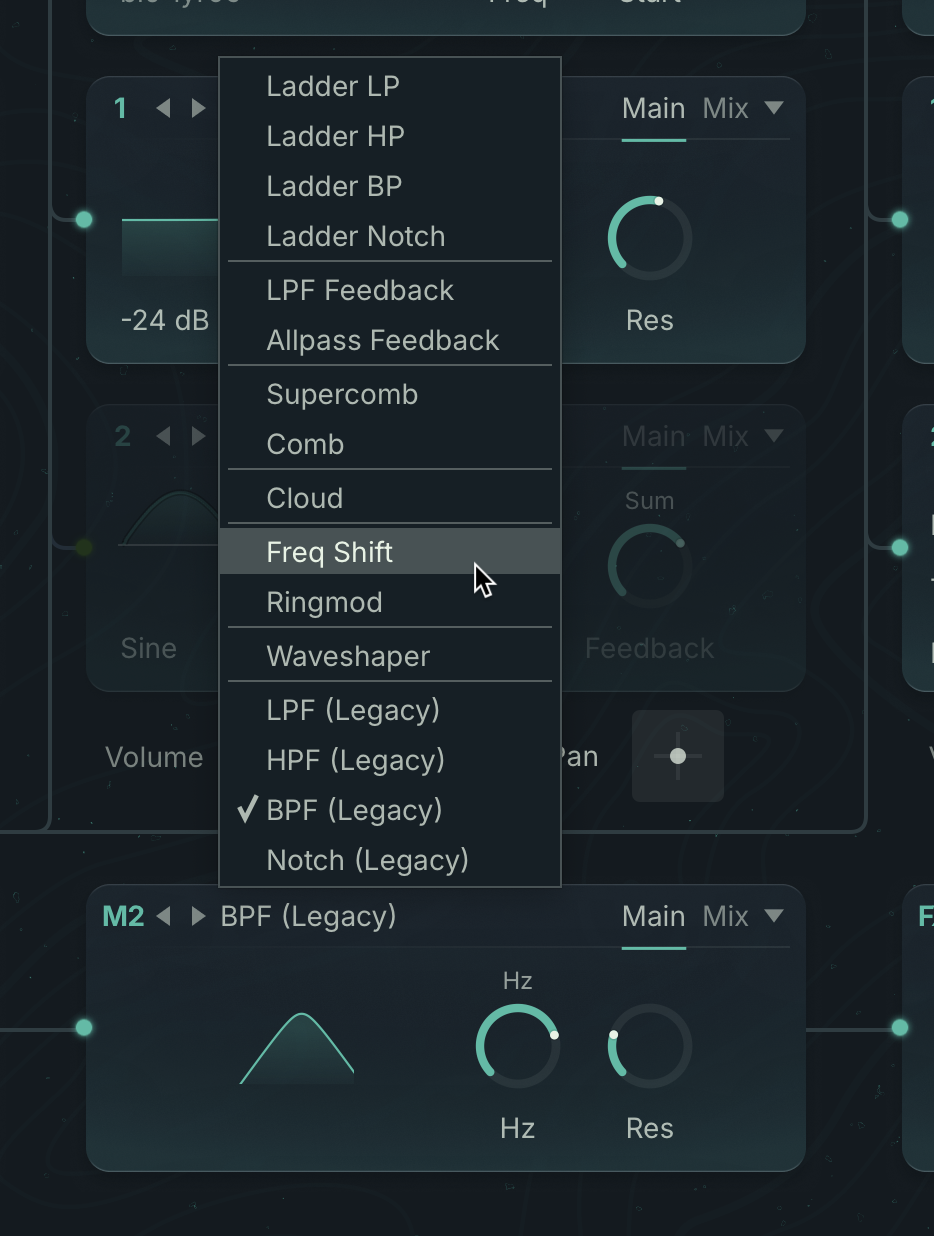
New filters. Comb filtering is an essential element of the Absynth ethos, but the other filters were simply too vanilla. Now you get Moog-style ladder filters in lowpass, highpass, bandpass, and notch varieties. That finally brings Absynth up to spec for use in modern sound design, and it pairs beautifully with all the other physical modeling and granular materials. It just feels like a gap that’s been filled. Put these options together with the new grain engine and updated Cloud Filter, and you’re really in heaven.

Improved Sample Engine editing. This now includes a better loop editor; Absynth 5 had just a numeric entry, whereas Absynth 6 gives you a waveform and draggable edit points. I wish the same view were in the Mod section for the Granular Engine, too, but it’s more important here. File import also now supports MP3, OGG, and FLAC, so you can go nuts.

Insert modules now have dry/wet. Okay, this is not going to make anyone’s headlines, but it’s really important, partly because you use effects inserts as part of the sound design workflow.
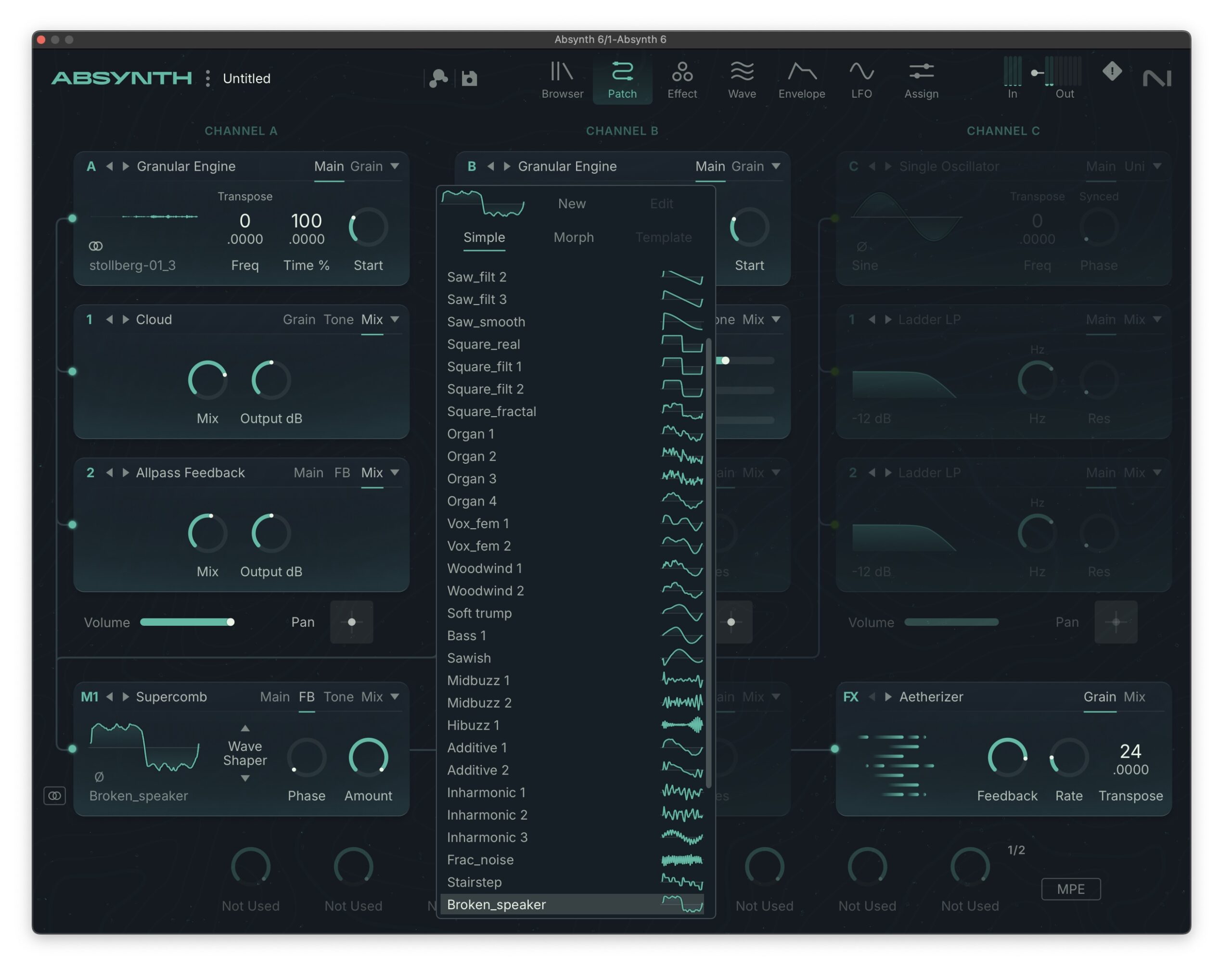
Lots of additional content. There are some 415 (!) new instrument presets, 30 new presets for the effects alone, and 266 new samples — plus you can import your own samples, which is what I generally did!
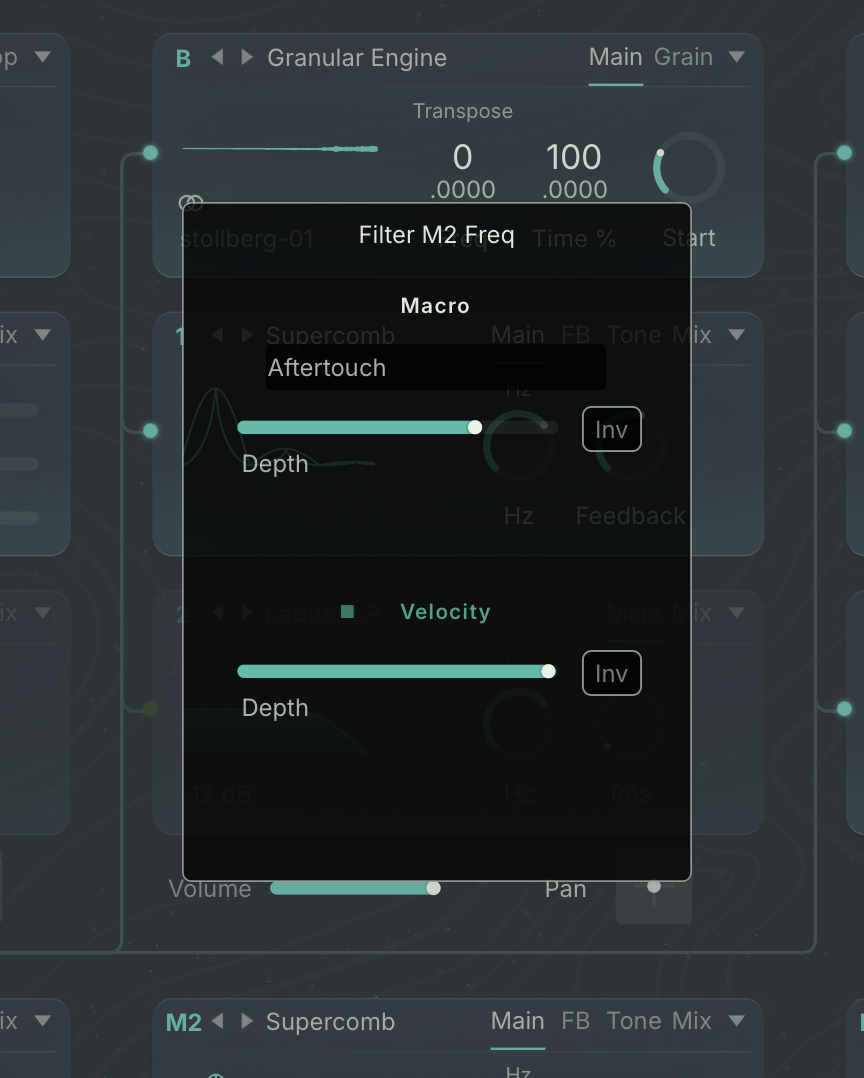
MPE and poly aftertouch support. This is equally major, as Absynth was always designed to be a “playable” synth. MIDI Polyphonic Expression makes Absynth a killer new engine for something like an Osmose or Haken Continuum or even Push 3, and the addition of poly AT expands that to a wide variety of keyboards (and Ableton Move, even).
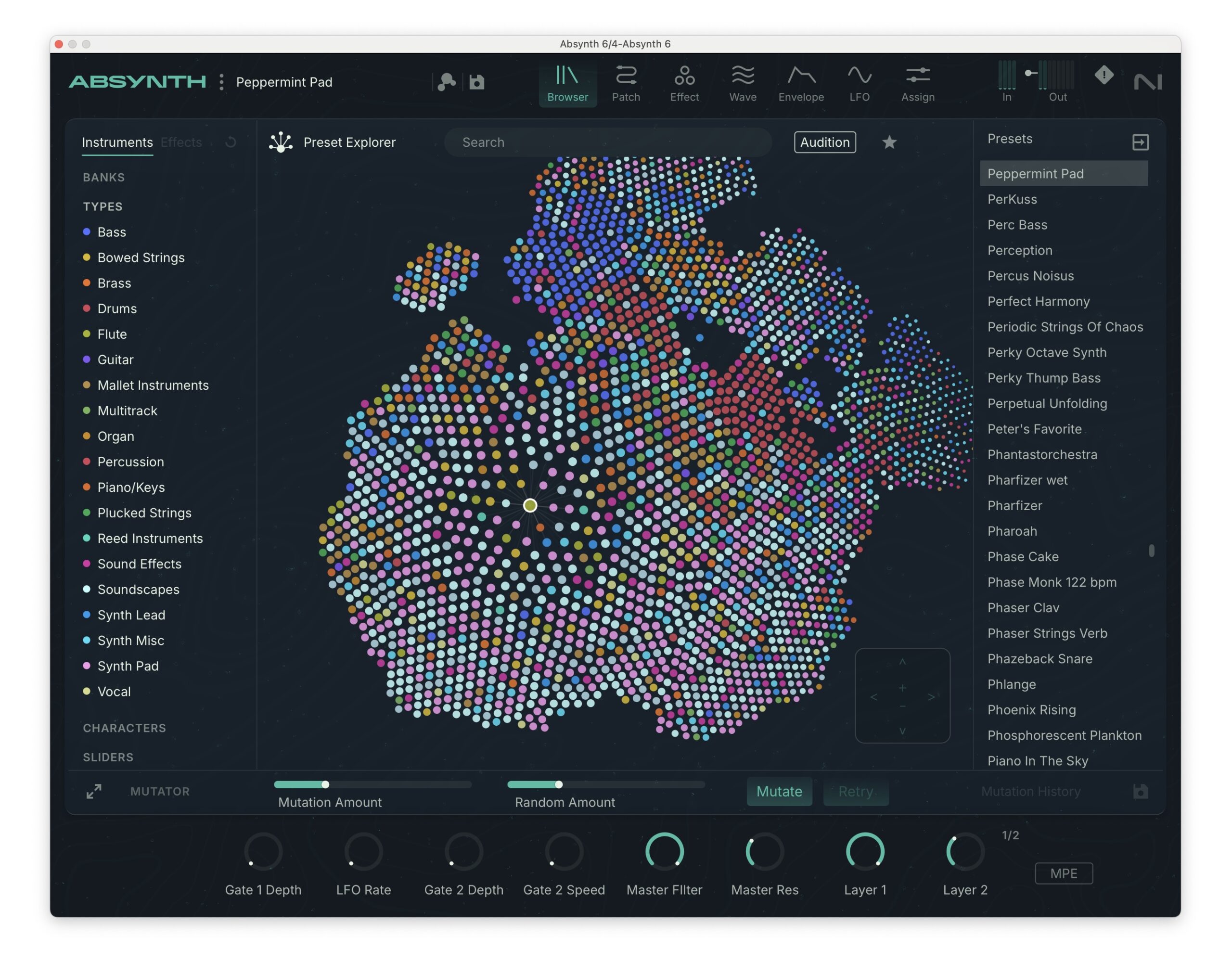
AI-powered 2D visual Preset Explorer. This part is just fun. Using machine learning — via a separate research project at NI — you get a sea of colored dots representing different patches. You can navigate by character, not just tags or names, continuously varying sliders like soft/aggressive or static/evolving. That sort of fluid, non-hierarchical navigation wouldn’t function in the same way without AI assistance.
The new Browser page feels like it’s a work in progress, at least in the current build. User presets don’t yet appear in the star map, which would be fun; they appear in a more conventional NI factory/user split in a textual page on the Browser. I also couldn’t edit the metadata for my user presets, but I suspect that’s coming soon in an update and just didn’t quite get done. The trick to finding your user presets: in the Browser, click the Preset Explorer to deselect/hide it, then click the silhouette of the person (the universal NI sign for user preset) to switch to yours. These will then appear exclusively in the menu.
It’s important to note what this isn’t: AI doesn’t in any way get involved in the construction of sounds. It’s instead a case of AI making the software more human, allowing a messy, playful interface. Some of us went into music because we hated rigid categorizations and columns and rows, anyway. Fun as this is, it’s also the feature I used the least, because I was busy making new sounds. But it also ensures you’re never stuck on a blank screen or with one preset and a menu, because the software now drops you in this star map instead when you launch.
DATABROTH has some nice patches, too, with a written review (if you’d like a second opinion):
All our tomorrows
They’ve done all of this without breaking compatibility with existing patches and techniques — see my separate interview with Absynth creator Brian Clevinger. And that last release was a long time ago. Absynth 5 was released back in fall 2009; the first Absynth release dates to 2000 (pre-NI). It’s worth recalling what was in that release, as it’s all become more relevant in Absynth 6; v5 debuted the granular Cloud Filter, modeling Supercomb Filter, surround-sound features, gorgeous Aetherizer effect, preset exploration with Mutator, filter feedback, plus oversampling through the signal path. Most of the team at NI that worked on Absynth 5 is long-since gone from the company, but Absynth 6 builds on all that work in some thrilling ways.
Absynth 5 does still run, and I’m keeping it around as a software collector. But also crucial, you solve two major compatibility roadblocks on newer machines. On Windows, you avoid the PC’s inexplicably terrible way of dealing with high-density displays. (Don’t get me started. Peak Microsoft.) And on the Mac, you avoid having to run in Rosetta 2, which is a minor issue running standalone but a bigger running in hosts.
The truth is, I think the synth world is more ready for even the Absynth 5 features in 2025 than it was in 2009 — and with the updates, they sound and look better, are expanded in functionality, and are far more discoverable. If Absynth 5 was ahead of its time, Absynth 6 has found its future.
In use
One first play here from last month:
There’s still nothing quite like Absynth. Actually, maybe the closest to the experience of the playful, one-screen patching, semi-modular with on/off switching and easy routing is Rhizomatic’s Plasmonic and Synestia — also created by Brian Clevinger. Part of what is notably different in working with Absynth versus some of the other leading semi-modular polysynths is that ability to keep the far-out possibilities in easy reach, to encourage play and experimentation. Much as I love the depth of some of the competition, their approaches do tend to feel like kitchen-sink setups. Absynth feels focused.
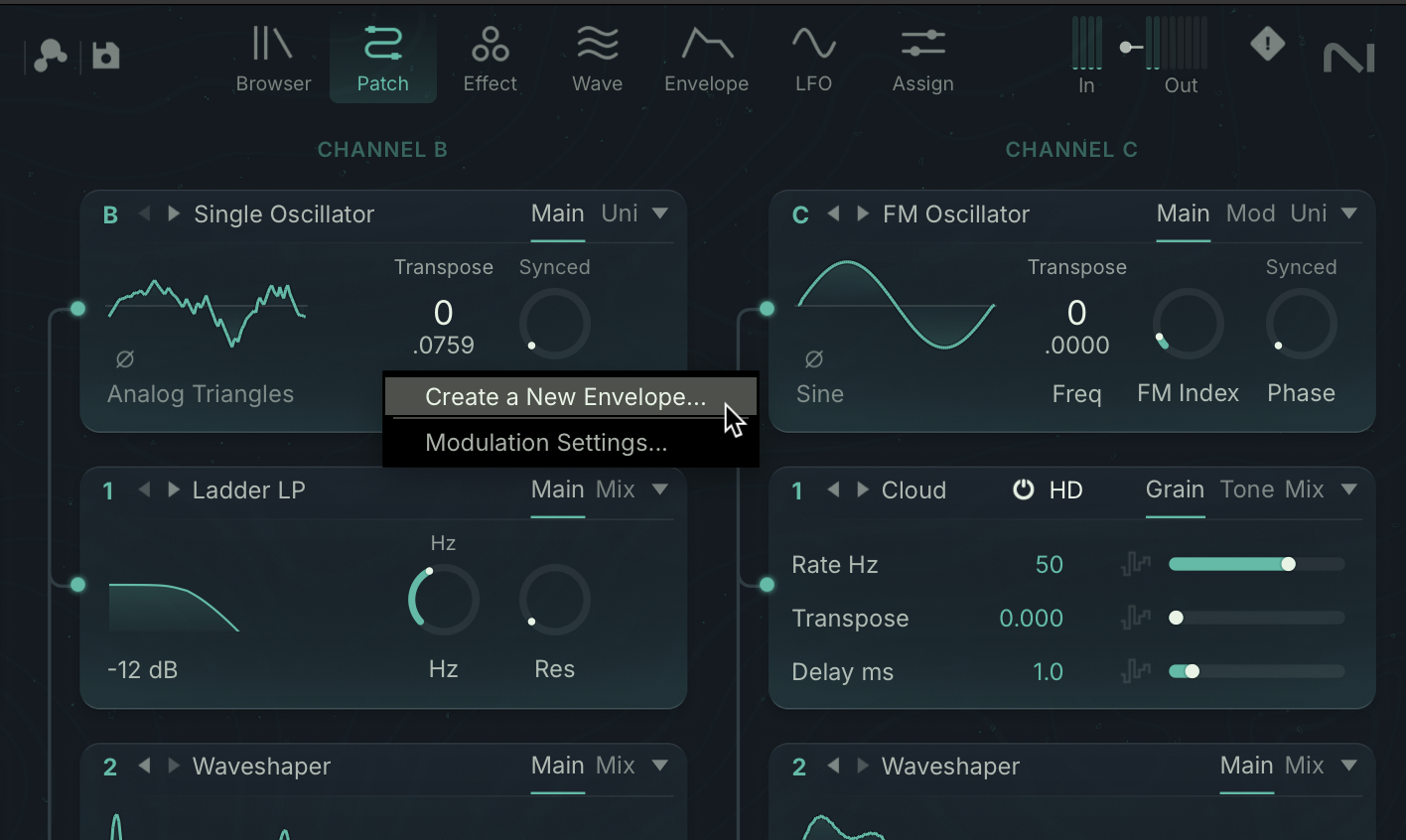
There’s also just the power of being able to click any parameter and turn it into an envelope, and then view those envelopes in a vertical orientation. (That’s a long-running Absynth feature, yet it still stands out today.) Recent polysynths have made it uncommonly easy to drag-and-drop modulation and envelopes from anywhere in the interface, and to see those envelopes in the main window. But typically, you can’t really see how envelopes relate to one another. The Absynth design really holds up in that way.
Also, even though we have a lot more granular and granular delay options in 2025 than we did in 2009, at least in commercial software, the sound of the engine here is unique, as is its accessibility in the overall modular. I found myself breathing new life into all kinds of samples just by dropping them into oscillators in the Granular Engine (or even Sample Engine) and going nuts. Remember that freebie from Robert Henke I mentioned? That’s a great way to create waveforms. I also got some great results doing some weird sounds in VCV Rack, like one waveform that was literally just twisting an LFO and VCO.
Don’t forget that you also get an FX variant of the synth as a dedicated plug-in. Given the extraordinary Pipe, Multicomb, Resonators, and especially Aetherizer, that really doubles up the value of this package.
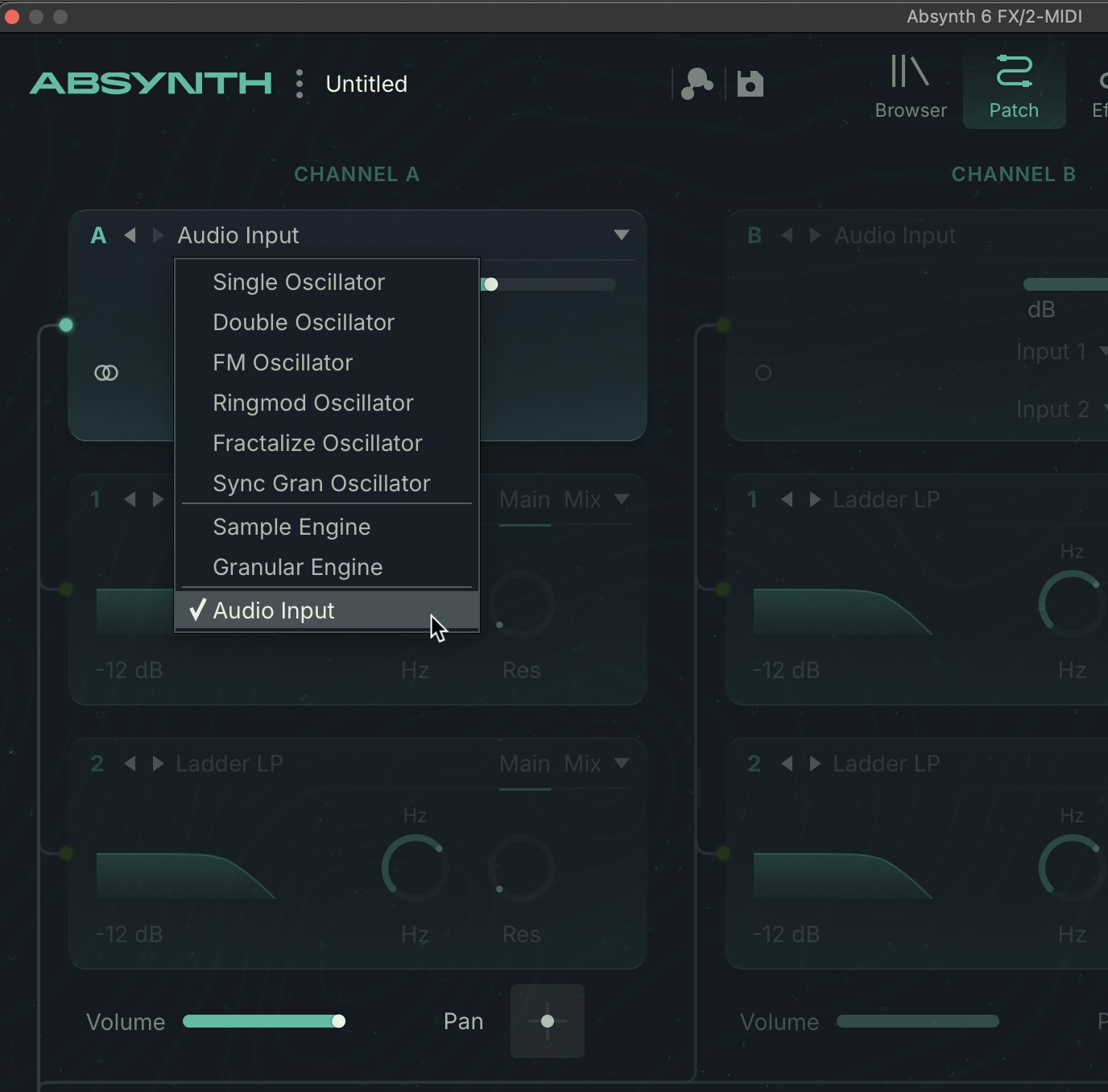
I do miss some of the direct LFO assignments, as introduced in software like Massive. Having to go back to a separate LFO screen does remind you that this is software that requires you to work a different way. I also found a handful of parameters that couldn’t be assigned or that weren’t handled consistently. And I wish the macro section editing worked a little more flexibly. If anything, my hope for a future Absynth (6.1?) would be the ability to add more consistent modulation easily, not new features or to get sucked into the arms race with other big software polysynths.
But those are minor complaints in this epic release, and I imagine the backlog of ideas for Absynth updates is significant.
One note on reliability, too: this was prerelease software, so I didn’t evaluate this aspect. I will note that a lot of these modules use feedback, and I was able to overload the system in a couple of instances.
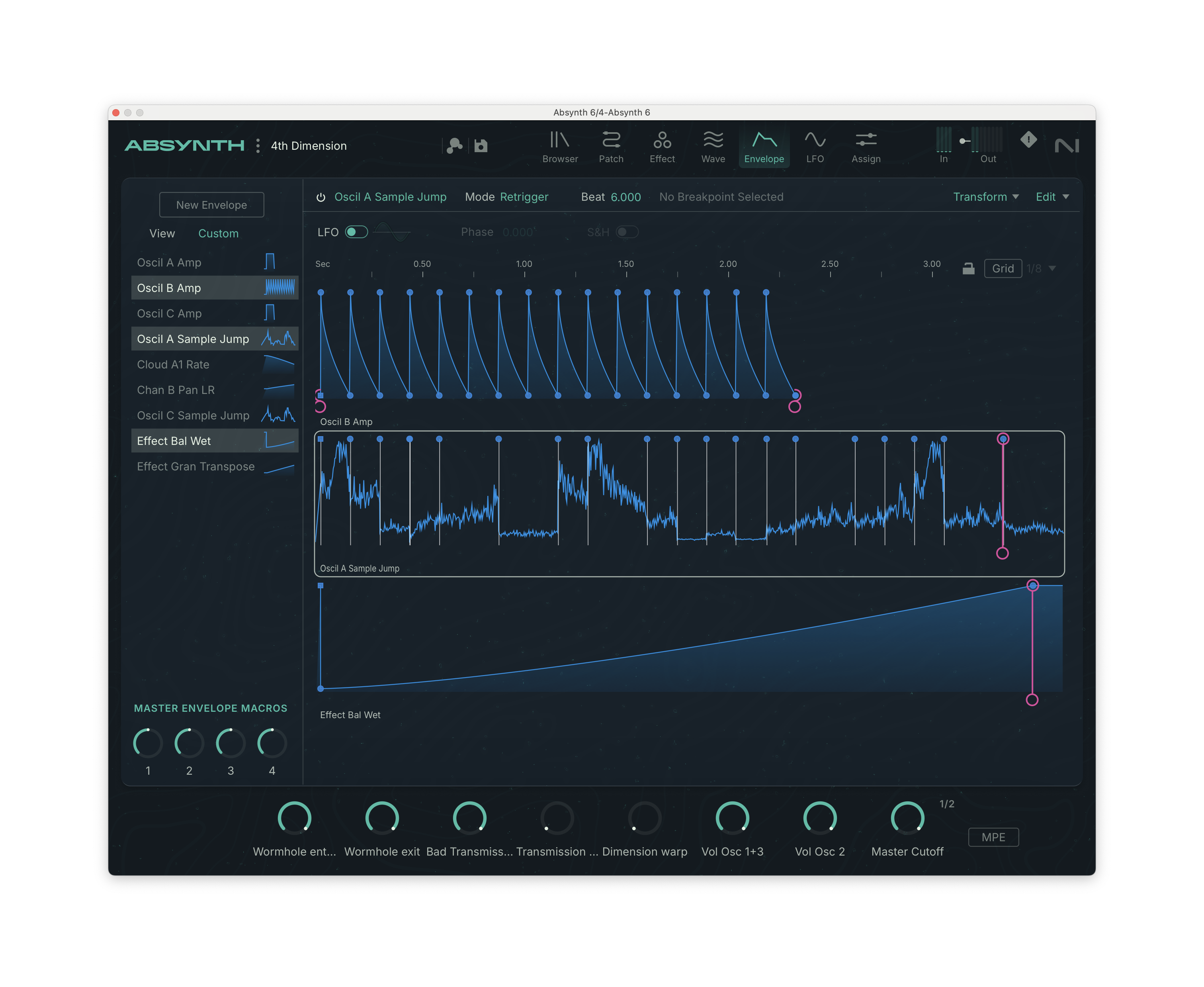
And yes, you absolutely can make other weird/percussive/short sounds, not just pads! Plus a lot of nicely strange morphing stuff. So not everything has to descend into long pad land, even if it’s tempting to go there. Excerpt:
I will say, I still have a special place in my heart for Plasmonic/Synestia. If you haven’t tried those, you owe it to yourself to do so; the resonance and reverb models and additional physical modeling features still make them a perfect successor to Absynth, even after Abysnth 6. Putting Plasmonic and Absynth together, of course, is perfect. I did check the color schemes, too — for the obsessive, they don’t clash at all with the new Absynth 6 look.
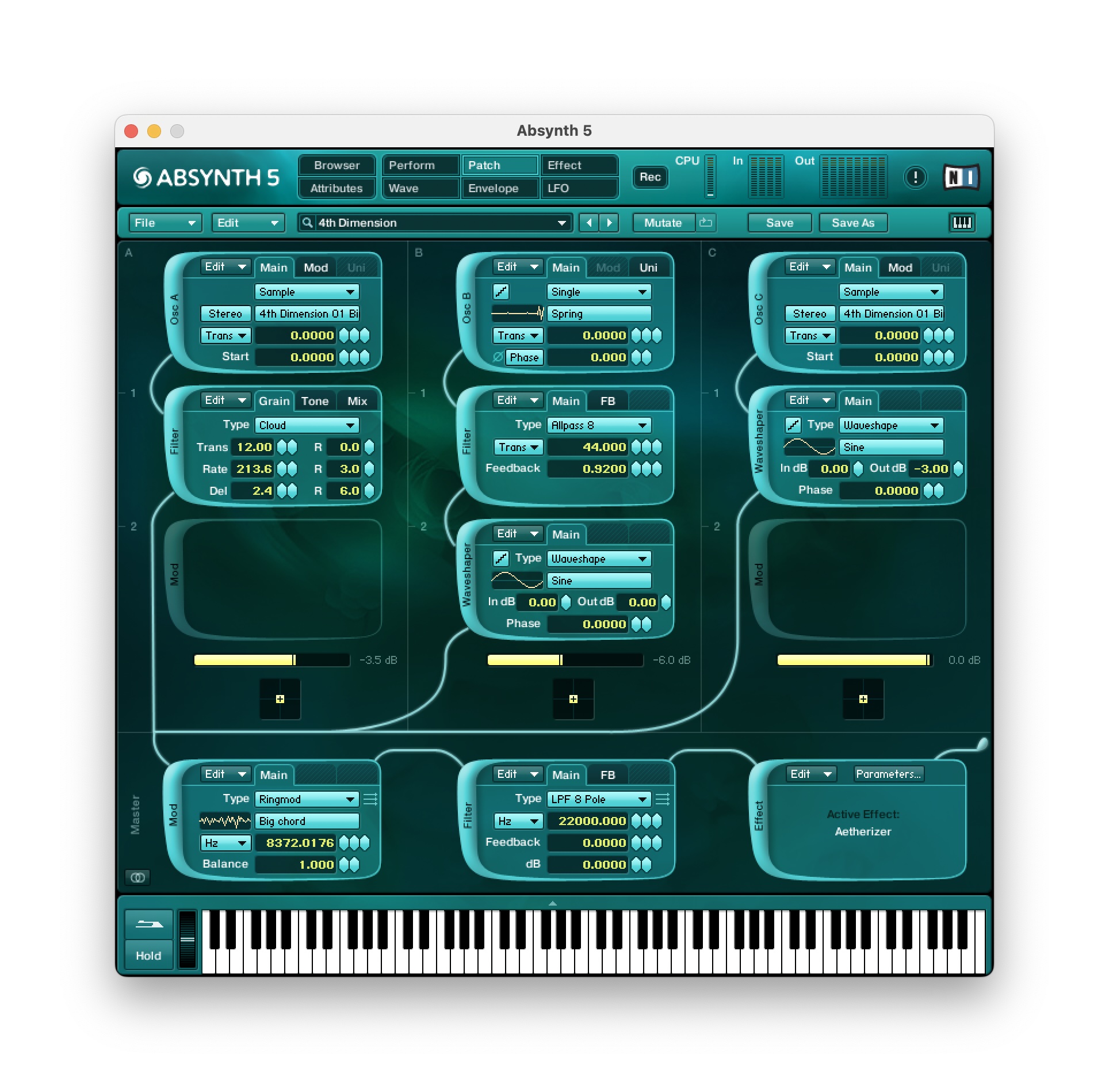
But what’s really striking about the Absynth 6 launch is how much it reveals just how good Absynth 5 was. I kept Absynth 5 open while reviewing it, and very often when I’d find some amazing feature I thought was new, I’d discover it was in Absynth 5 (or earlier, even). But that doesn’t mean this is an insignificant update. On the contrary, there was a Herculean effort to modernize the engine and UI to realize what Absynth 5 was trying to do — and to give the granular functionality some of its intended depth and richness. You won’t miss Absynth 5 at all — okay, I do miss the Perform screen a bit; maybe that’s an Absynth 6.1 feature. But Absynth 5 absolutely paved the way for 6.
The difference between this and another synth that might do the same is that quarter century-long legacy of artistry, presets, and evolution, and the greater focus that came from building this around an original design. You also effectively get more range, because you can get all kinds of extra sounds when you turn the new HD modes off or experiment with changing the granular density.
The question isn’t, does it do more than other tools — or even, necessarily, does it do something different. Granular techniques and resonators are well understood. But as with Plasmonic, you get a unique vision of those tools and the precision to explore with them. In the case of Absynth specifically, the restrictions on oscillators, effects inserts, send effects, and so on make the relationship with the instrument closer. After all, if you want a fully modular environment, you’ve got those — VCV Rack being especially beloved for me. But isn’t the point of a semi-modular that it makes some decisions? The return to that Absynth architecture just feels intuitive, not restrictive. And I wasn’t really much of an Absynth user when it launched; it’s v6 that’s won me over. Apparently, I also had to wait 16 years to be ready.
It’s fitting to me that Absynth 6 arrived at the same time as the awesome GRM Tools Atelier. It’s not just that everything old is new again. It’s proof that a full reboot of the sound engine and interface can create a tool that combines some of that history with new ideas. And at a time when people are looking to make sound more personal and experimental, it means you have a tool you can really explore — the opposite of the normative, automated, consumption-oriented culture around us.
Software synths can help us explore strange new worlds all over again.
Absynth 6 at Native Instruments
Everything (else) new
Here are highlights from the 6.0.1 changelog, the release-day build (which I’ve just begun testing, since I was working with late prerelease software). In addition to everything above:
- Improved List Browser
- User presets and favorites now appear in the Browser
- Improved Mutation algorithm; collapse and expand the Mutator panel; scroll through your Mutator History as a list; reset and include macros with Mutator Lock
- Macros visible from the Footer
- Envelope improvements: stepped breakpoints, slope-to-step conversion, transform, scaling, and rhythm generation
- Improved Envelope grid zooming
- MTS-ESP microtuning support; add custom tunings
- Defaults for page and zoom options
- Waveform list shows visualizations (okay, in my screenshot but I didn’t mention it)
- Pin the New Envelope dialog so you can quickly spawn a bunch of envelopes in one go (Brian talked about the importance of easy envelopes in our interview)
I forgot to mention the tuning features. It’s not just MTS-ESP, either. Thanks to MPE support, Absynth will follow Ableton Live’s Tuning Support. (It also works with Bitwig’s Microtuner.) And you can import Scala files, as well, which also interoperate with Ableton’s free tuning site and Leimma/Apotome by Khyam Allami and Counterpoint.
That’s just 6.01; I’ll keep an eye on future updates, though I know this team needs some sleep!
Absynth 6 at Native Instruments
Updated 10 December: Added full changelog section, details of modulation and tuning, explanation of user presets.