Digital preservation is the new challenge for synths, just as it is in areas like games. And the Roland JP-8000 got a big leg up with a free and open source release from The Usual Suspects available this month, the JE8086. It’s one of several recent emulations, so let’s talk about why the 1998 synth attracts such unique passion.
The free Super
The Usual Suspects is a community-driven effort to preserve digital instruments of yore. They’re not just doing rough, sounds-alike modeling. They’ve actually emulated the DSP chip itself, the Motorola 56300. The 56K family has had a long, illustrious history dating back to the 80s, appearing even in the likes of workstations from NeXT, Atari, and SGI. In synth land, it’s the DSP brains behind the Access Virus A, B, C, TI / Clavia Nord Lead 3 / Waldorf Q, Microwave II / Novation Supernova and Nova, among others. (See this emulation.)
That’s allowed The Usual Suspects to be prolific with various rare Access, Nord, and Waldorf synths, which Synth Anatomy has dutifully covered. And next up: the mighty JP-8000 from Roland. (That also allows convincingly covering a lot of the JP-8080 rack, too.)
While it’s free, the instrument here does require a little more effort on your part. Because it relies on the original ROM, it’s your job to hunt that down and manage some other wrinkles in the installation process. It’s also your obligation to make sure that’s legal — as in, you own the original hardware (technically speaking).
But it sounds really, really good, and aided by some improvements to their JUCE-based UI framework released earlier this year, it also sports a friendly, authentic rendition of the original’s panel.
And yes, you can make trance with this. Can you ever:
Yes, technically, this skirts some legal gray areas (though likely only once you find the ROM); you’ll notice there’s no Roland logo on there. But past experience has shown that community-driven projects frequently coexist happily with commercial/proprietary ones, even informing and encouraging developments.
Downloads:
Find the code for this and all The Usual Suspects’ GPLv3-licensed projects on GitHub:
https://github.com/dsp56300/gearmulator
For fans of the 8080 and supersaw, of course, you’ll want all the emulations. I’m glad to have the modernized Arturia take on this, as it also puts the sound engine in the context of a more flexible synth architecture.
CCC
All of this came in time for the legendary German Chaos Communication Congress, which at the start of this week offered a talk on the topic — all of which you can watch (as seen on Hack-a-Day; thanks, Enkerli!):
From Silicon to Darude Sand-storm: breaking famous synthesizer DSPs
The main obstacle was emulating the 4 custom DSP chips the device used, which ran software written with a completely undocumented instruction set. In this talk I will go through the story of how we overcame that obstacle, using a mixture of automated silicon reverse engineering, probing the chip with an Arduino, statistical analysis of the opcodes and fuzzing. Finally, I will talk about how we made the emulator run in real-time using JIT, and what we found by looking at the SuperSaw code.
The original, Airwave, Arturia, and the love of the supersaw
Updated: I forgot Adam Szabo’s incredible Airwave recreation (thanks to Musical Entropy for the reminder). This might be the one to beat on Windows (it’s Windows-only), interesting as the technical deconstruction above is; it’s a beautifully designed piece of software and I sure can’t tell the difference between this and the original:
Aruria’s Jup-8000 V (part of V Collection 11 Pro) also ventures into this territory, with novel features like a Multi-Arp with Euclidean generator (and other extras). It’s your best bet for creative twists on the 8000/8080 sound, and if you’ve got V Collection, of course, though even with this installed, I ran out and added the tool above (and The Usual Suspects is your primary choice on Linux).
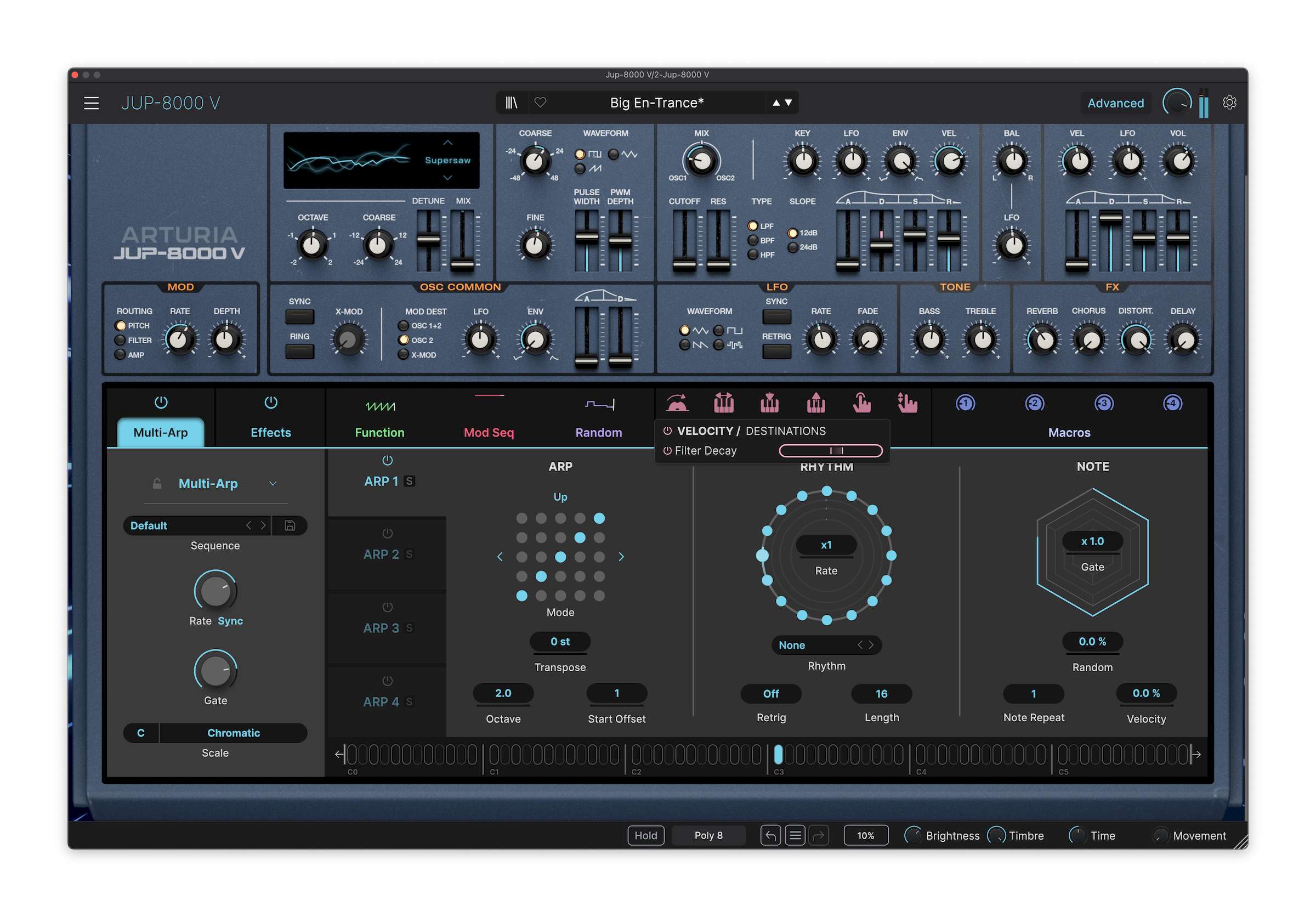
Lorenzo Senni is one artist who has obsessed over the unique character of the 8080 and its Super Saw waveform more than just about anyone else. (I’m reminded of the short-lived TV series Totally Obsessed, featuring a guest organizing their lives around Boo Berry Crunch. Like that, but Super Saw.)
Lorenzo also did a nice explainer of that supersaw:
And I mean really into it:
As heard on releases like this:
And let’s stand back and admire the JP-8080. We can even go back and read the 1998 reviews, like this one from Sound on Sound‘s Paul Ward:
Roland JP8080: Analogue Modelling Synthesizer
And a modern-era review of the original hardware:
Image at top, CC-BY-SA 3.0:
- JP-8000.png: Danny Darko at en.wikipedia
- derivative work: Clusternote
