Finally, proof that there’s life for Live after Apple and Microsoft. It’s unofficial and totally unsupported, but a set of patches for the free Wine compatibility environment lets you run Ableton Live 12, Max for Live, and Push 2 and Push 3 on Linux. And the result is just about indistinguishable from native support.
First, let’s talk Wine, for those not in the know. Wine is a mature environment for running software built for Windows as if it were native on Linux — literally, the acronym was originally Wine Is Not an Emulator. And since it’s not an emulator, once it’s working, software works as if it were written for the OS. Patched variations of Wine are already widely deployed in gaming. It’s a wonder that music tech hasn’t embraced the idea, too — especially since gaming has proven that customers will gladly pay for the experience.
Now, patching Wine to run Live? You’d figure that was possible. But check out the feature list here, because it’s extensive — and growing. From shibco/Cade in Berlin:
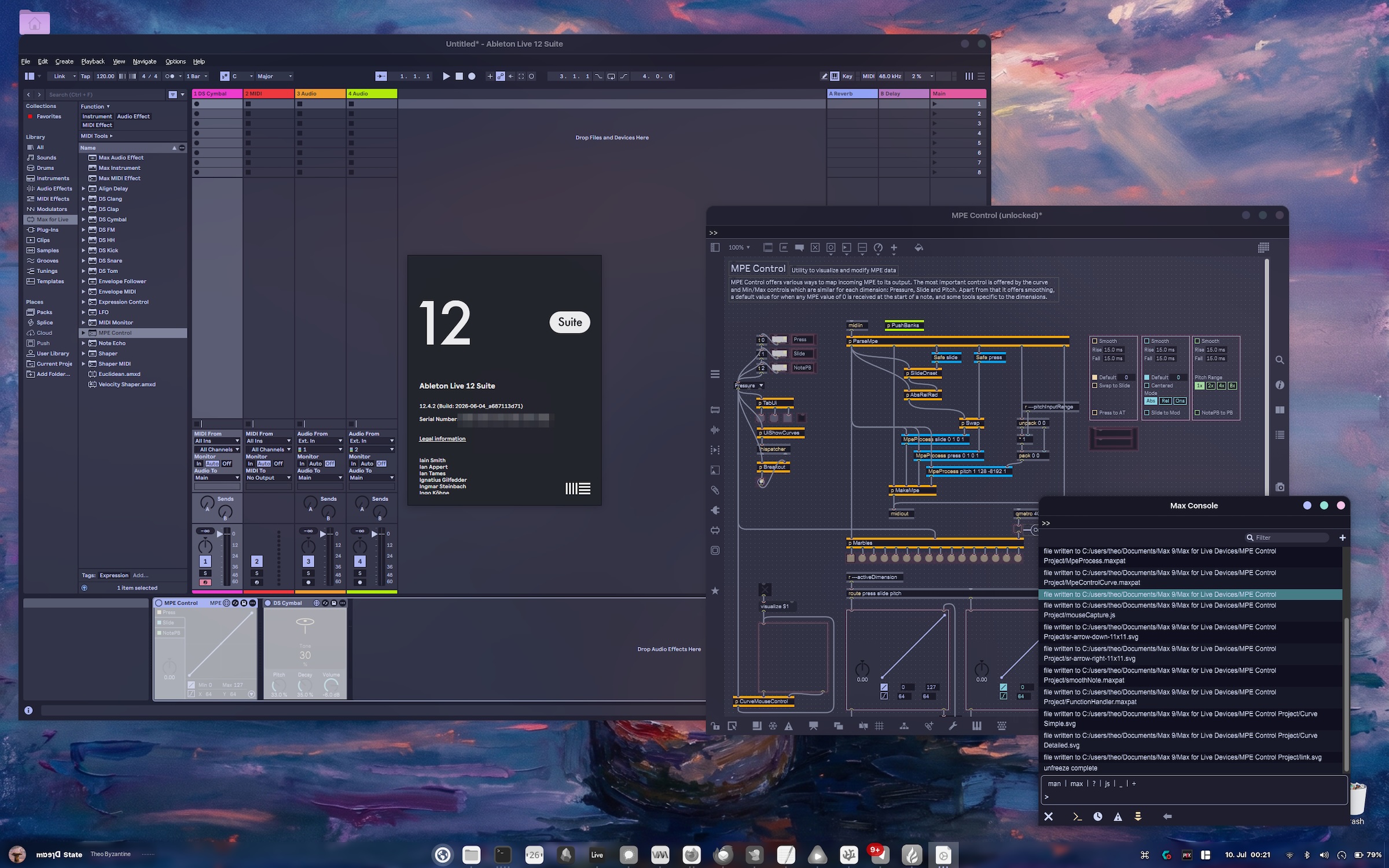
- Live 12 Suite and Beta support
- Push 1 + 2 support.
- Device recovery: audio and MIDI devices (Push included) survive in-session disconnect and reconnect.
- Experimental Max/MSP and Max for Live support.
- Native file dialogs including open/save dialogs are your desktop’s (XDG portal).
- Dark/light theme mode follows the system setting.
- System font support, Ableton’s UI renders with your desktop’s fonts.
- Low-latency audio via autobuilt WineASIO → JACK/PipeWire at 256 frames, with additional hardening to prevent crashes.
- VST3/JUCE/OpenGL editor windows render, take input, and scale correctly.
- HiDPI support display scale auto-detected and recalibrated on every launch.
- Extensions SDK support.
- VST specific fixes for Autuira, Pianoteq, SWAM and KORG (with others to follow).
- Reproducible builds.
Check it out, including a separate listing of the Wine patches:
https://github.com/shibco/ableton-linux
(I’m not sure why Push 3 isn’t supported here, but can find out; it may just be that the developer didn’t have a unit handy.)
It’s unclear if any Abletons were involved in this project, even if in their spare time or unofficially. But I do hope we see official support at some point from Ableton or other developers who haven’t yet made the leap.
But because you’re running in Wine, you can do this without touching binaries or anything like that. The repository is really about patching Wine specifically and managing an installer for this environment.
Again, because you’re running this essentially as if Linux were Windows, you can absolutely use your paid license and paid plug-ins. And that gets me back to the earlier point. The trajectory of Apple and Microsoft is uncertain — Microsoft, especially — when it comes to music. The industry’s ongoing dependence on these vendors for their very survival is a huge risk. Future lockdowns to security, the rise of AI, changes in corporate leadership — all kinds of things could derail your business with little to no notice. There’s a lot about having a free and open source OS running underneath you that just makes sense.
This full rant should wait for another time, but at a bare minimum, developers should look at Linux. Of course, tools like the open-source Ardour and commercial entries from Pianoteq, Bitwig, Sinevibes, and many others are on the platform already, many for a long time. It’s just about time the party grew. End rant.
I mean, you can even imagine a music equivalent of the Steambox making an appearance in the future. (Yes, some have tried before — but the tech has improved a lot.)
And vitally, Linux is a lifeline when it comes to security and privacy. Age verification looms, among other problems. Yes, the trans community is watching this (for example).
Meanwhile, this makes me want to build a new Linux bo– oh yeah, RAMageddon. This makes me want to resurrect an old computer with Linux and Live. There, fixed it.
AI disclosure. This dev does it right — both in applying agentic assistance to places where it makes sense (like test automation) and in disclosing. I’m just about to create a form or something for that on CDM! Here you go, quoting from the repository:
Local models (Qwen 3.6) and Claude Opus were used during QA testing, documentation checking, and to help setup the build pipleline at the very end of this project’s release.