This one’s for the heads, literally. Otoacoustic emissions (OAEs) are sounds produced by your ear, ghostly tones emitted from inside the cochlea itself. The phenomenon has been employed in experimental music (and medical applications), but it has been hard to explore on your own — until now.
The idea
When we last caught up with leftfield developer/inventor jelle akkerman of everything something, he was toying around with plug-ins for chaotic vocal synthesis and polyrhythmic envelopes. Now he’s back with something more radical: what if you build a plug-in that makes your inner ear part of the synthesis process?
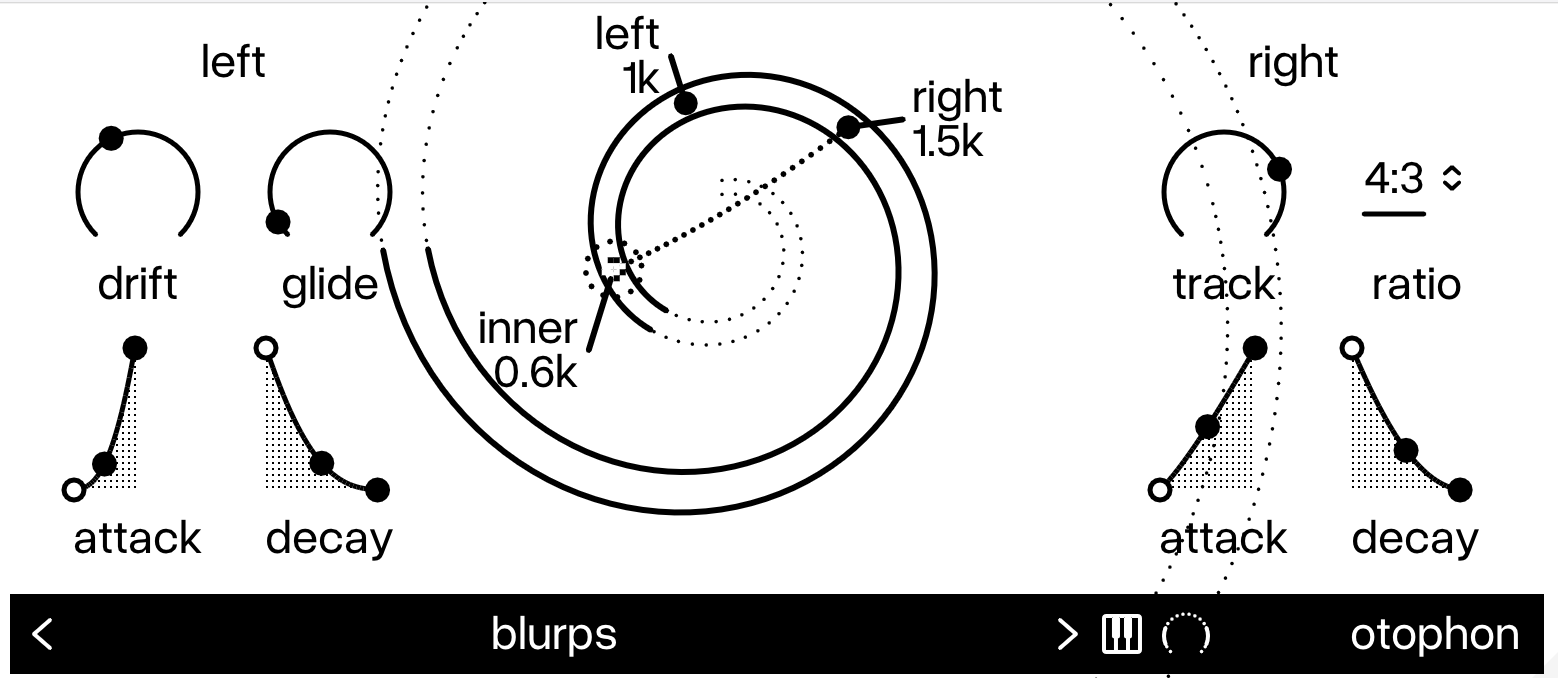
The starting point for otophon’s design is simple: produce two tones at the offset required to generate the effect inside the ear. Turn up the volume — loud, large speakers work best; I’m using my studio monitors. Headphones may work in a pinch. As you hit different ratios, your cochlea will spring into action, and what you’ll hear is three (or possibly more) tones, especially as you cup your ears, move your head, and listen closely. It’s a trippy experience.
otophon, in the spirit of every something’s earlier glosso, is animated and alive. The right-side oscillator, a phase-locked loop, will “struggle” to track the left-side frequency using pitch detection, rather than just including boring, fixed MIDI input. The additional frequency in your inner ear (also called “tartini tone”) actually saturates and distorts in a satisfying way. Remember, the cochlea is a kind of amplifier, a wetware oscillator that responds in gooey and unpredictable ways.
Explore the tracking setting, try different ratios, listen closely. The human body is an oscillator now.
Just think: you need big speakers, and you need them to be loud. Someone, somewhere will quietly sneak these into a club track, and some DJ, at just the right moment, will start to make the dancefloor totally trip.
But let’s back up.
Musical precedent, and why you’d do this
First, it is totally normal to respond viscerally to the physical sensations — especially in experimental compositions where they effect is pushed to its extreme and the main part of the piece. Here’s Adam Neely shooting some reactions on the ADAM Audio speakers over at Thomann (I’m actually working on a pair of S2X’s now):
Adam also did explainer videos on combination tones.
Measuring otoacoustic emissions has medical significance in evaluating everything from tinnitus to hearing loss. It’s a way of detecting what’s happening inside the inner ear that would otherwise be impossible to detect outside someone’s head. It’s even been a way of understanding what happens to astronauts in microgravity.
Here’s a nice video featuring a faculty member from the University of Chicago, a precise explanation of how this works that laypeople can understand, a whiteboard, and the legendary Tacoma Narrows Bridge collapse (aka a good explanation of what resonant frequencies are, and also one of the only things I remember from high school physics). Enjoy!
But otophon is not a medical tool. So how is this musical?
This beautiful Thomas Ankersmit composition demonstrates that composing with these tones can be gentle and sublime, bathing the inside of your head with a slow-flowing dance of psychoacoustic hues. (As per previous instruction, you’ll have to turn it up.)
Ankersmit dedicates his piece to the pioneering work of Maryanne Amacher, whose compositions — all in stereo — build a kind of immersion that floods your mind almost from the inside out. The iconic compositions — and you could reproduce this with jelle’s plug-in — come from the 1999 album Sound Characters (Making The Third Ear). Get your pets or significant others into another room and enjoy “Head Rhythm 1” and “Plaything 2”:
It’s a hallucinogenic journey: here’s a subtler, but equally perceptual, 1980 work that I adore:
Far Out‘s Poppy Burton has a great write-up detailing Amacher’s work:
Maryanne Amacher and the strange study of psychoacoustic phenomena
I got to know these kinds of perceptual explorations through the work of Marcus Schmickler. And I was just thinking — wait, didn’t I actually interview Marcus? Fortunately, YouTube remembers!
This is worth a watch not just for this process itself, but how to think about perception as a composition tool more broadly.
Working compositionally with this is wonderful. But in plug-in form, you could start to tune this effect in musical contexts no one has tried before.
The plug-in
otophon takes all of this and makes it playful. To my knowledge, it’s the first development of the concept into an experimental instrument. If a conventional two-oscillator synth plays with detuning, think of this as a synth that plays with that oscillator inside your ear — and jelle’s distinctive “struggling” randomization.
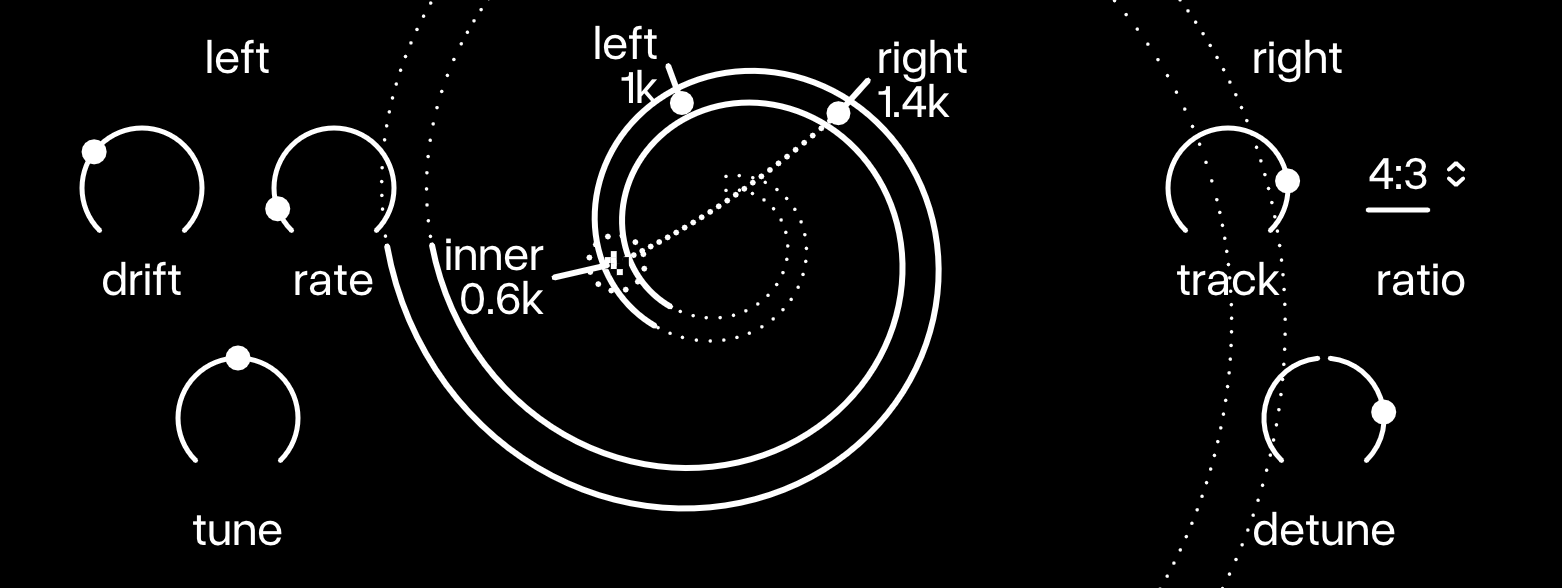
What you get:
- Left oscillator
- Right side — the phase-locked loop — with pitch tracking of the left
- Tracking dial, to adjust sensitivity of the tracking (which will determine how much it fluctuates with deviations of the main frequency)
- Attack and glide, adjusting timing of the tracking
- Drift — which gives you the “lazy walk” (some stochastic gendy-ness of the whole affair)
- …and it’s all routed through West Coast-style low-pass gates (LPGs), not conventional amplifiers, for extra pluckiness
You can either feed MIDI notes (constrained from around 500-4500 Hz), or switch over to drone mode and start the transport.
The package includes a VST3 and AU plug-in for macOS and Windows.
In use
Depending on how you tweak it, otophon can be bordering on painful (do be mindful of your ears). Or it can be fun and, for lack of a better word, blorpy. Those LPGs are good, clean fun — meaning you can determine the amount of perceptual spice you want, and tune this to different musical contexts. You might just be able to sneak some psychoacoustic freak-outs into your next techno hit. I’m sure going to try to. (Shhhh — don’t tell.)
These are not intended as musical examples, but to give you a sense of how the parameters work.
First, drone mode. (Remember to start your DAW’s transport.) Note the change in controls (since there are no triggers, no LPG/envelope), and the reverse color scheme.
Next, here’s a melody — and listen to what happens as you move in and out of the frequency range that produces the effect.
Here’s an example from jelle, which shows off the LPGs nicely.
YouTube quality, so go download the trial and try it yourself.
Tips
The main tip here is — turn it up (being kind to your ears), and experiment! Also worth considering:
- Don’t be afraid to turn it up! The perceptual experience can feel a little strange, so there’s a point where you’re listening at safe volumes but have this unusual experience inside your ear. You can always take a break.
- 11:9 is often an optimal starting point, according to jelle. (I also really like 9:8 — but this can even vary by ear.) Turn on drone mode, turn up the volume, and you should hear three clear pitches. Only two of them are being emitted by the plug-in. The third is your ear.
- The distortion you hear is inside your ear, not in the signal! (Wild!)
- You can trigger in and out of the OAE range — so, compositionally, you can also choose when to trigger the effect in a melodic line, etc.
- Try stereo width.
- Drone mode can be automated, in case you want to trigger it from your DAW arrangement.
For more:
https://plugins.every-something.com
We’ve got some exclusive codes to give away! For a chance to win this plug-in, comment below or on our Instagram. We’ll randomly select some winners for Monday morning.