plugdata, the visual programming environment for sound and media based on Pure Data (Pd), is becoming its own scene. It’s a great place to start patching your own sonic experiments, and if you haven’t already done that, you should. But it’s also becoming a treasure trove of free and paid tools and toys for musicians even if you never touch the wires inside. v.0.9.2 makes that better for developers and users alike. And did I mention it’s free, on Mac, Windows, Linux, and iOS/iPad?
The greater good
Yes, Max and Pd are essentially separated at birth, to the point that knowledge is fairly transferable between them, and yes, both were first created by Miller Puckette. (Miller continued Pd development; Max now lives with the lovely people of Cycling ’74.) I love Max; I’m finishing some projects in Max now, and it’s great to return to that environment and its unique capabilities. But Pd — actually the younger free/libre/open-source cousin of Max — would also be worth a look even if it didn’t have the advantage of being free. It’s its own environment; make no mistake.
The problem was, Pd, until recently, had some very rough edges. So you were left with choosing the most compatible, stable vanilla version, but giving up a modern UI and library support. Or you could wade into greater library compatibility and a fresh UI, but you’d have to juggle a fork that wouldn’t be as compatible. Or you could choose embeddability for mobile development on smartphones and devices, but have more tradeoffs for those targets. You get the idea.
After many years of work, the Pd landscape looks very different. A ton of effort from the communities working on Pd vanilla, libpd (the embeddable version), Heavy compiler (which outputs C/C++ code), and various libraries (like ELSE), plus plug-in and device support, has remade the Pd experience while preserving years of backward compatibility. And in particular, community contributions to plugdata give us all something that’s friendly, attractive, and interoperable with all of these different environments for free, in a single download, without sacrificing vanilla compatibility.
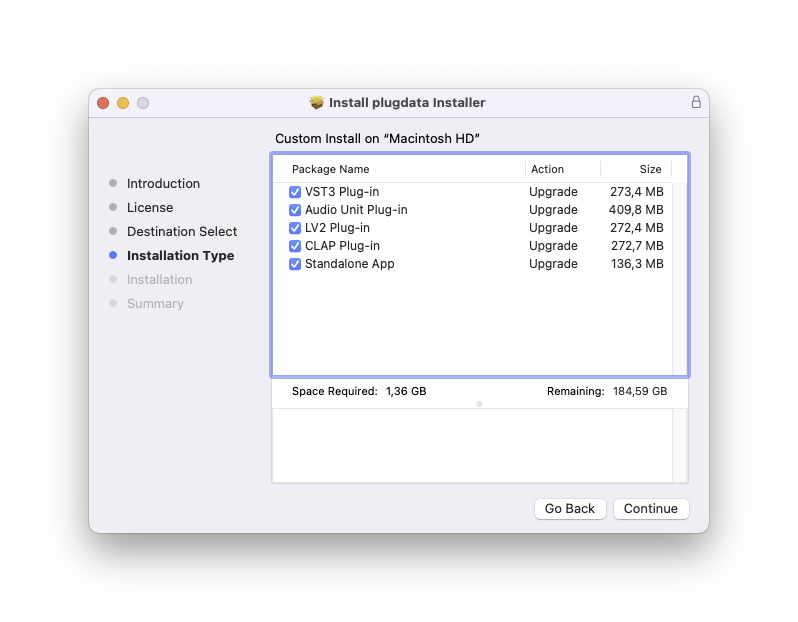
You’ll know you’re in for something different from the moment you run the installer. Plug-ins in every format! Standalone!
Oh, yeah, and — iPad:
The upshot is you don’t actually need to understand a lot of what I wrote above. End users can download projects from independent creators like Ewan Bristow and Nasko, and they just work — now with a store and plug-ins. And developers can focus on building instead of troubleshooting (or even getting stuck figuring out what the heck to download or where to start). That matters to beginners and experienced creators alike.
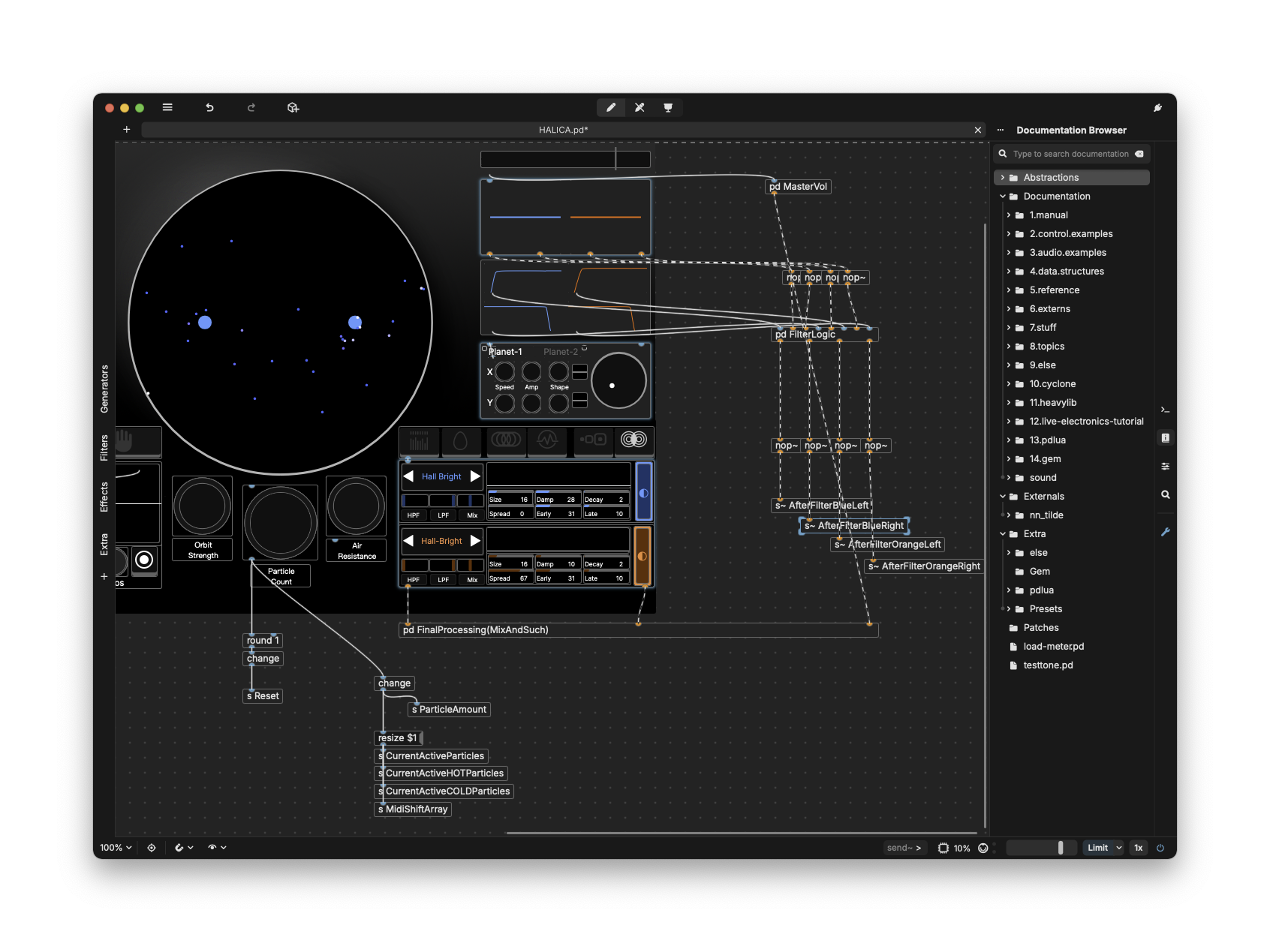
Seriously. People like Ewan are making tools like this (that’s the actual patch above!):
In fact, the fully free and open-source project here can inspire some of what’s happening in commercial environments like Max and Reaktor. (Don’t worry — we all get along, partly because, well, none of us ever gets tired of doing weird things with sound.)
So let’s talk about 0.9.2.
New features in 0.9.2
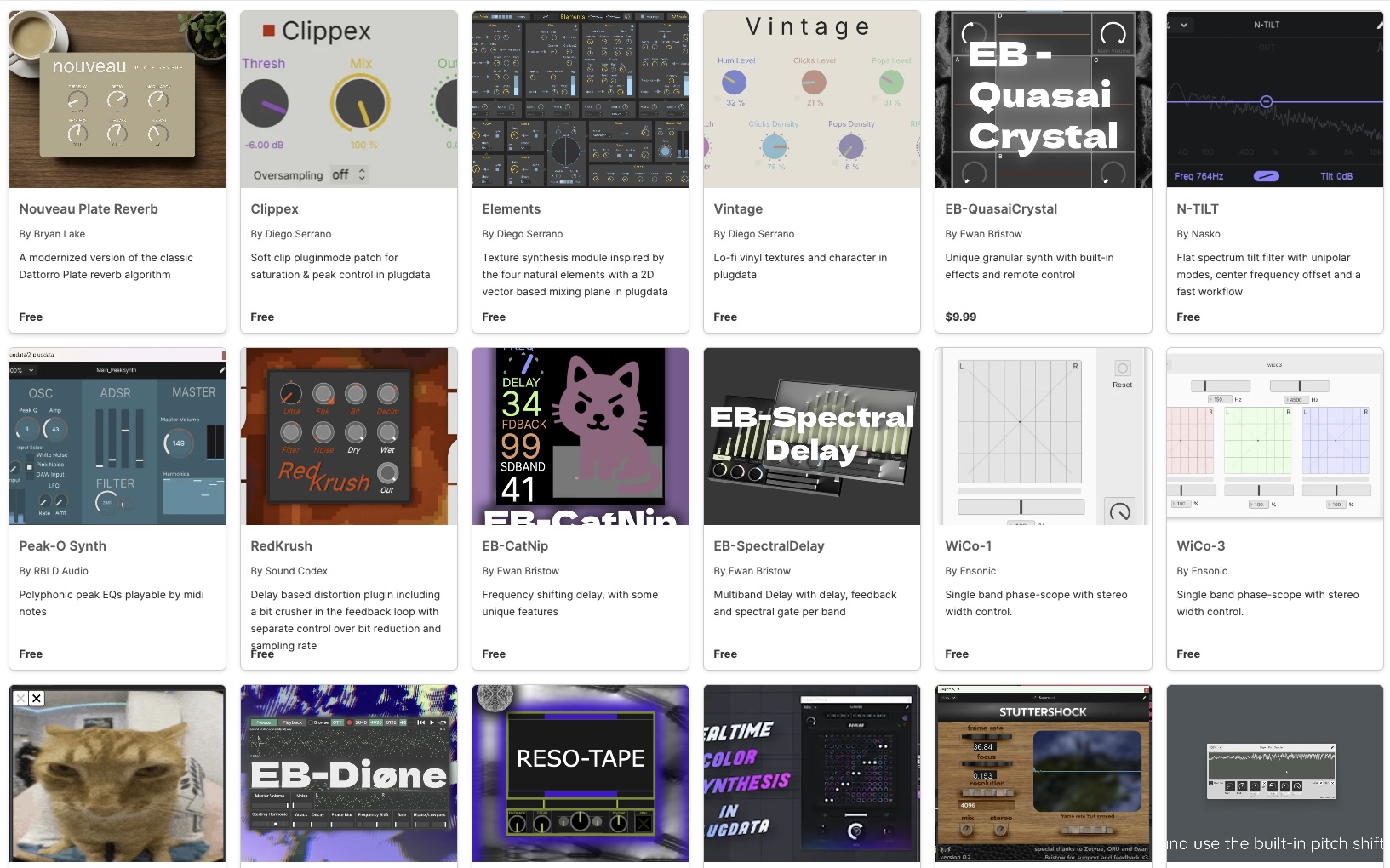
There’s a store and integrated patch installer. Oh, yes. You can now easily browse and find new patches to play with and/or learn from, online or inside plugdata. That also gives you one-button install for whole libraries. This supports both paid and free patches. Plus when you go from one machine to another, this acts as a way of syncing your DAW’s projects.
Drag and drop plugdata patches. Anyone who did try one of those free patches may have gotten tripped up by the installer. But now patches have drag-and-drop installers, plus thumbnails to make them not only look pretty but easier to identify. And these installations now run in more predictable ways (like zoom).
VST3 and CLAP export is coming! There are some different ways to do this that I need to examine, but the early support here is already working well, and having this in plugdata is amazing.
Prolific dev Nasko has a great run-down of these features, with illustrations, explaining why they’re cool.
Nasko’s stuff is updated, so celebrate with, you know, this song:
Plus…
Improved interface. Welcome panel, limiter and oversampling controls, and inspector parameters were all improved, plus the ability to see the inspector and console at the same time — nice! (courtesy @AlexMitchellMus) There’s a cute miniview, as well, to keep your sense of where you are in the patch (especially on bigger displays), like the minimap in games.
Send messages directly to objects. You can select an object and send messages without separate message objects! That’s pretty radical stuff in the Max/Pd world.
Patches load faster, volume sliders show dBFS over hover, palettes support import/export, and there are many other improvements:
https://github.com/plugdata-team/plugdata/releases/tag/v0.9.2
New library and device support in 0.9.2 (ELSE!)
There’s some major news in the library and device support area, too:
- Experimental Gem support. Gem stands for Graphics Environment for Multimedia, and it’s the preferred way of building visuals inside Pd. You’d be forgiven for thinking it was dead; it’s not, and now it is acutally possible to build on modern systems without losing your mind! So plugdata integration even at this early stage is exciting. (Gem is to Pd a little as Jitter is to Max — kinda sorta.) I haven’t seen posting a lot of Gem stuff lately (this may change that), but there’s an indication above.
- Expanded iOS support. (sfizz~ and plugin mode, filesystem and networking fixes!)
- More Heavy exports: OWL and WASM. Rebel Technology’s OWL-hardware (living on as a standalone device or Eurorack you can build) and WASM, WebAssembly for Web export, now work as Heavy export targets.
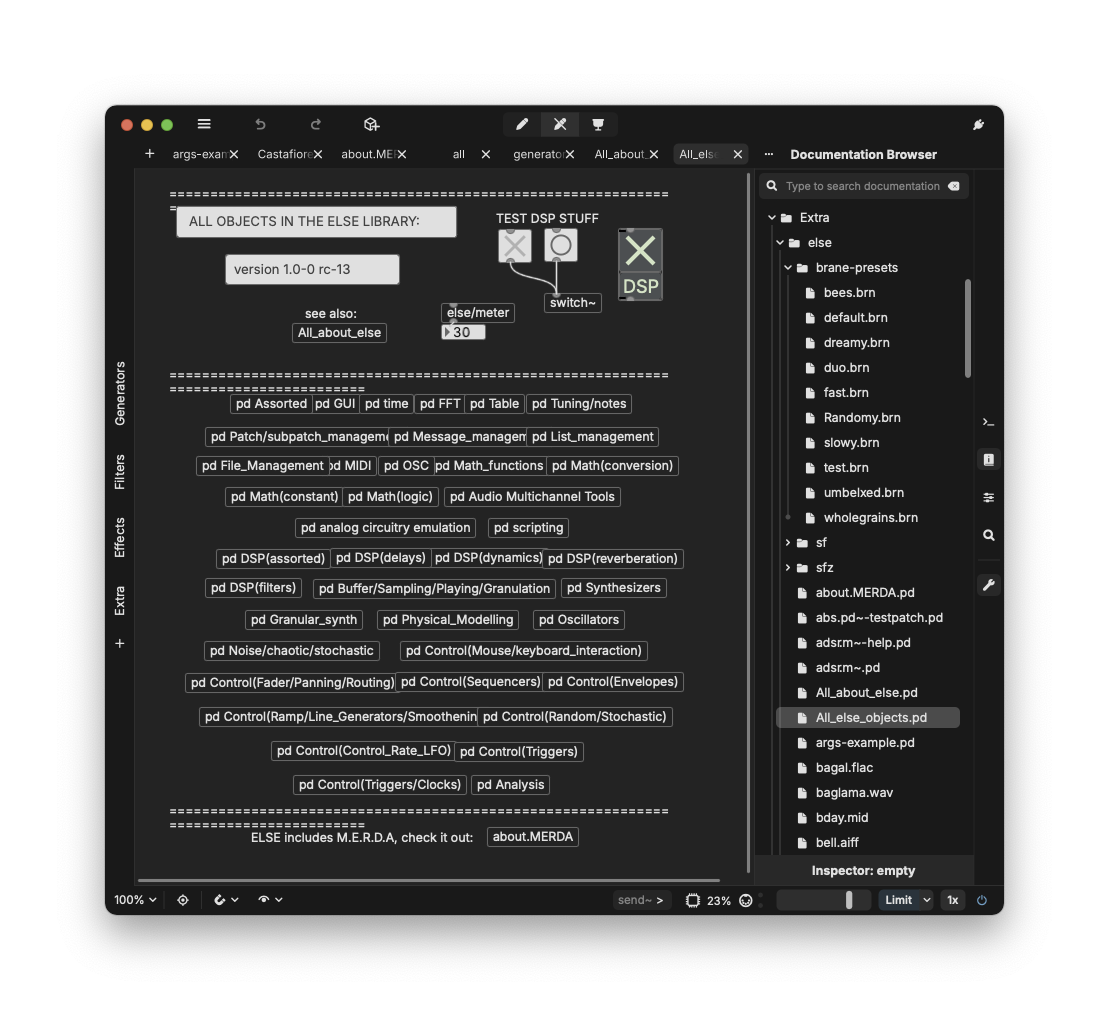
I’m putting the spotlight here on plugdata, but reall,y ELSE is just as important — enough so that I hope to give it a separate writeup. Created by Alexandre Torres Porres, ELSE expands on the vanilla library with externals that fill in a lot of Pd’s deficiencies and make this feel like a more usable, complete environment. They do that without giving you the sense of too many objects to learn, and you still have something free and open source that is astonishingly agnostic about architectures and OSes, from desktop to mobile to embedded. That involves stuff you need, from managing OSC (Open Sound Control) messages to playing audio files and using band-limited oscillators, basically the major stuff that you may have noticed was either missing in Pd or required a library that became out-of-date.
I’m glossing over this a little, but maybe the simpler way to say it is, Pd + ELSE = contentment.
Oh yeah, and there are a bunch of abstractions in the wonderful Modular Euroracks Dancing Along subset, plus some modal synthesis goodies.
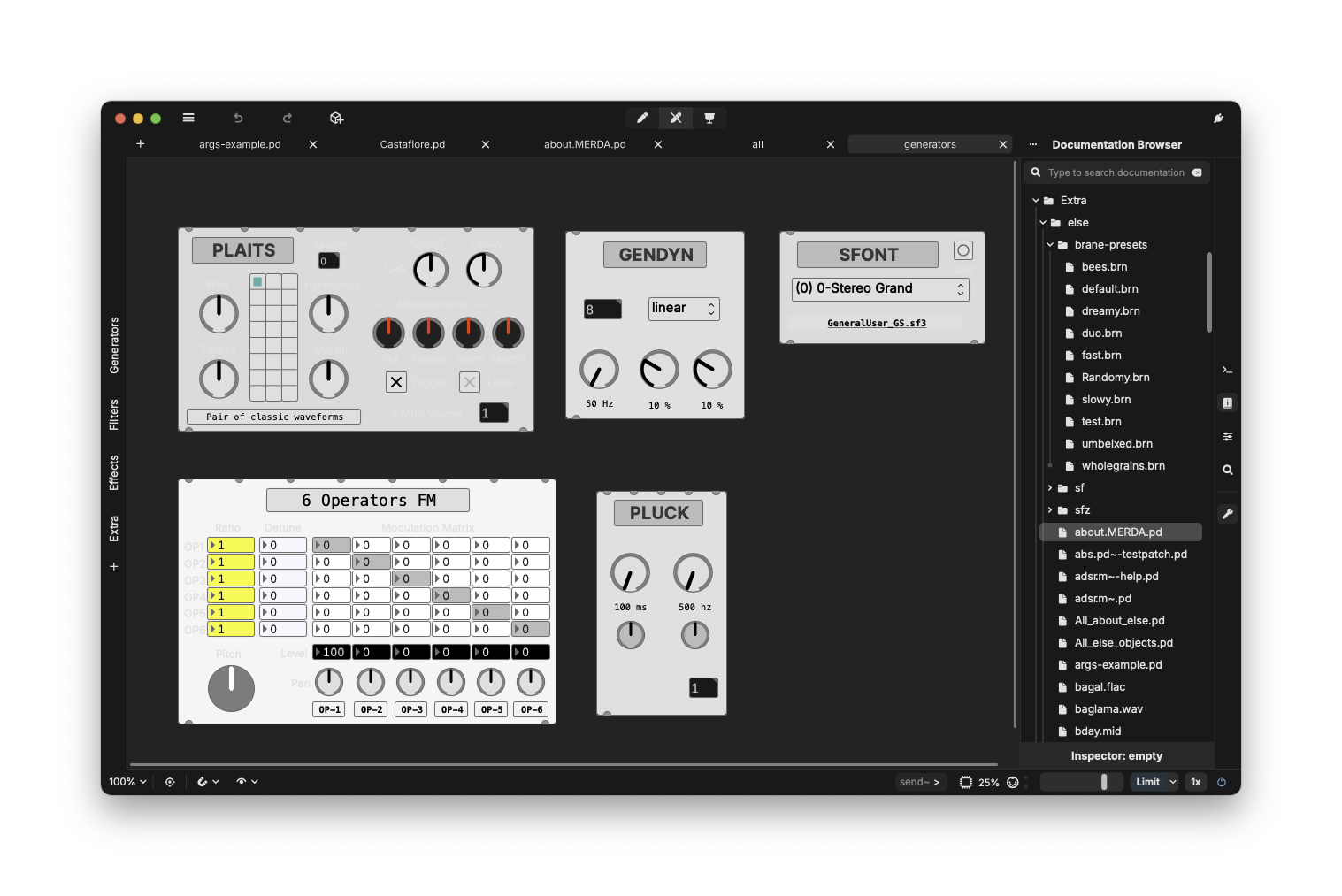
Anyway, for now, plugdata adds the following with suport for ELSE 1.0 rc13:
- Improved multichannel support
- Improved envelope generators
- Improvements to [knob]
- Improved [play.file~] object and new [sfinfo] and [sfload] object allow loading any kind of audio file format out there. Many audio file abstractions are also now based on these objects
- New [popmenu] GUI object
- Other new objects: [float2imp~], [lace], [delace], [lace~], [delace~], [gatehold], [gatedelay],[gatedelay~], [gaterelease~], [gaterelease], [scope3d~], [tanh~], [resonator~], [smooth], [smooth2], [smooth~], [smooth2~], [dbgain~], [level~] plus [crusher.m~], [sfont.m~] and [level.m~] MERDA Modules.
ELSE is expected to hit v1 before plugdata, so that may be the time for the deep dive.
That should have given you a good idea of all the goodness in there. So go check plugdata:
And hey, even if you haven’t got time for patching yourself (I feel you), your music deserves some far-out sounds:
https://plugdata.org/store.html
It’s a wonderful time to be alive. I mean, it’s in so many ways really not, but it is a wonderful time to retreat onto a remote mountain with some balanced rainfall and food supply and devote yourself to making really crazy sounds with plugdata, possibly befriending some wolves. I’ll see you there. You’ll know from the combination of howling and dubstep.